What did Titan report for Q2 FY27?
Titan filed its Q2 FY27 results (July to September 2026) on 5 Nov 2026. Net profit to shareholders was ₹2,393 crore, up 113.7% from ₹1,120 crore [S2] [S5].
Revenue grew 10.1% to ₹20,614 crore [S2] [S5]. Gold-bar sales, including digital gold, held that growth down: they fell to ₹226 crore from ₹2,429 crore [S1].
So profit more than doubled while revenue grew by about a tenth. Two items in the quarter explain most of that gap.
Where did the customs-duty gain come from?
Customs duty is the tax India charges on imported goods, gold included. The duty on gold rose from 6% to 15% from 13 May 2026 [S7].
Titan said the rise produced a gain on gold it already held as stock. It booked ₹407 crore of this in Q1 FY27 (April to June 2026) [S6] [S8].
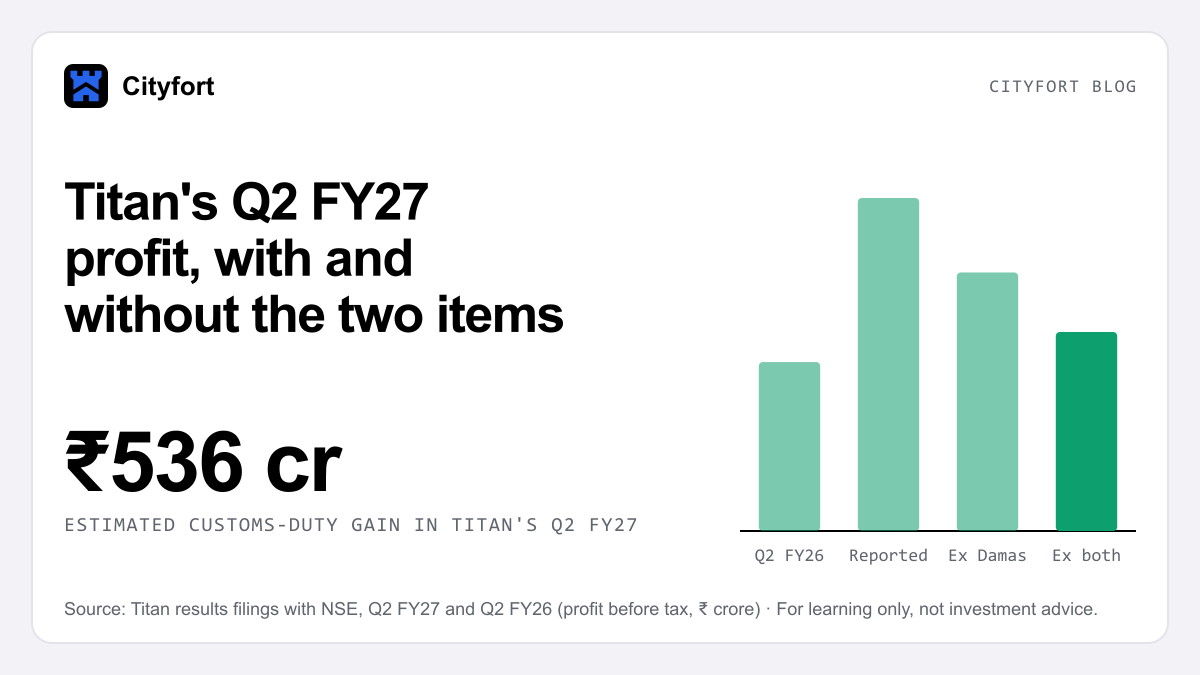
For Q2 FY27, Titan estimated a further ₹536 crore [S1] [S3]. On the 5 Nov 2026 call, the CFO split it. Tanishq, Mia and Zoya had ₹490 crore, and CaratLane ₹46 crore [S3].
The gain is part of the jewellery segment's profit [S1] [S2]. It is also inside EBITDA, which is profit before interest, tax and wear-and-tear of assets.
Cityfort works out EBITDA from the results. It was ₹2,983 crore, or 14.5% of revenue, against ₹1,875 crore and 10.0% in Q2 FY26 [S2] [S5].
Without the duty gain, EBITDA was ₹2,447 crore, or 11.9% of revenue. Both figures are Cityfort calculations.
Titan's EBITDA as a share of revenue
- Q2 FY2610.0%
- Q2 FY27, reported14.5%
- Q2 FY27, without duty gain11.9%
Cityfort calculation from the consolidated results. The last bar removes Titan's estimated ₹536 crore customs-duty gain.
%
Sources
Titan Q2 FY27 consolidated financial results, XBRL filing [S2]; Titan Q2 FY26 consolidated financial results, XBRL filing (quarter ended 30 Sep 2025) [S5]; Titan Q2 FY27 financial results (standalone and consolidated) with press release and board-meeting outcome (quarter ended 30 Sep 2026) [S1]; Titan Q2 FY27 earnings call transcript (call of 5 Nov 2026) [S3]
See the numbers
What else is inside the profit figure?
Titan owns 67% of Damas, a jewellery chain it bought in Jan 2026 [S9]. Damas has core stores in six Gulf countries [S4].
Titan carries a liability for buying the other 33% of Damas. In Q2 FY27 that liability was revalued down by ₹671 crore, and the drop was booked as income [S1].
The results table shows the ₹671 crore on its own line, apart from other income [S1]. Cityfort's EBITDA leaves it out, as it leaves out other income.
On 5 Nov 2026 the CFO said the liability is reassessed every quarter: "there could be pluses and minuses" [S3].
What does profit look like without the two items?
Profit before tax is the easiest line to compare, because Titan's press release gives both adjusted figures there [S1].
Reported profit before tax was ₹3,000 crore, against ₹1,522 crore in Q2 FY26 [S1]. That is a 97.1% rise (Cityfort calculation).
Without the Damas credit, Titan put it at about ₹2,329 crore, up 53%. Without the duty gain as well, it was about ₹1,793 crore, up 18% [S1].
Titan's profit before tax, with and without the two items
Consolidated. The last two bars are Titan's own adjusted figures from its Q2 FY27 press release.
₹ crore
Sources
Titan Q2 FY27 financial results (standalone and consolidated) with press release and board-meeting outcome (quarter ended 30 Sep 2026) [S1]
See the numbers
Profit before tax rose by ₹1,478 crore. On Titan's figures, ₹1,207 crore of that came from the two items, about 82% (Cityfort calculation).
After tax, Titan put profit without the Damas credit at about ₹1,722 crore, up 54% [S1]. This post does not work out an after-tax figure without the duty gain, since that needs a tax assumption.
Is the duty gain a one-time item?
It comes from one event, the May 2026 duty rise [S7]. But it has shown up in two quarters: ₹407 crore in Q1 FY27, ₹536 crore in Q2 FY27 [S6] [S1].
On the Q1 FY27 call (7 Aug 2026), the CFO said more gain would come in Q2 and Q3 FY27 [S8]. He also said the effect would reverse when the duty goes down [S8].
On the 5 Nov 2026 call, the CFO put the Q2 FY27 margin for Tanishq, Mia and Zoya at 11.1% without the ₹490 crore gain. He said Titan "would like to anchor our margin target at around 11%" [S3].
How should a beginner read the 113.7% rise?
The 113.7% is the reported figure, and it is correct as filed [S2]. It includes a ₹671 crore accounting credit and an estimated ₹536 crore gain from a tax change [S1] [S3].
A results press release often lists items like these separately. Titan's gives profit with and without them, so the two quarters can be compared on the same footing [S1].
The adjusted figures are Titan's own and come from its press release, not the results table. The reported figures are the ones in the filed results.
The Titan stock page lists every Q2 FY27 change, including the rise in borrowings.
For a plain guide to the profit line used above, read what EBITDA means. For other makers of jewellery, watches and appliances, see the consumer durables sector page.