Automobile and Auto Components · NSE: BAJAJ-AUTO · BSE: 532977
Bajaj Auto: how the business works
Bajaj Auto makes motorcycles, three-wheelers and Chetak electric scooters, exports to over 100 countries and controls KTM; FY26 revenue was ₹62,905 crore.
Follow Bajaj Auto
Email me when Bajaj Auto's page is updated after results.
We store your email address with Kit, our email provider, which also records when you sign up and whether you open or click our emails. We send a confirmation email first. See our privacy policy.
Bajaj Auto Limited · Pune, Maharashtra · Founded 2007
Updated for Q2 FY27 · checked
- Revenue, FY26
- ₹62,905 cr
- Profit to shareholders, FY26 (incl. ₹1,599 cr one-off KTM gains)
- ₹10,744 cr
- Vehicles exported, FY26 (Bajaj Auto Ltd)
- 22.5 lakh
- Employees, 31 Mar 2026 (Bajaj Auto Ltd)
- 8,073
- Promoter holding, 30 Sep 2026
- 55.95%
The short version
Bajaj Auto in 5 points
1 · What it sells
Bajaj Auto makes motorcycles, three-wheelers and Chetak electric scooters, controls KTM, and its FY26 revenue from operations was ₹62,905 crore.
2 · Who pays it
In FY26, vehicle and spare-part buyers, through dealers in India and distributors abroad, gave Bajaj Auto 93.0% of its segment revenue, borrowers from its lending arm 5.0% and its investments 2.0%.
3 · What it keeps from ₹100
Of every ₹100 that came in during FY26, Bajaj Auto kept ₹16.1 as profit for shareholders, but that includes ₹1,599 crore of one-off KTM gains, and without them profit was ₹9,145 crore.
4 · Where the operating profit comes from
Vehicles earned ₹12,016 crore of Bajaj Auto's ₹14,212 crore FY26 segment result, including the one-off KTM gains, while investments earned ₹1,307 crore and the lending arm ₹889 crore.
5 · The one thing to watch
Bajaj Auto's share of Indian motorcycle sales fell from 18.2% in FY24 to 15.6% in FY26, while its exports rose 20.8% in FY26, to 22.5 lakh vehicles.
Sources: From Bajaj Auto's FY26 annual report and its Q4 FY26 results filings · checked
01Where the money goes · FY26
Where does ₹100 of Bajaj Auto's money go?
Bajaj Auto · FY26
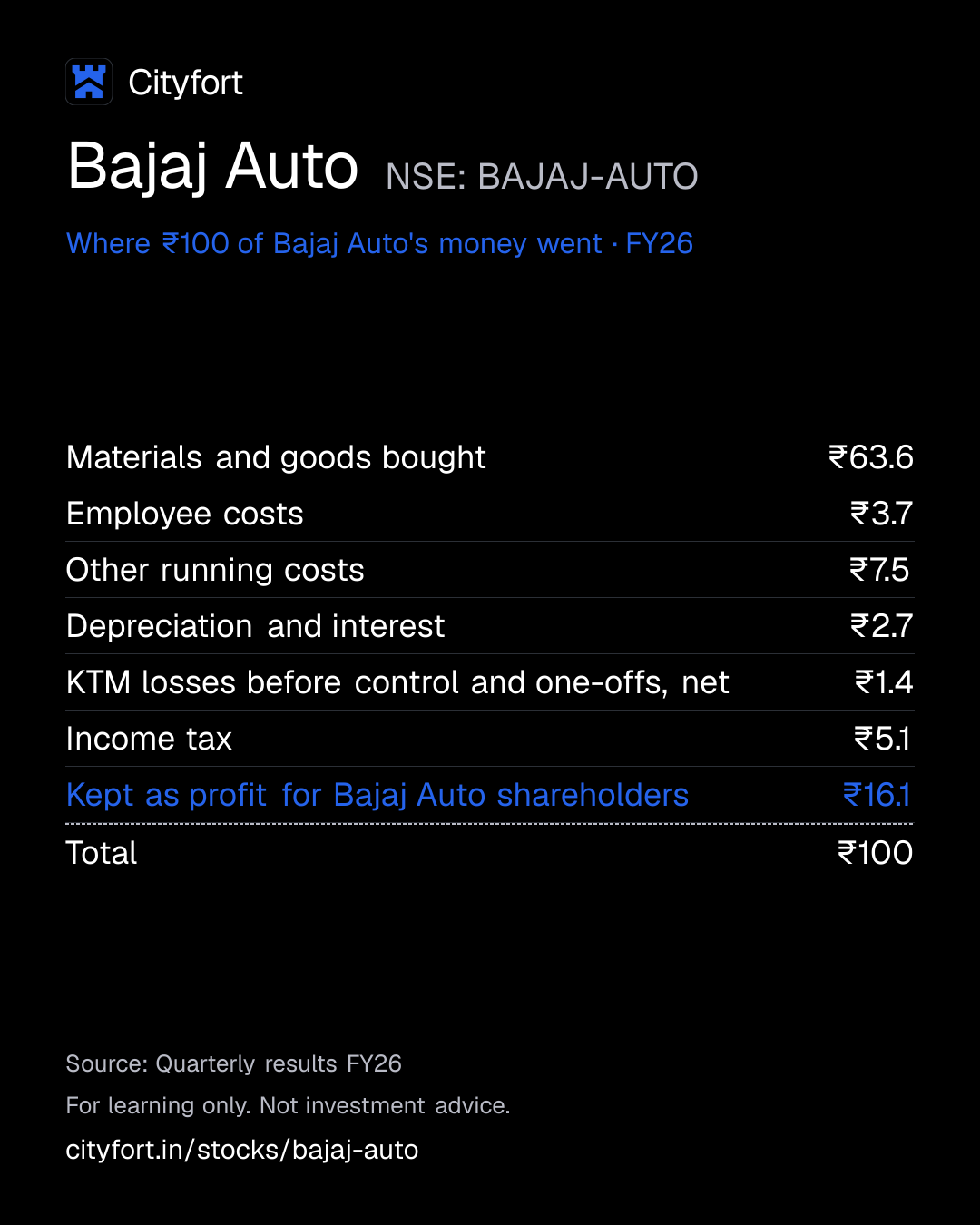
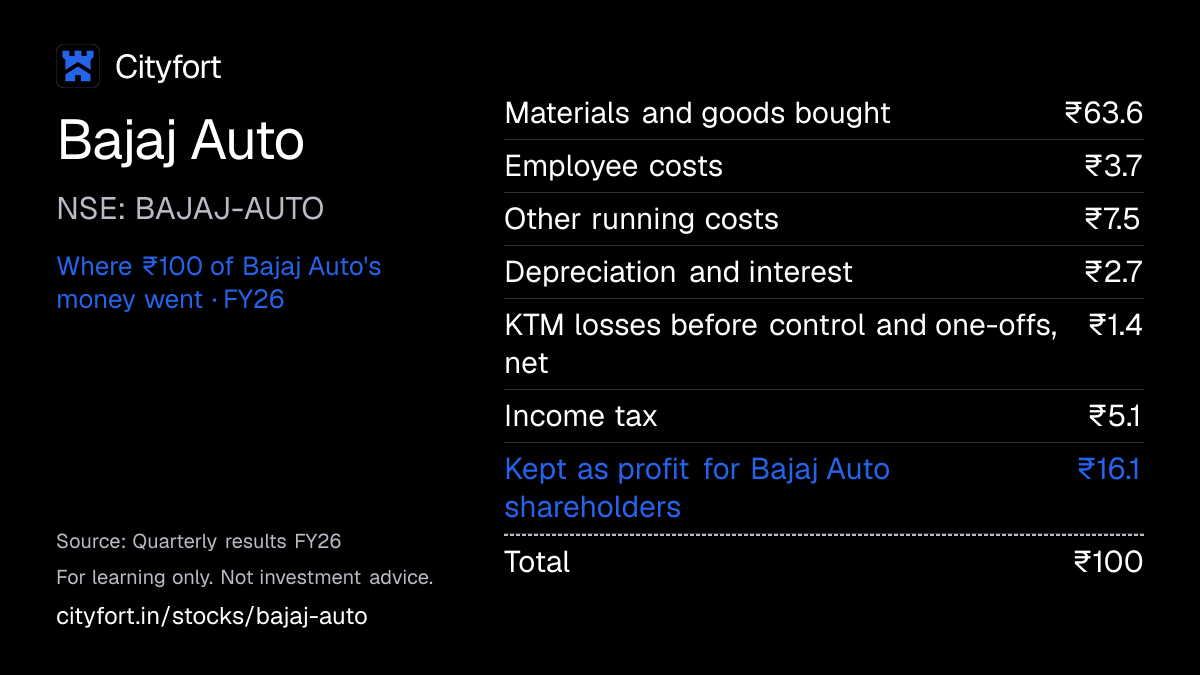
Receipt for every ₹100
| Materials and goods bought | ₹63.6 |
|---|---|
| Employee costs | ₹3.7 |
| Other running costs | ₹7.5 |
| Depreciation and interest | ₹2.7 |
| KTM losses before control and one-offs, net | ₹1.4 |
| Income tax | ₹5.1 |
| Kept as profit for Bajaj Auto shareholders | ₹16.1 |
| Total | ₹100 |
Each line = amount ÷ total money in × 100. Lines may not add to exactly ₹100 because of rounding.
How this is worked out
Of every ₹100 that came in during FY26: revenue (₹62,905 crore), other income (₹2,182 crore) and one-off KTM gains (₹1,599 crore). The KTM line is Bajaj's ₹1,038 crore share of KTM's losses before control, plus ₹39 crore of one-off charges. KTM's minority holders bore ₹170 crore of losses, which is taken off. Without the one-off gains, profit was ₹9,145 crore.
Save this receipt as an image
Embed this receipt or the key numbers
Paste this code into a blog or website to show the card you choose, with a link back to this page.
Each week: the next company due to report results, explained in 5 points.
We'll email you once a week with what changed on Cityfort. Facts only, no tips. Unsubscribe any time.
We store your email address with Kit, our email provider, which also records when you sign up and whether you open or click our emails. We send a confirmation email first. See our privacy policy.
02The business in one line
What does Bajaj Auto do?
Riders and transport operators in India and abroad pay Bajaj Auto for motorcycles, three-wheelers and scooters; materials take ₹64 of every ₹100 that comes in, and ₹16 is profit.
- Vehicles and spare parts were 93.0% of FY26 segment revenue. A lending arm that finances Bajaj buyers and dealers was 5.0%, and investments 2.0%.
- Bajaj has controlled KTM since 18 Nov 2025. So FY26 and later figures are not like-for-like with earlier years.
03Who pays it
Who pays Bajaj Auto?
Vehicle and spare-part buyers
93%
of revenue
Riders and transport operators buy Bajaj, KTM and Chetak vehicles and parts from dealers in India and distributors abroad. Share is of FY26 segment revenue, which includes other income.
Borrowers of Bajaj Auto Credit
5%
of revenue
Buyers and dealers of Bajaj vehicles who take loans from the lending arm and pay interest.
Investments (not customers)
2%
of revenue
Interest and gains on Bajaj Auto's cash and investments, reported as its Investments segment.
- Vehicle and spare-part buyers93%
- Borrowers of Bajaj Auto Credit5%
- Investments (not customers)2%
How spread out the customers are
Bajaj Auto does not disclose revenue by customer; it sells through dealers in India and distributors abroad. FY26 segment shares: Automotive 93.0%, Financing 5.0%, Investments 2.0%.
04How it makes money
How does Bajaj Auto make money?
Bajaj Auto makes vehicles at scale in India and sells a large share of them abroad, so its plants stay busy.
Before KTM was added, Bajaj Auto kept ₹20.5 of every ₹100 of FY25 revenue as operating profit before interest, depreciation and tax, up from ₹15.8 in FY22. That is a Cityfort calculation: revenue minus costs other than interest and depreciation, leaving out KTM's results and one-off items. In FY26, with six weeks of KTM, it was ₹20.8.
Operating profit before interest, depreciation and tax per ₹100 of revenue (Cityfort calculation, before KTM)
₹15.8₹20.5
FY22 to FY25
- Bajaj's Indian plants can make 72 lakh vehicles a year.
- It sells at home and abroad; it exported 22.5 lakh vehicles in FY26.
- Bikes of 125cc and above were 77.5% of its motorcycle sales in India in FY26.
- Materials take ₹64 of every ₹100 that comes in, so steel and parts prices matter.
- Profit pays for dividends and buybacks, and its lending arm finances more buyers.
- KTM adds bigger bikes, but its own profit is still small (EBIT €11.3 million, Jul–Sep 2026).
↺ Step 6 feeds back into step 1.
05Business segments · FY26
Which businesses make up Bajaj Auto?
Automotive
93%Motorcycles, three-wheelers, Chetak and spares, with KTM from 18 Nov 2025. Its ₹12,016 crore FY26 result, 84.6% of the ₹14,212 crore segment total, includes Bajaj's share of KTM's results and the one-off KTM gains.
Revenue ₹60,530 cr · Operating profit ₹12,016 cr
Investments
2%Income from Bajaj Auto's cash and investments.
Revenue ₹1,309 cr · Operating profit ₹1,307 cr
Financing
5%Bajaj Auto Credit, which lends to buyers and dealers of Bajaj vehicles. Its result is after its own interest costs.
Revenue ₹3,248 cr · Operating profit ₹889 cr
How the mix changed
- Automotive
- Investments
- Financing
Revenue by segment, Q1 FY26 to Q2 FY27.
₹ crore
See the numbers
Sources (8)
- Q1 FY26 consolidated results, Integrated Filing (Financials) XBRL
- Q2 FY26 consolidated results, Integrated Filing (Financials) XBRL
- Q3 FY26 consolidated results, Integrated Filing (Financials) XBRL
- Q4 FY26 / FY26 consolidated results, Integrated Filing (Financials) XBRL
- Q1 FY27 consolidated results, Integrated Filing (Financials) XBRL
- Q2 FY27 consolidated results, Integrated Filing (Financials) XBRL
- 19th Annual Report 2025-26 (FY26)
- Outcome of board meeting: audited results Q4 FY26 and FY26, auditor's reports
06The numbers · Consolidated · ₹ crore
How has Bajaj Auto done?
Revenue
₹62,905 crFY26
Revenue rose every year, from ₹33,145 crore in FY22 to ₹62,905 crore in FY26; KTM is included from Q4 FY26, so later periods are not like-for-like with earlier ones.
₹ crore
See the numbers
Net profit
₹10,744 crFY26
FY26 profit of ₹10,744 crore includes ₹1,599 crore of one-off KTM gains (₹9,145 crore without them), and FY25's ₹7,325 crore is after a ₹915 crore KTM loss and write-down.
₹ crore
See the numbers
Net profit for every ₹100 of revenue
₹17.1FY26
Profit per ₹100 of revenue ranged from ₹14.4 (FY25, after the KTM write-down) to ₹18.6 (FY22), and FY26's ₹17.1 includes the one-off KTM gains.
Net margin: ₹ of net profit per ₹100 of revenue
See the numbers
Free cash flow
₹1,874 crFY26
Free cash flow was −₹2,279 crore in FY25 and ₹1,874 crore in FY26, because cash from operations counts the lending arm's loan growth.
₹ crore · cash from operations minus spending on plants and equipment
See the numbers
See all yearly numbers
EBITDA = profit before interest, tax and wear-and-tear of assets. Financial year runs April to March (March year end). Net profit is the share belonging to the company's owners. Total net income differs from net profit to the company's owners: Profit for shareholders is higher than total profit because KTM's minority shareholders bore ₹170 crore of losses.
Sources (14)
- 16th Annual Report 2022-23 (FY23; NSE zip)
- 15th Annual Report 2021-22 (FY22; NSE zip)
- 17th Annual Report 2023-24 (FY24)
- 18th Annual Report 2024-25 (FY25)
- 19th Annual Report 2025-26 (FY26)
- Q3 FY25 consolidated results XBRL
- Outcome of board meeting: audited results Q4 FY25 and FY25
- Q1 FY26 consolidated results, Integrated Filing (Financials) XBRL
- Q2 FY26 consolidated results, Integrated Filing (Financials) XBRL
- Q3 FY26 consolidated results, Integrated Filing (Financials) XBRL
- Q4 FY26 / FY26 consolidated results, Integrated Filing (Financials) XBRL
- Outcome of board meeting: audited results Q4 FY26 and FY26, auditor's reports
- Q1 FY27 consolidated results, Integrated Filing (Financials) XBRL
- Q2 FY27 consolidated results, Integrated Filing (Financials) XBRL
07Who runs it
Who runs Bajaj Auto, and did they deliver?
Niraj Bajaj
Chairman
Rajiv Bajaj
Managing Director
Rakesh Sharma
Joint Managing Director · since 2026
Joint MD from 1 Jun 2026 to 31 Mar 2029; Executive Director before that.
Dinesh Thapar
Chief Financial Officer
What they said, and what happened
1 missed · 1 partly delivered · 3 too early to tell
Said on 30 Jan 2026
Expand KTM–Triumph joint (KT) showrooms from about 50 to over 100 by March 2026.
MissedWhat happened
The FY26 annual report counts 80 KT showrooms at the end of FY26. Management said 120 were open by 27 Oct 2026.
Said on 6 May 2026
Chetak capacity is 50,000 units a month: "I think we will max that."
Partly deliveredWhat happened
Management said Chetak retail sales reached about 45,000 in Sep 2026, but supply problems held output that month to 40,000.
Said on 6 May 2026
Results of simplifying KTM's structure should "start showing up in the latter part of 2026".
Too early to tellWhat happened
Bajaj Mobility reported EBIT of €11.3 million in Jul–Sep 2026; management said KTM's EBIT was also positive in Apr–Jun 2026.
Said on 21 Jul 2026
Introduce two new brands in the 125cc motorcycle segment during FY27.
Too early to tellWhat happened
FY27 ends on 31 Mar 2027.
Said on 27 Oct 2026
Raise Chetak capacity to 80,000 a month by Q4 FY27, and overall capacity to about 7,75,000 a month in 6 to 9 months.
Too early to tellWhat happened
Due by Q4 FY27 (Jan–Mar 2027) and Apr–Jul 2027.
Sources (7)
- 19th Annual Report 2025-26 (FY26)
- Outcome of board meeting: Rakesh Sharma appointed Joint Managing Director from 1 Jun 2026
- Transcript of earnings conference call Q2 FY27 (27 Oct 2026)
- Transcript of earnings conference call Q3 FY26 (30 Jan 2026)
- Transcript of earnings conference call Q4 FY26 (6 May 2026)
- Ad hoc announcement by Bajaj Mobility AG: Quarterly Report Q3/26
- Transcript of earnings conference call Q1 FY27 (21 Jul 2026)
08What could go wrong
What could go wrong for Bajaj Auto?
- Execution
KTM's recovery
Bajaj took control of KTM's parent in Nov 2025, after KTM's 2025 restructuring. In FY25 Bajaj wrote down its KTM investment by ₹601 crore. KTM's parent earned EBIT of €11.3 million on €351.1 million of revenue in Jul–Sep 2026.
Watch Bajaj Mobility's quarterly EBIT, and Bajaj Auto's consolidated margin each quarter.
- Competition
Falling share of Indian motorcycles
Bajaj's share of Indian motorcycle sales fell from 18.2% in FY24 to 15.6% in FY26, while industry sales grew 6.6% in FY26. The company cites heavier competition in entry and mid-level commuter bikes.
Watch Domestic motorcycle share in the FY27 annual report.
- Raw-material prices
Material costs
Materials and goods bought were 67.4% of FY26 revenue. Management called input-cost inflation in Jul–Sep 2026 "hyperinflationary" and said electrical components rose by mid-teens.
Watch Materials cost as a share of revenue each quarter.
- Debt
Lending arm and borrowings
Bajaj Auto Credit lends to vehicle buyers, so the group carries credit risk. Group borrowings rose from nil in FY23 to ₹25,778 crore on 30 Sep 2026; management put the loan book at about ₹21,000 crore.
Watch Borrowings and Financing segment profit in each quarterly result.
- Currency
Dependence on export markets
In FY26, 39.3% of revenue from customers came from outside India. Sales abroad depend on demand and currencies in those countries; Crisil said exports were 40% of Bajaj's volumes in FY25.
Watch Export volumes and export revenue in the FY27 annual report.
- Execution
Supply shortages
A rare-earth magnet shortage from China's export curbs held back Chetak in the first half of FY26. Management said in Oct 2026 that three-wheeler demand exceeds capacity by about 10%.
Watch Chetak monthly output against the 80,000 a month capacity planned for Q4 FY27.
- Technology
Cyber attack
A ransomware attack hit Bajaj Auto's systems on 23 Jun 2026. The company said operations were normal by 26 Jun and the investigation was ongoing.
Watch Any further filing on the incident.
- Governance
A small promoter pledge
13,822 shares held by Vanraj Bajaj, a promoter-group member, have been pledged since Jun 2025. That is 0.01% of the promoter group's 15.38 crore shares.
Watch Pledged shares in each quarterly shareholding pattern.
Sources (12)
- Completion of acquisition of sole controlling stake in Pierer Bajaj AG (18 Nov 2025)
- Outcome of board meeting: audited results Q4 FY26 and FY26, auditor's reports
- Ad hoc announcement by Bajaj Mobility AG: Quarterly Report Q3/26
- 19th Annual Report 2025-26 (FY26)
- Transcript of earnings conference call Q2 FY27 (27 Oct 2026)
- 17th Annual Report 2023-24 (FY24)
- Q2 FY27 consolidated results, Integrated Filing (Financials) XBRL
- Rating Rationale: Bajaj Auto Limited, ratings reaffirmed at Crisil AAA/Stable/Crisil A1+
- Intimation of cyber security incident (ransomware), 23 Jun 2026
- Update to the cyber security incident, 26 Jun 2026
- Shareholding pattern, quarter ended Sep 2026 (XBRL)
- Shareholding pattern, quarter ended Jun 2025 (XBRL)
09Supporters and critics
What do supporters and critics point to?
What supporters point to
- Revenue rose every year from FY22 to FY26, from ₹33,145 crore to ₹62,905 crore.
- Exports rose 20.8% in FY26 to 22.5 lakh vehicles; Crisil says Bajaj made about 45% of India's two-wheeler exports in FY25.
- Chetak sold 302,674 scooters in FY26, up 16%, with 20.7% of Indian electric scooter sales.
- Crisil reaffirmed AAA/Stable on 1 Sep 2026.
- Bajaj paid ₹5,855 crore of dividends in FY26 and bought back shares for up to ₹5,633 crore in 2026.
What critics point to
- Bajaj's share of Indian motorcycle sales fell from 18.2% in FY24 to 15.6% in FY26.
- FY26 profit of ₹10,744 crore includes ₹1,599 crore of one-off KTM gains; without them it was ₹9,145 crore.
- Group borrowings rose from nil in FY23 to ₹25,778 crore on 30 Sep 2026.
- KTM's parent earned EBIT of €11.3 million on €351.1 million of revenue in Jul–Sep 2026, a 3.2% margin.
- Operating profit before interest, depreciation and tax fell to ₹19.5 per ₹100 of revenue in Q2 FY27, from ₹22.0 a year earlier (Cityfort calculation). Q2 FY27 includes KTM, so the two quarters are not like-for-like.
10What to watch next
What should you watch next at Bajaj Auto?
Next event
Q3 FY27 results (date not announced; Q3 FY26 results came on 30 Jan 2026)
Date not announced yet.
KTM's profit
Q3 FY27 will include KTM's Jul–Sep 2026, when its parent earned EBIT of €11.3 million.
Capacity build-out
Management said on 27 Oct 2026 that capacity is rising to about 7,75,000 a month over 6 to 9 months, and Chetak to 80,000 a month by Q4 FY27.
Share at home and material costs
Domestic motorcycle share was 15.6% in FY26. Management called Jul–Sep 2026 input-cost inflation "hyperinflationary".
11Key facts
Key facts about Bajaj Auto
- What does Bajaj Auto do?
- Bajaj Auto Ltd, based in Pune, makes motorcycles, three-wheelers and Chetak electric scooters and sells them in India and over 100 other countries. Since 18 Nov 2025 Bajaj Auto has also controlled KTM's parent company. Bajaj Auto's FY26 consolidated revenue from operations was ₹62,905 crore.
- How does Bajaj Auto make money?
- Bajaj Auto makes most of its money selling vehicles and spare parts. Its automotive segment was 93.0% of Bajaj Auto's FY26 segment revenue, its lending arm Bajaj Auto Credit 5.0% and income from investments 2.0%.
- Who are Bajaj Auto's customers?
- Bajaj Auto sells through dealers in India and distributors abroad, and does not disclose revenue by customer. In FY26, 39.3% of Bajaj Auto's revenue from contracts with customers came from outside India.
- How big is Bajaj Auto?
- Bajaj Auto's FY26 consolidated revenue from operations was ₹62,905 crore and its profit for shareholders was ₹10,744 crore. That profit included ₹1,599 crore of one-off gains on taking control of KTM. Bajaj Auto Ltd had 8,073 employees on 31 Mar 2026.
- Who owns Bajaj Auto?
- On 30 Sep 2026 Bajaj Auto's promoter group held 55.95% of its shares, including 34.77% held by Bajaj Holdings & Investment Ltd. Foreign investors held 8.87% of Bajaj Auto, Indian institutions 13.31% and individuals and others 21.87%.
- Does Bajaj Auto own KTM?
- Bajaj Auto has controlled KTM since 18 Nov 2025. Through a Dutch subsidiary, Bajaj Auto owns Bajaj Auto International Holdings AG (formerly Pierer Bajaj AG), which holds about 74.9% of Bajaj Mobility AG, KTM's listed parent. Bajaj Auto adds KTM's results one quarter late, so its Q2 FY27 accounts include KTM's Apr–Jun 2026.
- Does Bajaj Auto have debt?
- On 30 Sep 2026 Bajaj Auto's consolidated borrowings were ₹25,778 crore, against ₹26,251 crore of cash and investments. Most borrowings sit in the group, mainly the lending arm and KTM; Crisil described Bajaj Auto Ltd's own balance sheet as debt-free in Jun 2025. Bajaj Auto Ltd's own borrowings were ₹326 crore on 30 Sep 2026. Crisil reaffirmed its AAA/Stable rating on 1 Sep 2026.
- How many vehicles does Bajaj Auto export?
- Bajaj Auto Ltd exported 2,250,183 vehicles (22.5 lakh) in FY26, up 20.8% from FY25, worth ₹20,416 crore. Crisil's June 2025 report says Bajaj Auto made about 45% of India's two-wheeler exports in FY25.
- What did Bajaj Auto pay shareholders for FY26?
- Bajaj Auto's board recommended a dividend of ₹150 per share for FY26 on 6 May 2026. Bajaj Auto also bought back 4,694,000 shares at ₹12,000 each, up to ₹5,633 crore, completed in Jul 2026.
Sources (14)
- 19th Annual Report 2025-26 (FY26)
- Business Responsibility and Sustainability Report FY26
- Completion of acquisition of sole controlling stake in Pierer Bajaj AG (18 Nov 2025)
- Q4 FY26 / FY26 consolidated results, Integrated Filing (Financials) XBRL
- Outcome of board meeting: audited results Q4 FY26 and FY26, auditor's reports
- Shareholding pattern, quarter ended Sep 2026 (XBRL)
- Transcript of earnings conference call Q2 FY27 (27 Oct 2026)
- Q2 FY27 consolidated results, Integrated Filing (Financials) XBRL
- Rating Rationale: Bajaj Auto Limited, ratings reaffirmed at Crisil AAA/Stable/Crisil A1+
- Q2 FY27 standalone results, Integrated Filing (Financials) XBRL
- Intimation: Crisil Ratings reaffirms Crisil AAA/Stable / Crisil A1+ on bank facilities (letter 1 Sep 2026)
- Board outcome: dividend of ₹150 per share recommended for FY26; AGM date
- Outcome of board meeting: buyback of up to 4,694,000 shares at ₹12,000 (tender offer)
- Post-buyback public advertisement (dated 15 Jul 2026)
Terms on this page
- Capital expenditure (capex)
- Credit rating
- Dividend payout ratio
- EBITDA
- FII and DII holding
- Free cash flow
- Market capitalisation
- Net debt
- Net profit
- Operating margin
Each explains the term in plain English, with the same number from other companies on Cityfort.
Go deeper
More detail from the same filings. Open any section.
12What it sells
12What it sells
What does Bajaj Auto sell?
Motorcycles (Bajaj brands)
Boxer, CT, Platina, Discover, Freedom, Pulsar, Avenger and Dominar. Bajaj Auto Ltd sold 2,043,316 motorcycles in India in FY26; Pulsar alone brought in over ₹11,000 crore of domestic revenue.
KTM, Husqvarna and Triumph motorcycles
Bigger bikes made at the Chakan-2 plant near Pune, and by KTM AG in Austria. KTM and Triumph sold over 1.30 lakh units in India in FY26.
Three-wheelers
Passenger and goods autorickshaws on petrol, CNG and electric power, plus the Riki e-rickshaw. Bajaj sold 424,888 non-electric and 90,342 electric autorickshaws in India in FY26.
Chetak electric scooters
Battery scooters sold through 550+ exclusive stores. Sales in India were 302,674 in FY26, up 16%.
Exports
Motorcycles and three-wheelers shipped to distributors abroad: 2,250,183 vehicles worth ₹20,416 crore in FY26.
Spare parts
Parts and oil for vehicles already on the road. Management said spares sales passed ₹2,000 crore in Q2 FY27, up 15%.
Vehicle loans (Bajaj Auto Credit)
A wholly owned lender that finances buyers and dealers of Bajaj vehicles. Management put its loan book at about ₹21,000 crore in Q2 FY27.
What it does
- Does: Makes motorcycles, three-wheelers and electric scooters in India
- Does: Exports vehicles to over 100 countries
- Does: Controls KTM through a holding of about 74.9% in KTM's listed parent, Bajaj Mobility AG
- Does: Lends to buyers and dealers of its vehicles through Bajaj Auto Credit
What it does not do
- Does not: Report KTM's results in step with its own: they are added one quarter late
- Does not: Include KTM as a subsidiary before 18 Nov 2025; KTM was only a part-owned associate until then
- Does not: Publish investor presentations; it files results with a press release, plus call transcripts
13How the money flows
13How the money flows · FY26
How does money flow through Bajaj Auto?
Money in
- Revenue from operations₹62,905 cr
- One-off gains on taking control of KTM₹1,599 cr
- Other income₹2,182 cr
The company
Bajaj Auto
₹66,686 cr came in
Money out
- Materials and goods bought₹42,410 cr
- Employee costs₹2,461 cr
- Other running costs₹4,973 cr
- Depreciation and interest (mostly the lending arm's)₹1,813 cr
- Share of KTM's losses before control and one-off charges, less minority holders' share₹908 cr
- Income tax₹3,377 cr
- Net profit for Bajaj Auto shareholders₹10,744 cr
- In FY26 Bajaj Auto's businesses brought in ₹62,905 crore of revenue, plus ₹2,182 crore of other income.
- Taking control of KTM added ₹1,599 crore of one-off accounting gains: ₹953 crore from revaluing the old stake and ₹646 crore of currency gains.
- Materials and goods bought took ₹42,410 crore. Employees took ₹2,461 crore and other running costs ₹4,973 crore.
- Depreciation and interest took ₹1,813 crore. Bajaj's share of KTM's losses before it took control, and one-off charges, took a net ₹908 crore.
- After ₹3,377 crore of income tax, ₹10,744 crore was left as profit for Bajaj Auto's shareholders.
14What it needs to run
14What it needs to run
What does Bajaj Auto need to run?
Plants
Capacity of 72 lakh vehicles a year on 31 Mar 2026, at Waluj, Chakan, Akurdi and Pantnagar in India. Bajaj also has a plant in Manaus, Brazil.
Materials and parts
Steel, parts and battery components. Materials and goods bought were ₹42,410 crore in FY26, or 67.4% of revenue. Crisil puts raw materials at 70–75% of revenue.
Dealers and distributors
Management said on 27 Oct 2026 that Chetak has 550+ exclusive stores, three-wheelers 1,600+ stores and KTM–Triumph 120 joint showrooms.
People
8,073 employees at Bajaj Auto Ltd on 31 Mar 2026, of whom 708 were women.
Borrowed money for lending
Bajaj Auto Credit borrows to fund its loans. Group borrowings were ₹25,778 crore on 30 Sep 2026, which also include KTM's bank loans.
15Where it sells
15Where it sells · FY26
Where does Bajaj Auto sell?
- India60.7%
- Outside India39.3%
Sources (1)
16Competitors and what protects it
16Competitors and what protects it
Who does Bajaj Auto compete with?
Hero MotoCorp Ltd
NSE: HEROMOTOCO
Named by Crisil (5 Jun 2025) as a competitor in India's two-wheeler market, which it calls highly competitive.
Honda Motorcycle & Scooter India
Named by Crisil (5 Jun 2025) as a competitor in Indian two-wheelers; it is unlisted in India and owned by Japan's Honda.
TVS Motor Company Ltd
NSE: TVSMOTOR
Named by Crisil (5 Jun 2025) as a competitor in India's two-wheeler market.
What protects the business
Each strength is scored 1 (weak) to 5 (strong) for the business, with the reason. It is not a rating of the share.
- Export reach5 of 5
Crisil says Bajaj Auto made about 45% of India's two-wheeler exports in FY25. It exported 22.5 lakh vehicles in FY26 and says it is No. 1 in 9 of its 15 key export markets.
- Three-wheeler share5 of 5
Bajaj held 73.8% of India's non-electric three-wheeler sales in FY26 and 87.9% of CNG three-wheelers, according to its FY26 annual report.
- Plant scale4 of 5
Its Indian plants could make 72 lakh vehicles a year on 31 Mar 2026. Management said capacity is being raised from 6,25,000 to about 7,75,000 a month.
- Brands across price bands4 of 5
Its range runs from Platina and Pulsar to KTM and Triumph. Pulsar brought in over ₹11,000 crore of Indian revenue in FY26, and 125cc-plus bikes were 77.5% of Indian motorcycle sales.
- Financial strength4 of 5
Crisil reaffirmed AAA/Stable on 1 Sep 2026 and called Bajaj Auto Ltd's own balance sheet debt-free in Jun 2025. Bajaj Auto Ltd's own borrowings were ₹326 crore on 30 Sep 2026. Group borrowings, mostly in the lending arm and KTM, were ₹25,778 crore on 30 Sep 2026.
Weak spot
Losing share in Indian motorcycles
Bajaj's share of Indian motorcycle sales fell from 18.2% in FY24 to 15.6% in FY26. The company cites heavier competition in entry and mid-level commuter bikes; Crisil notes its 75–110cc share fell to 9% in FY25 from 12%.
Sources (6)
- Rating Rationale: Bajaj Auto Limited, ratings reaffirmed at Crisil AAA/Stable/Crisil A1+
- 19th Annual Report 2025-26 (FY26)
- Transcript of earnings conference call Q2 FY27 (27 Oct 2026)
- Intimation: Crisil Ratings reaffirms Crisil AAA/Stable / Crisil A1+ on bank facilities (letter 1 Sep 2026)
- Q2 FY27 consolidated results, Integrated Filing (Financials) XBRL
- Q2 FY27 standalone results, Integrated Filing (Financials) XBRL
17Where growth could come from
17Where growth could come from
Where could Bajaj Auto's growth come from?
Management said in the Q2 FY27 call on 27 Oct 2026 that overall capacity "of 6,25,000 units per month is being expanded to about 7,75,000 units per month over the next 6 to 9 months in a phased manner". It also said Chetak capacity is being raised to 80,000 a month by Q4 FY27.
Exports
Working+20.8% to 22.5 lakh vehicles, FY26
Exports by Bajaj Auto Ltd rose from 18.6 lakh vehicles in FY25 to 22.5 lakh in FY26, worth ₹20,416 crore. Q1 FY27 exports were 636,005, up 52%.
Status: Working, on track against what the company said.
Chetak electric scooters
Working302,674 sold in FY26, +16%
Chetak's share of Indian electric scooter sales was 20.7% in FY26; management said 23% in Q2 FY27. Rare-earth magnet shortages held back supply in the first half of FY26.
Status: Working, on track against what the company said.
Three-wheelers, including electric
Working33.5% of electric autorickshaws, FY26
Bajaj sold 90,342 of India's 269,926 electric autorickshaws (L5) in FY26. Management said on 27 Oct 2026 that three-wheeler demand exceeds its capacity by about 10%.
Status: Working, on track against what the company said.
KTM turnaround
EarlyEBIT €11.3 million, Jul–Sep 2026
Bajaj Mobility, KTM's parent, reported revenue of €351.1 million in Jul–Sep 2026, up 57.0%, and EBIT (operating profit) of €11.3 million, a 3.2% margin.
Status: Early, too early to judge.
Vehicle loans
WorkingFinancing segment revenue ₹1,177 crore, Q2 FY27
Financing segment revenue rose from ₹728 crore in Q2 FY26 to ₹1,177 crore in Q2 FY27. Management put the loan book at about ₹21,000 crore.
Status: Working, on track against what the company said.
Status compares progress with what the company itself said it would do: Working = on track against what the company said; Mixed = partly on track; Behind = behind the company's own plan; New = recently announced; Early = too early to judge.
Sources (6)
- Transcript of earnings conference call Q2 FY27 (27 Oct 2026)
- 19th Annual Report 2025-26 (FY26)
- Outcome of board meeting: unaudited results and press release Q1 FY27
- Ad hoc announcement by Bajaj Mobility AG: Quarterly Report Q3/26
- Q2 FY26 consolidated results, Integrated Filing (Financials) XBRL
- Q2 FY27 consolidated results, Integrated Filing (Financials) XBRL
18Financial strength and debt
18Financial strength · 30 Sep 2026
How much debt does Bajaj Auto have?
- Total debt₹25,778 cr
- Cash and investments₹26,251 cr
- Net cash (cash minus debt)₹473 cr
- Net worth (shareholders' money)₹36,606 cr
- Debt to equity
- 0.7×
- ₹ of debt for every ₹1 of shareholders' money
- Borrowings rose from nil on 31 Mar 2023 to ₹21,981 crore on 31 Mar 2026. They reached ₹25,778 crore on 30 Sep 2026, as the lending arm grew and KTM was added.
- On 30 Sep 2026 the Financing segment (Bajaj Auto Credit) had ₹19,341 crore of liabilities and the Automotive segment, including KTM, ₹21,902 crore.
- Crisil described Bajaj Auto Ltd's own (standalone) balance sheet as debt-free in its 5 Jun 2025 report. Bajaj Auto Ltd's own borrowings were ₹326 crore on 30 Sep 2026.
- Cash and investments = cash, bank balances and short- and long-term investments (₹26,251 crore). Borrowings exclude lease liabilities.
- Net worth fell from ₹38,832 crore on 31 Mar 2026 to ₹36,606 crore after the 2026 buyback and the FY26 dividend.
19Who owns it
19Who owns it · Q2 FY27
Who owns Bajaj Auto?
- Promoters (founders or parent company)56.0%
- Foreign institutions (FII)8.9%
- Indian institutions (DII)13.3%
- Public and others21.9%
Promoter shares pledged
0.0% of promoter shares
A pledge means promoters gave shares as security for a loan. If the loan isn't repaid, the lender can sell them.
How ownership changed
* Pledged = share of the promoters' own holding reported as pledged. In older filings this can include shares “otherwise encumbered”; the governance flags say when.
Sources (12)
- Shareholding pattern, quarter ended Sep 2026 (XBRL)
- Shareholding pattern, quarter ended Jun 2026 (XBRL)
- Shareholding pattern, quarter ended Mar 2026 (XBRL)
- Shareholding pattern, quarter ended Dec 2025 (XBRL)
- Shareholding pattern, quarter ended Sep 2025 (XBRL)
- Shareholding pattern, quarter ended Jun 2025 (XBRL)
- Shareholding pattern, quarter ended Mar 2025 (XBRL)
- Shareholding pattern, quarter ended Dec 2024 (XBRL)
- Shareholding pattern, quarter ended Sep 2024 (XBRL)
- Shareholding pattern, quarter ended Jun 2024 (XBRL)
- Shareholding pattern, quarter ended Mar 2024 (XBRL)
- Shareholding pattern, quarter ended Dec 2023 (XBRL)
20What it does with profit
20What it does with profit
What does Bajaj Auto do with its profit?
Dividend per share
₹150.00FY26
Dividend paid for each share, by financial year.
₹ per share
See the numbers
Buyback · 6 May 2026
Board approved a tender-offer buyback of up to 4,694,000 shares (1.68%) at ₹12,000 each; completed in Jul 2026, cutting the share count to 274,803,838.
₹5,633 cr
Sources (6)
- Board outcome: dividend of ₹210 per share recommended for FY25
- 19th Annual Report 2025-26 (FY26)
- Board outcome: dividend of ₹150 per share recommended for FY26; AGM date
- Outcome of board meeting: buyback of up to 4,694,000 shares at ₹12,000 (tender offer)
- Post-buyback public advertisement (dated 15 Jul 2026)
- Shareholding pattern, quarter ended Sep 2026 (XBRL)
21Governance signals
21Governance signals
What do Bajaj Auto's governance filings show?
- Auditor
- S R B C & Co LLP
- Auditor changes
- None in the period covered
- Audit qualifications
- Q4 FY26: S R B C & Co LLP qualified its report on the Q4 FY26 consolidated results. KTM's holding company gave no quarterly figures. So the auditor said it could not determine how Bajaj's share of its loss affected profit for the Dec 2025 and Mar 2026 quarters. Its opinion on the FY26 consolidated financial statements in the annual report is unmodified.; Q4 FY25: The auditor qualified the Q4 FY25 consolidated results on the same point. Pierer Bajaj AG shared results only half-yearly, under European listing rules, so six months of its loss were booked in Q4. The FY25 annual results carried an unmodified opinion, the company told NSE on 27 Jun 2025.
- Related-party dealings
- This page does not yet summarise Bajaj Auto's related-party transactions; they are listed in the FY26 annual report. The largest shareholder, Bajaj Holdings & Investment Ltd (34.77%), is part of the promoter group.
- Credit rating
- Crisil AAA (long term), A1+ (short term) (outlook Stable), 1 Sep 2026
A credit rating describes the company's ability to repay debt. It is not a rating of the share.
Flags to know about
auditor · 6 May 2026
Quarterly results qualified over KTM timing
The auditor qualified the Q4 FY25 and Q4 FY26 consolidated quarterly results, and some quarterly reviews, because KTM's holding company reported only half-yearly. The Q1 FY27 review conclusion is unmodified.
disclosure · 6 May 2026
KTM added one quarter late; years not like-for-like
KTM became a subsidiary on 18 Nov 2025 and is consolidated one quarter late. The company says FY26 and later periods are not comparable with earlier ones.
disclosure
No investor presentations
Bajaj Auto publishes results, a press release and earnings-call transcripts, but no investor presentation decks.
pledge · 30 Sep 2026
Small promoter pledge
13,822 shares held by promoter-group member Vanraj Bajaj have been pledged since Jun 2025: 0.01% of the promoter group's holding.
other · 23 Jun 2026
Ransomware attack, Jun 2026
Bajaj Auto reported a ransomware attack on its systems on 23 Jun 2026 and told CERT-In. On 26 Jun it said manufacturing, sales, service and dealer work were operating normally.
Sources (12)
- 19th Annual Report 2025-26 (FY26)
- Outcome of board meeting: audited results Q4 FY26 and FY26, auditor's reports
- Reply to NSE clarification on audit qualification, quarter ended 31 Mar 2025
- Outcome of board meeting: audited results Q4 FY25 and FY25
- Shareholding pattern, quarter ended Sep 2026 (XBRL)
- Intimation: Crisil Ratings reaffirms Crisil AAA/Stable / Crisil A1+ on bank facilities (letter 1 Sep 2026)
- Rating Rationale: Bajaj Auto Limited, ratings reaffirmed at Crisil AAA/Stable/Crisil A1+
- Outcome of board meeting: unaudited results and press release Q1 FY27
- Transcript of earnings conference call Q2 FY27 (27 Oct 2026)
- Shareholding pattern, quarter ended Jun 2025 (XBRL)
- Intimation of cyber security incident (ransomware), 23 Jun 2026
- Update to the cyber security incident, 26 Jun 2026
22What the market paid
22What the market paid · price as of 11 Nov 2026
What did the market pay for Bajaj Auto on 11 Nov 2026?
Price as of 11 Nov 2026 (shown for education; prices change daily).
Price as of 11 Nov 2026: ₹11,040, the NSE closing price. Times 274,803,838 shares, that is a market value of ₹303,383 crore. P/E divides the market value by profit for shareholders over the last four quarters, Q3 FY26 to Q2 FY27 (₹13,073 crore). That profit includes ₹1,599 crore of one-off KTM gains; on FY26 profit the P/E is 28.2. P/B divides the market value by shareholders' equity on 30 Sep 2026 (₹36,606 crore).
- Share price
- ₹11,040.00
- Market value (market cap)
- ₹303,383 cr
- P/E
- 23.2×
- P/B
- 8.3×
Source: NSE security-wise historical price data, BAJAJ-AUTO EQ, 27 Oct-11 Nov 2026 (close ₹11,040 on 11 Nov 2026); Shareholding pattern, quarter ended Sep 2026 (XBRL); Q3 FY26 consolidated results, Integrated Filing (Financials) XBRL and 3 more
Sources (6)
- NSE security-wise historical price data, BAJAJ-AUTO EQ, 27 Oct-11 Nov 2026 (close ₹11,040 on 11 Nov 2026)
- Shareholding pattern, quarter ended Sep 2026 (XBRL)
- Q3 FY26 consolidated results, Integrated Filing (Financials) XBRL
- Q4 FY26 / FY26 consolidated results, Integrated Filing (Financials) XBRL
- Q1 FY27 consolidated results, Integrated Filing (Financials) XBRL
- Q2 FY27 consolidated results, Integrated Filing (Financials) XBRL
23How it got here
23How it got here
How did Bajaj Auto get here?
2007
Milestone
Today's company incorporated
Bajaj Auto Ltd in its present form was incorporated in Pune in 2007; its FY26 report is its 19th annual report.
2020
Business-model change
Chetak goes electric
Bajaj sold 212 Chetak electric scooters in FY20; sales reached 302,674 in FY26.
2021
Business-model change
KTM stake restructured
On 29 Sep 2021 Bajaj swapped its 46.50% of KTM AG for 49.90% of Pierer Bajaj AG, booking a ₹501 crore gain.
2024
Milestone
Lending arm grows
Borrowings first appear in the consolidated accounts in FY24 (₹1,786 crore) as Bajaj Auto Credit expands.
2025
Crisis
KTM restructuring
KTM AG restructured under court-approved self-administration; its creditors met on 25 Feb 2025. Bajaj's FY25 profit carried a ₹915 crore KTM loss and write-down.
2025
Milestone
Lower GST on smaller bikes
From Sep 2025, GST on motorcycles up to 350cc was cut from 28% to 18%.
2025
Business-model change
Bajaj takes control of KTM
On 18 Nov 2025 Bajaj gained sole control of Pierer Bajaj AG, which owns about 74.9% of KTM's parent. Bajaj had arranged a €880 million package for KTM's restructuring.
2026
Crisis
Ransomware attack
Bajaj Auto's systems were hit on 23 Jun 2026; it said operations were normal by 26 Jun.
2026
Milestone
₹5,633 crore buyback
Bajaj bought back 4,694,000 shares at ₹12,000 each, completed in Jul 2026.
Sources (10)
- 19th Annual Report 2025-26 (FY26)
- Outcome of board meeting: unaudited results Q2 FY27 (scanned PDF)
- 16th Annual Report 2022-23 (FY23; NSE zip)
- 17th Annual Report 2023-24 (FY24)
- Outcome of board meeting: audited results Q4 FY26 and FY26, auditor's reports
- Completion of acquisition of sole controlling stake in Pierer Bajaj AG (18 Nov 2025)
- Intimation of cyber security incident (ransomware), 23 Jun 2026
- Update to the cyber security incident, 26 Jun 2026
- Outcome of board meeting: buyback of up to 4,694,000 shares at ₹12,000 (tender offer)
- Post-buyback public advertisement (dated 15 Jul 2026)
24What changed
24What changed · Q2 FY27
What changed in Q2 FY27?
Updated 11 Nov 2026
- Q2 FY27 revenue was ₹25,126 crore, up 59.7% from Q2 FY26; it includes KTM's Apr–Jun 2026, so the two quarters are not like-for-like.
- Profit for shareholders was ₹3,436 crore, up 61.9%. Q2 FY26 profit was after a ₹634 crore share of KTM's loss.
- Borrowings were ₹25,778 crore on 30 Sep 2026, up from ₹21,981 crore on 31 Mar 2026.
- The ₹5,633 crore buyback was completed in Jul 2026; shares outstanding fell to 274,803,838.
25Sources and changes
Where every number on this page comes from
Sources (47 documents)
- S119th Annual Report 2025-26 (FY26) · Bajaj Auto Ltd (filed with NSE) · Tier 1: company or exchange filing · 25 Jun 2026
- S218th Annual Report 2024-25 (FY25) · Bajaj Auto Ltd (company IR site; NSE archive link returned 404) · Tier 1: company or exchange filing · 12 Jul 2025
- S317th Annual Report 2023-24 (FY24) · Bajaj Auto Ltd (filed with NSE) · Tier 1: company or exchange filing · 21 Jun 2024
- S416th Annual Report 2022-23 (FY23; NSE zip) · Bajaj Auto Ltd (filed with NSE) · Tier 1: company or exchange filing · 3 Jul 2023
- S515th Annual Report 2021-22 (FY22; NSE zip) · Bajaj Auto Ltd (filed with NSE) · Tier 1: company or exchange filing · 4 Jul 2022
- S6Outcome of board meeting: unaudited results Q2 FY27 (scanned PDF) · Bajaj Auto Ltd (filed with NSE) · Tier 1: company or exchange filing · 27 Oct 2026
- S7Q2 FY27 consolidated results, Integrated Filing (Financials) XBRL · Bajaj Auto Ltd (filed with NSE) · Tier 1: company or exchange filing · 27 Oct 2026
- S8Q2 FY27 standalone results, Integrated Filing (Financials) XBRL · Bajaj Auto Ltd (filed with NSE) · Tier 1: company or exchange filing · 27 Oct 2026
- S9Outcome of board meeting: unaudited results and press release Q1 FY27 · Bajaj Auto Ltd (filed with NSE) · Tier 1: company or exchange filing · 21 Jul 2026
- S10Q1 FY27 consolidated results, Integrated Filing (Financials) XBRL · Bajaj Auto Ltd (filed with NSE) · Tier 1: company or exchange filing · 21 Jul 2026
- S11Outcome of board meeting: audited results Q4 FY26 and FY26, auditor's reports · Bajaj Auto Ltd (filed with NSE) · Tier 1: company or exchange filing · 6 May 2026
- S12Q4 FY26 / FY26 consolidated results, Integrated Filing (Financials) XBRL · Bajaj Auto Ltd (filed with NSE) · Tier 1: company or exchange filing · 6 May 2026
- S13Q3 FY26 consolidated results, Integrated Filing (Financials) XBRL · Bajaj Auto Ltd (filed with NSE) · Tier 1: company or exchange filing · 30 Jan 2026
- S14Q2 FY26 consolidated results, Integrated Filing (Financials) XBRL · Bajaj Auto Ltd (filed with NSE) · Tier 1: company or exchange filing · 7 Nov 2025
- S15Q1 FY26 consolidated results, Integrated Filing (Financials) XBRL · Bajaj Auto Ltd (filed with NSE) · Tier 1: company or exchange filing · 6 Aug 2025
- S16Q3 FY25 consolidated results XBRL · Bajaj Auto Ltd (filed with NSE) · Tier 1: company or exchange filing · 29 Jan 2025
- S17Outcome of board meeting: audited results Q4 FY25 and FY25 · Bajaj Auto Ltd (filed with NSE) · Tier 1: company or exchange filing · 29 May 2025
- S18Transcript of earnings conference call Q2 FY27 (27 Oct 2026) · Bajaj Auto Ltd (filed with NSE) · Tier 1: company or exchange filing · 2 Nov 2026
- S19Transcript of earnings conference call Q1 FY27 (21 Jul 2026) · Bajaj Auto Ltd (filed with NSE) · Tier 1: company or exchange filing · 27 Jul 2026
- S20Transcript of earnings conference call Q4 FY26 (6 May 2026) · Bajaj Auto Ltd (filed with NSE) · Tier 1: company or exchange filing · 12 May 2026
- S21Transcript of earnings conference call Q3 FY26 (30 Jan 2026) · Bajaj Auto Ltd (filed with NSE) · Tier 1: company or exchange filing · 6 Feb 2026
- S22Shareholding pattern, quarter ended Sep 2026 (XBRL) · Bajaj Auto Ltd (filed with NSE) · Tier 1: company or exchange filing · 15 Oct 2026
- S23Shareholding pattern, quarter ended Jun 2026 (XBRL) · Bajaj Auto Ltd (filed with NSE) · Tier 1: company or exchange filing · 20 Jul 2026
- S24Shareholding pattern, quarter ended Mar 2026 (XBRL) · Bajaj Auto Ltd (filed with NSE) · Tier 1: company or exchange filing · 20 Apr 2026
- S25Shareholding pattern, quarter ended Dec 2025 (XBRL) · Bajaj Auto Ltd (filed with NSE) · Tier 1: company or exchange filing · 21 Jan 2026
- S26Shareholding pattern, quarter ended Sep 2025 (XBRL) · Bajaj Auto Ltd (filed with NSE) · Tier 1: company or exchange filing · 16 Oct 2025
- S27Shareholding pattern, quarter ended Jun 2025 (XBRL) · Bajaj Auto Ltd (filed with NSE) · Tier 1: company or exchange filing · 21 Jul 2025
- S28Shareholding pattern, quarter ended Mar 2025 (XBRL) · Bajaj Auto Ltd (filed with NSE) · Tier 1: company or exchange filing · 21 Apr 2025
- S29Shareholding pattern, quarter ended Dec 2024 (XBRL) · Bajaj Auto Ltd (filed with NSE) · Tier 1: company or exchange filing · 21 Jan 2025
- S30Shareholding pattern, quarter ended Sep 2024 (XBRL) · Bajaj Auto Ltd (filed with NSE) · Tier 1: company or exchange filing · 21 Oct 2024
- S31Shareholding pattern, quarter ended Jun 2024 (XBRL) · Bajaj Auto Ltd (filed with NSE) · Tier 1: company or exchange filing · 17 Jul 2024
- S32Shareholding pattern, quarter ended Mar 2024 (XBRL) · Bajaj Auto Ltd (filed with NSE) · Tier 1: company or exchange filing · 19 Apr 2024
- S33Shareholding pattern, quarter ended Dec 2023 (XBRL) · Bajaj Auto Ltd (filed with NSE) · Tier 1: company or exchange filing · 5 Jan 2024
- S34Business Responsibility and Sustainability Report FY26 · Bajaj Auto Ltd (filed with NSE) · Tier 1: company or exchange filing · 25 Jun 2026
- S35Intimation: Crisil Ratings reaffirms Crisil AAA/Stable / Crisil A1+ on bank facilities (letter 1 Sep 2026) · Bajaj Auto Ltd (filed with NSE) · Tier 1: company or exchange filing · 1 Sep 2026
- S37Rating Rationale: Bajaj Auto Limited, ratings reaffirmed at Crisil AAA/Stable/Crisil A1+ · Crisil Ratings Ltd · Tier 2: rating agency or regulator · 5 Jun 2025
- S38Outcome of board meeting: buyback of up to 4,694,000 shares at ₹12,000 (tender offer) · Bajaj Auto Ltd (filed with NSE) · Tier 1: company or exchange filing · 6 May 2026
- S39Post-buyback public advertisement (dated 15 Jul 2026) · Bajaj Auto Ltd (filed with NSE) · Tier 1: company or exchange filing · 16 Jul 2026
- S40Intimation of cyber security incident (ransomware), 23 Jun 2026 · Bajaj Auto Ltd (filed with NSE) · Tier 1: company or exchange filing · 23 Jun 2026
- S41Update to the cyber security incident, 26 Jun 2026 · Bajaj Auto Ltd (filed with NSE) · Tier 1: company or exchange filing · 26 Jun 2026
- S42Reply to NSE clarification on audit qualification, quarter ended 31 Mar 2025 · Bajaj Auto Ltd (filed with NSE) · Tier 1: company or exchange filing · 27 Jun 2025
- S45Completion of acquisition of sole controlling stake in Pierer Bajaj AG (18 Nov 2025) · Bajaj Auto Ltd (filed with NSE) · Tier 1: company or exchange filing · 19 Nov 2025
- S46Ad hoc announcement by Bajaj Mobility AG: Quarterly Report Q3/26 · Bajaj Auto Ltd (filed with NSE) · Tier 1: company or exchange filing · 3 Nov 2026
- S47Outcome of board meeting: Rakesh Sharma appointed Joint Managing Director from 1 Jun 2026 · Bajaj Auto Ltd (filed with NSE) · Tier 1: company or exchange filing · 6 May 2026
- S48NSE security-wise historical price data, BAJAJ-AUTO EQ, 27 Oct-11 Nov 2026 (close ₹11,040 on 11 Nov 2026) · National Stock Exchange of India · Tier 1: company or exchange filing · 11 Nov 2026
- S49Board outcome: dividend of ₹150 per share recommended for FY26; AGM date · Bajaj Auto Ltd (filed with NSE) · Tier 1: company or exchange filing · 6 May 2026
- S50Board outcome: dividend of ₹210 per share recommended for FY25 · Bajaj Auto Ltd (filed with NSE) · Tier 1: company or exchange filing · 29 May 2025
Changes to this page (v2 · 17 Nov 2026)
- v2 · 17 Nov 2026Share text now gives FY26 two-wheeler exports from the FY26 annual report instead of Crisil's FY25 export share. (editorial update, Q2 FY27)
- v1 · 11 Nov 2026First version. (first version)
Numbers come only from tier 1 and tier 2 sources. Read how we research.
Disclaimer
For learning only. Cityfort is not a SEBI-registered adviser and does not recommend buying or selling any security. Prices shown are dated and may be out of date.
Investing in securities involves risk, including loss of capital. Before making any investment decision, do your own research and consider consulting a SEBI-registered investment adviser.
Cityfort, its owners and contributors may or may not hold securities of companies covered. Content is not an offer or solicitation to buy or sell any security.
Read the full disclaimerHide the full disclaimer
Cityfort publishes educational content that explains how listed companies work. Cityfort is not registered with the Securities and Exchange Board of India (SEBI) as an Investment Adviser or Research Analyst and does not provide investment advice, recommendations, ratings, price targets or any opinion on whether to buy, sell or hold any security.
All information is taken from publicly available sources, mainly company filings on BSE and NSE, which are listed on each page with dates. We work to keep it accurate and correct errors publicly, but we do not guarantee that it is complete, accurate or up to date. Any market price or price-based ratio shown is dated, may be out of date by the time you read it, and is included only to explain concepts.
Statements by company management are reported as statements, with their date and source; they are not our forecasts.