Financial Services · NSE: BAJAJHFL · BSE: 544252
Bajaj Housing Finance: how the business works
Bajaj Housing Finance, a home-loan company 86.70% owned by Bajaj Finance, lends against homes, rented buildings and property projects, and earned ₹2,560 crore of profit in FY26.
Follow Bajaj Housing Finance
Email me when Bajaj Housing Finance's page is updated after results.
We store your email address with Kit, our email provider, which also records when you sign up and whether you open or click our emails. We send a confirmation email first. See our privacy policy.
Bajaj Housing Finance Limited · Pune, Maharashtra · Founded 2008
Updated for Q2 FY27 · checked
- Total income, FY26
- ₹11,150 cr
- Profit, FY26
- ₹2,560 cr
- Loans managed (AUM), 30 Sep 2026
- ₹158,205 cr
- Branches, 30 Sep 2026
- 223
- Promoter (Bajaj Finance) holding, Sep 2026
- 86.70%
The short version
Bajaj Housing Finance in 5 points
1 · What it sells
Bajaj Housing Finance lends money secured on property, mostly home loans but also loans to landlords against rent, to property developers and to property owners, and its loans under management (AUM) were ₹158,205 crore at 30 Sep 2026.
2 · Who pays it
Borrowers pay Bajaj Housing Finance interest, and at 30 Sep 2026 home loans were 53.9% of its AUM, lease rental discounting 24.0%, developer finance 10.7%, loans against property 10.3% and other loans 1.1%.
3 · What it keeps from ₹100
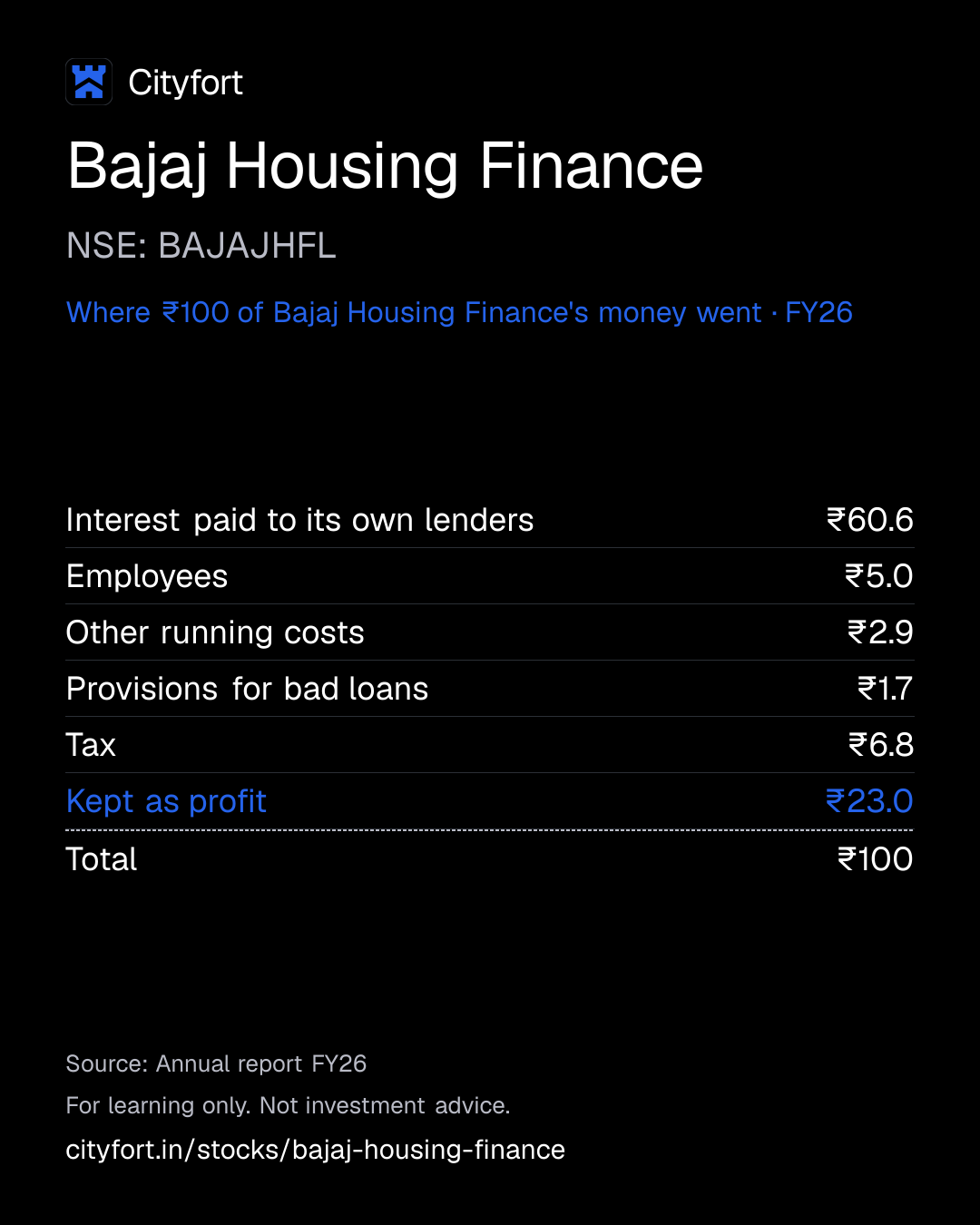
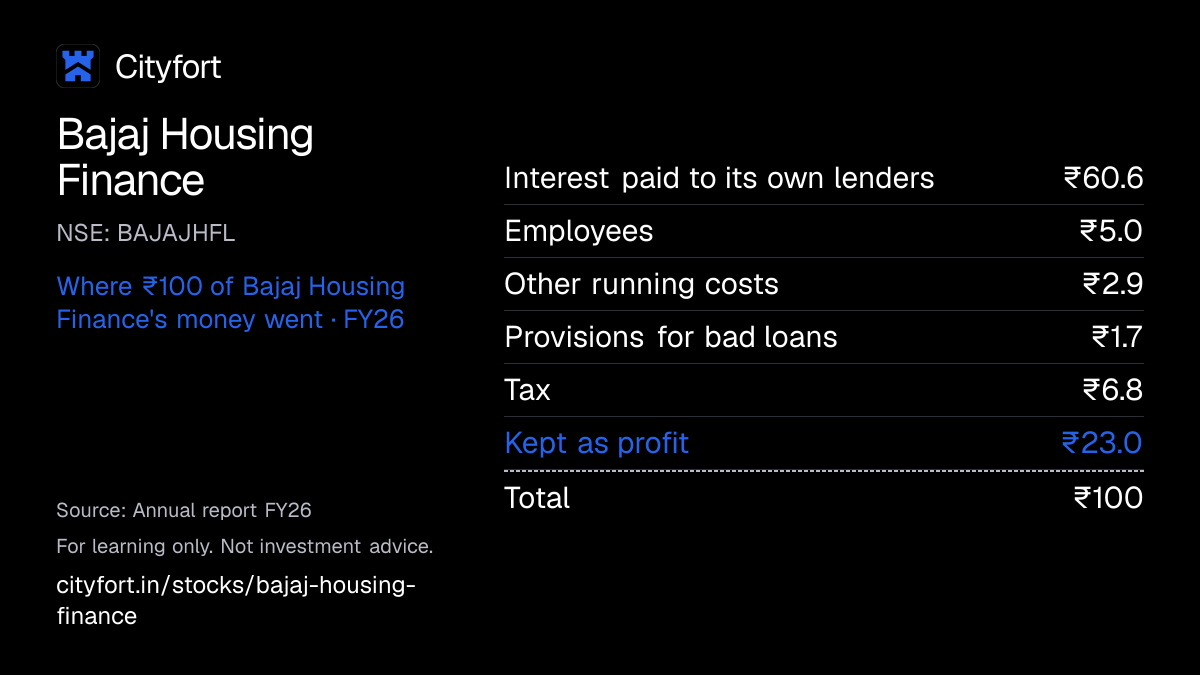
Of every ₹100 that came in to Bajaj Housing Finance during FY26, it kept ₹23.0 as profit, after ₹60.6 of interest to its own lenders and ₹1.7 set aside for bad loans, and its only exceptional item was a one-time ₹13 crore labour-code charge.
4 · Where the operating profit comes from
Bajaj Housing Finance's profit comes mainly from the gap between the interest it earns and the interest it pays, which was ₹3,752 crore of net interest income in FY26, against ₹639 crore of fees and other income.
5 · The one thing to watch
Bajaj Housing Finance's net interest margin, as it reports it, was 3.7% in Q2 FY27 against 4.0% in Q3 FY25, and in its Jul 2026 presentation management assessed FY27 NIM moderation of 20–25 bps.
Sources: From Bajaj Housing Finance's FY26 annual report and its Q1 FY27 and Q2 FY27 investor presentations · checked
01Where the money goes · FY26
Where does ₹100 of Bajaj Housing Finance's money go?
Bajaj Housing Finance · FY26
Receipt for every ₹100
| Interest paid to its own lenders | ₹60.6 |
|---|---|
| Employees | ₹5.0 |
| Other running costs | ₹2.9 |
| Provisions for bad loans | ₹1.7 |
| Tax | ₹6.8 |
| Kept as profit | ₹23.0 |
| Total | ₹100 |
Each line = amount ÷ total money in × 100. Lines may not add to exactly ₹100 because of rounding.
How this is worked out
Of every ₹100 that came in to Bajaj Housing Finance in FY26 (Cityfort calculation from the FY26 annual report). Money in = interest ₹10,512 crore + fees and other income ₹639 crore = ₹11,150 crore. Lines add to ₹100.
Save this receipt as an image
Embed this receipt or the key numbers
Paste this code into a blog or website to show the card you choose, with a link back to this page.
Each week: the next company due to report results, explained in 5 points.
We'll email you once a week with what changed on Cityfort. Facts only, no tips. Unsubscribe any time.
We store your email address with Kit, our email provider, which also records when you sign up and whether you open or click our emails. We send a confirmation email first. See our privacy policy.
02The business in one line
What does Bajaj Housing Finance do?
Home buyers, landlords and property firms pay Bajaj Housing Finance interest on their loans; most of that money goes on interest to its own lenders, and what's left after staff, provisions and tax is profit.
- In FY26 borrowers paid Bajaj Housing Finance ₹10,512 crore of interest. Fees and other income added ₹639 crore.
- Interest paid to bondholders, banks and the National Housing Bank took ₹6,759 crore. ₹2,560 crore was left as profit.
03Who pays it
Who pays Bajaj Housing Finance?
Bajaj Housing Finance does not disclose how much each type of customer pays.
Home buyers
Pay interest on home loans: 53.9% of AUM at 30 Sep 2026. Salaried, self-employed and professional borrowers are in an 83:14:3 mix.
Landlords of rented buildings
Pay interest on lease rental discounting loans: 24.0% of AUM, up from 21.5% a year earlier. Borrowers include REITs, sovereign and foreign funds, large companies and developers; the average loan at origination is ₹146.5 crore.
Property developers
Pay interest on developer finance: 10.7% of AUM, down from 11.8% a year earlier.
Property owners
Pay interest on loans against property: 10.3% of AUM. Self-employed, salaried and professional borrowers are in an 80:13:7 mix; the average loan at origination is ₹99.9 lakh.
Other borrowers
Other loans: 1.1% of AUM.
How spread out the customers are
The shares above are of loans under management (AUM), not of income; the company does not disclose income by product or its number of customers. Its 20 largest borrowers held ₹11,108 crore, 8.92% of loans, at 31 Mar 2026, against 7.76% a year earlier.
04How it makes money
How does Bajaj Housing Finance make money?
A housing lender earns the gap between the interest it charges and the interest it pays, and running costs and bad loans come out of that gap
Bajaj Housing Finance borrows at an average 7.0% (Q2 FY27) and lends mostly against homes and rented buildings. Its net interest margin was 3.7% in Q2 FY27, as it reports it. Running costs per ₹100 of net total income fell from ₹29.2 in FY22 to ₹19.7 in FY26, and loan losses were 0.17% of average loans in FY26.
Running costs per ₹100 of net total income (opex to NTI)
₹29.2₹19.7
FY22 to FY26
- Home buyers, landlords and developers take loans secured on property
- AAA ratings let it borrow from bond markets, banks and NHB
- The gap between interest earned and paid is net interest income
- Running costs take ₹19.7 of each ₹100 of net total income (FY26)
- Few bad loans keep provisions small
- Profit adds to capital, which supports more lending
↺ Step 6 feeds back into step 1.
05The numbers · Standalone · ₹ crore
How has Bajaj Housing Finance done?
Net interest income
₹3,752 crFY26
Net interest income (interest earned minus interest paid) rose every year, from ₹1,326 crore in FY22 to ₹3,752 crore in FY26.
* Q3 FY25: As first filed, earlier basis.
₹ crore · interest earned minus interest paid
See the yearly numbers
See the quarterly numbers
Net profit
₹2,560 crFY26
Profit rose every year, from ₹710 crore in FY22 to ₹2,560 crore in FY26; FY26 includes a one-time ₹13 crore labour-code charge.
₹ crore
See the yearly numbers
See the quarterly numbers
Net interest margin
3.7%Q2 FY27
Bajaj Housing Finance publishes net interest margin (NIM) only for quarters, so no yearly NIM is shown; Cityfort does not calculate one. Its quarterly NIM was 4.0% in Q3 FY25 and 3.7% in Q2 FY27.
% · as reported by the company
See the numbers
Bad loans (gross NPA)
0.27%FY26
Gross NPA (loans not being repaid) was between 0.22% and 0.31% of loans at every year end from FY22 to FY26, and 0.29% at 30 Sep 2026.
* Q3 FY25: As first filed, earlier basis.
% of loans · gross and net (after provisions) non-performing assets
See the yearly numbers
See the quarterly numbers
See all yearly numbers
† Restated by the company. EPS is basic EPS as reported, per ₹10 share; basic and diluted EPS are equal in every year. The re-presentation of income and provisions did not change profit or EPS.
Net interest income = interest earned on loans and investments minus interest paid on deposits and borrowings. Provisions = money set aside for loans that may not be repaid. Financial year runs April to March.
- Bajaj Housing Finance has no subsidiaries, associates or joint ventures, so its standalone figures cover the whole company.
- From Q4 FY26 the company counts recoveries on loans it had written off as lower provisions, not as income, and re-presented earlier periods; profit is unchanged. Every yearly row uses that basis: FY25 and FY26 from the FY26 annual report, FY22–FY24 from the company's nine-year table in its Q2 FY27 presentation (rounded to whole crore). As first filed, total income was ₹3,767, ₹5,665, ₹7,618 and ₹9,576 crore and provisions ₹181, ₹124, ₹61 and ₹80 crore for FY22–FY25.
- Quarters from Q4 FY25 are on the new basis, from the latest results that show each one. Q3 FY25 was filed only on the earlier basis, so its total income (₹2,449 crore) and provisions (₹35 crore) are as first filed in the Q3 FY26 results, with recoveries on written-off loans counted as income; its profit is unaffected.
- Interest earned and interest paid are interest income and finance costs. Other income is fees and all other income. Operating expenses are staff, depreciation, fee and commission and other expenses; operating profit minus provisions (and, in FY26, the ₹13 crore exceptional charge) equals profit before tax. Cost-to-income matches the company's 'opex to net total income'.
- Bajaj Housing Finance does not publish a yearly NIM, so none is shown. Its quarterly NIM, (total income − interest paid) ÷ average loans, annualised, is as the company reports it: 4.0% in Q3 FY25 and 3.7% in Q2 FY27. For FY26 the company said NIM moderated by 7 bps.
- NBFCs report no CET1 ratio. Tier 1 capital was 18.95% in FY22, 22.19% in FY23, 20.67% in FY24, 27.72% in FY25, 22.01% in FY26 and 20.83% at 30 Sep 2026. RBI's minimums are 15% for CRAR and 10% for Tier 1.
- Bajaj Housing Finance does not take public deposits, so deposits and CASA do not apply; the small 'deposits' line on its balance sheet (₹47 crore at 31 Mar 2026) is not public deposits. Borrowings were ₹103,704 crore at 31 Mar 2026.
- Loans are net loans on the balance sheet: ₹123,745 crore at 31 Mar 2026 and ₹139,862 crore at 30 Sep 2026. Loans under management (AUM) also count loans assigned to others: ₹140,706 crore and ₹158,205 crore.
- ROA (profit ÷ average loans) and ROE (profit ÷ average equity) are as the company reports them. FY22–FY24 gross and net NPA and provision cover are the rounded figures in the company's nine-year table; FY22–FY24 capital ratios are from the IPO prospectus.
- One-off item: Q3 FY26 and FY26 include a one-time ₹13.14 crore charge for India's four new labour codes, shown as an exceptional item.
Sources (10)
- Annual Report FY22 (14th, 2021-22)
- Investor presentation Q2 FY27
- Red Herring Prospectus dated 30 Aug 2024 (IPO)
- Annual Report FY23 (15th, 2022-23)
- Annual Report FY24 (16th, 2023-24)
- Annual Report FY26 (18th, 2025-26), standalone financial statements, MD&A, BRSR
- Financial results for the quarter and year ended 31 March 2026 (Q4 FY26)
- Financial results for the quarter and nine months ended 31 December 2025 (Q3 FY26)
- Financial results for the quarter ended 30 June 2026 (Q1 FY27)
- Financial results for the quarter and half year ended 30 September 2026 (Q2 FY27), with press release
06Who runs it
Who runs Bajaj Housing Finance, and did they deliver?
Sanjiv Bajaj
Chairman (non-executive)
Rajeev Jain
Vice Chairman (non-executive)
Also Vice Chairman and Managing Director of the parent, Bajaj Finance.
Atul Jain
Managing Director · since 2022
Appointed to the board on 1 May 2022.
Gaurav Kalani
Chief Financial Officer
What they said, and what happened
2 delivered · 2 too early to tell
Said on 2 Feb 2026
Grow AUM 21–23% in FY26, with gross NPA of 35–40 bps and credit cost of 15–20 bps of average loans (management assessment, Q3 FY26 presentation).
DeliveredWhat happened
AUM grew 23% to ₹140,706 crore. Gross NPA was 27 bps and credit cost 17 bps.
Said on 2 Feb 2026
Keep FY26 operating costs at 20–21% of net total income and return on equity at 11–12%, with NIM moderating by 15–20 bps (same assessment).
DeliveredWhat happened
Operating costs were 19.7% of net total income and ROE 12.1%; NIM moderated by 7 bps.
Said on 29 Jul 2026
Grow AUM 21–23% in FY27, with credit cost of 10–15 bps and ROE of 12–13% (management assessment, Q1 FY27 presentation).
Too early to tellWhat happened
At 30 Sep 2026 AUM was 25% higher than a year earlier. First-half credit cost was 0.08% and ROE 12.6%. On 16 Oct 2026 management said it had not changed the AUM guidance.
Said on 16 Oct 2026
Take Sambhav home-loan disbursements to ₹600 crore or more a month within the next six months (Q2 FY27 presentation).
Too early to tellWhat happened
The monthly run-rate was ₹500–515 crore in Q2 FY27.
Sources (8)
- Annual Report FY26 (18th, 2025-26), standalone financial statements, MD&A, BRSR
- Red Herring Prospectus dated 30 Aug 2024 (IPO)
- Investor presentation Q3 FY26 (incl. management assessment FY26)
- Investor presentation Q4 FY26 (incl. FY26 actual vs assessment)
- Investor presentation Q2 FY27
- Investor presentation Q1 FY27 (incl. management assessment FY27)
- Press release: financial results for Q2 FY27
- Q2 FY27 earnings call transcript (call of 16 Oct 2026)
07What could go wrong
What could go wrong for Bajaj Housing Finance?
- Concentration
Large loans to landlords and developers
Lease rental discounting (24.0% of AUM) averages ₹146.5 crore a loan at origination and developer finance (10.7%) ₹60.3 crore, at 30 Sep 2026. The 20 largest borrowers held 8.92% of loans at 31 Mar 2026, up from 7.76% a year earlier.
Watch The top-20 borrower share in the FY27 annual report, and gross NPA (0.29% at 30 Sep 2026).
- Concentration
Loans concentrated in five regions
The RHP showed Maharashtra (32.0%), Karnataka (22.7%), Telangana (14.8%), Gujarat (8.1%) and New Delhi (7.6%) holding 85.2% of AUM at 30 Jun 2024, and lists this concentration as a risk.
Watch Any update of the state-wise loan mix in annual reports or presentations.
- Pricing
Margins and rising interest rates
NIM, as the company reports it, fell from 4.0% in Q3 FY25 to 3.7% in Q2 FY27. On 16 Oct 2026 management said the repo-rate hike's effect on margins was yet to play out, and that if rates on new loans did not rise in line, more borrowers could move their loans to other lenders, which would affect AUM growth.
Watch Quarterly NIM against the FY27 assessment of 20–25 bps moderation, and the cost of funds (7.0% in Q2 FY27).
- Debt
Capital adequacy has fallen since FY25
CRAR fell from 28.24% at 31 Mar 2025 to 21.24% at 30 Sep 2026; RBI's minimum is 15%. Management's FY27 assessment puts leverage (assets ÷ equity) at 5.8–6.3 times, against 5.65 times at 31 Mar 2026, and 7–8 times in the medium term.
Watch CRAR and Tier 1 capital each quarter, and any new equity raised.
- Other
The parent must cut its stake
Bajaj Finance owned 86.70% at 30 Sep 2026 and public shareholding must reach 25% by 15 Sep 2029. CRISIL wrote on 28 Apr 2026 that Bajaj Finance "is expected to further reduce its stake to or below 75% in medium term".
Watch Share sales by Bajaj Finance and the promoter holding in each shareholding pattern.
- Other
Property values and collateral
The IPO prospectus lists difficulty in recovering collateral, defects in property titles and exposure to the real-estate sector among its main risks. Developer finance was 10.7% of AUM at 30 Sep 2026.
Watch Gross NPA and credit cost each quarter (0.10% annualised in Q2 FY27).
Sources (9)
- Investor presentation Q2 FY27
- Annual Report FY26 (18th, 2025-26), standalone financial statements, MD&A, BRSR
- Financial results for the quarter and half year ended 30 September 2026 (Q2 FY27), with press release
- Red Herring Prospectus dated 30 Aug 2024 (IPO)
- Q2 FY27 earnings call transcript (call of 16 Oct 2026)
- Investor presentation Q1 FY27 (incl. management assessment FY27)
- Investor presentation Q3 FY26 (incl. management assessment FY26)
- Shareholding pattern as of 30 Sep 2026 (Q2 FY27), Reg 31
- Crisil Ratings rationale, Bajaj Finance Ltd (Bajaj group incl. BHFL), 28 Apr 2026
08Supporters and critics
What do supporters and critics point to?
What supporters point to
- Profit rose every year, from ₹710 crore in FY22 to ₹2,560 crore in FY26.
- Gross NPA was between 0.22% and 0.31% of loans at every year end from FY22 to FY26.
- Operating costs fell from 29.2% of net total income in FY22 to 19.7% in FY26.
- CRISIL and India Ratings rate its long-term borrowing AAA (Stable).
- FY26 AUM growth was 23% and credit cost 17 bps; management's FY26 assessment had been 21–23% and 15–20 bps.
What critics point to
- Return on equity fell from 15.2% in FY24 to 12.1% in FY26.
- NIM, as the company reports it, fell from 4.0% in Q3 FY25 to 3.7% in Q2 FY27.
- Lease rental discounting loans average ₹146.5 crore each at origination, and the 20 largest borrowers held 8.92% of loans at 31 Mar 2026.
- Capital adequacy fell from 28.24% at 31 Mar 2025 to 21.24% at 30 Sep 2026.
- Bajaj Finance owns 86.70% and public shareholding must reach 25% by 15 Sep 2029.
09What to watch next
What should you watch next at Bajaj Housing Finance?
Next event
Q3 FY27 results (date not announced)
Date not announced yet.
Margins after the repo-rate hike
NIM was 3.7% in Q2 FY27. On 16 Oct 2026 management said the hike's effect on margins was yet to play out; its FY27 assessment is 20–25 bps of NIM moderation.
Bajaj Finance's stake
Bajaj Finance owned 86.70% at 30 Sep 2026. Public shareholding must reach 25% by 15 Sep 2029.
Capital adequacy
CRAR was 21.24% at 30 Sep 2026, against 28.24% at 31 Mar 2025 and RBI's 15% minimum.
10Key facts
Key facts about Bajaj Housing Finance
- What does Bajaj Housing Finance do?
- Bajaj Housing Finance is a Pune-based housing finance company registered with the National Housing Bank. It does not take public deposits. It gives home loans, loans against property, loans to landlords against rent and loans to property developers; its loans under management (AUM) were ₹158,205 crore at 30 Sep 2026.
- How does Bajaj Housing Finance make money?
- Bajaj Housing Finance earns mostly interest on loans. In FY26 interest was ₹10,512 crore of its ₹11,150 crore total income; fees and other income made up the other ₹639 crore.
- Who are Bajaj Housing Finance's customers?
- At 30 Sep 2026 home loans were 53.9% of Bajaj Housing Finance's AUM, lease rental discounting (loans to landlords against rent) 24.0%, developer finance 10.7%, loans against property 10.3% and other loans 1.1%.
- How big is Bajaj Housing Finance?
- Bajaj Housing Finance's total income was ₹11,150 crore in FY26. Its profit was ₹2,560 crore in FY26, up from ₹2,163 crore in FY25.
- Who owns Bajaj Housing Finance?
- Bajaj Finance owned 86.70% of Bajaj Housing Finance at 30 Sep 2026, and public shareholders 13.26%, according to the Sep 2026 shareholding pattern. Bajaj Finserv owns 51.30% of Bajaj Finance, according to the Q2 FY27 investor presentation.
- Where does Bajaj Housing Finance get the money it lends?
- Bajaj Housing Finance's borrowings were ₹103,704 crore at 31 Mar 2026. At 30 Sep 2026 money markets supplied 56% of its borrowings, banks 35% and the National Housing Bank 9%.
- How many of Bajaj Housing Finance's loans are not being repaid?
- Bajaj Housing Finance's gross non-performing assets (loans not being repaid) were 0.29% of loans at 30 Sep 2026, and 0.12% after provisions (net NPA).
- When did Bajaj Housing Finance list on the stock exchanges?
- Bajaj Housing Finance listed on NSE and BSE on 16 Sep 2024, after a ₹6,560 crore IPO: ₹3,560 crore of new shares and ₹3,000 crore of shares sold by Bajaj Finance.
Sources (5)
Terms on this page
- Credit rating
- FII and DII holding
- Gross and net NPA
- Market capitalisation
- Net profit
- Promoter holding
- Provision coverage ratio (PCR)
- Public shareholding
- Return on equity (ROE)
Each explains the term in plain English, with the same number from other companies on Cityfort.
Go deeper
More detail from the same filings. Open any section.
11What it sells
11What it sells
What does Bajaj Housing Finance sell?
Home loans
Loans to buy or build a home: ₹85,224 crore at 30 Sep 2026. The average new home loan was ₹49.5 lakh.
Lease rental discounting
A loan to the owner of a rented building, such as an office or warehouse, repaid from the rent: ₹37,988 crore at 30 Sep 2026.
Developer finance
Loans to property developers for their projects: ₹16,904 crore at 30 Sep 2026, with an average loan at origination of ₹60.3 crore.
Loans against property
Loans secured on a home or shop the borrower already owns, mostly to self-employed people: ₹16,382 crore at 30 Sep 2026.
Sambhav home loans
Home loans for near-prime and affordable-housing borrowers, with an average loan of ₹28 lakh, from 73 urban and 72 rural locations. They were 16% of new home loans in Q2 FY27.
What it does
- Does: Lends from 223 branches in 182 locations across 20 states and union territories (30 Sep 2026)
- Does: Borrows from bond and money markets, banks and the National Housing Bank (NHB) to fund its loans
- Does: Manages some loans it has passed on to others (assigned), so its AUM is larger than the loans on its balance sheet
What it does not do
- Does not: It does not take deposits from the public: NHB registered it in 2015 as a non-deposit-taking housing finance company
- Does not: It is not Bajaj Finance: Bajaj Finance is its parent, owning 86.70% at 30 Sep 2026
- Does not: It is not a bank; RBI regulates it and places it in the NBFC 'upper layer'
12How the money flows
12How the money flows · FY26
How does money flow through Bajaj Housing Finance?
Money in
- Interest on loans₹10,512 cr
- Fees and other income₹639 cr
The company
Bajaj Housing Finance
₹11,150 cr came in
Money out
- Interest paid to bondholders, banks and NHB₹6,759 cr
- Employees₹559 cr
- Other running costs (incl. one-time ₹13 cr labour-code charge)₹321 cr
- Provisions for bad loans₹191 cr
- Tax₹760 cr
- Net profit₹2,560 cr
- These are Bajaj Housing Finance's FY26 accounts; it has no subsidiaries.
- Borrowers paid ₹10,512 crore of interest. Fees and other income added ₹639 crore.
- The company paid ₹6,759 crore of interest to the bondholders, banks and NHB that lend to it.
- Staff cost ₹559 crore and other running costs ₹321 crore, including a one-time ₹13 crore labour-code charge. ₹191 crore was set aside for loans that may not be repaid.
- After ₹760 crore of tax, ₹2,560 crore was profit.
13What it needs to run
13What it needs to run
What does Bajaj Housing Finance need to run?
Borrowed money
Borrowings were ₹103,704 crore at 31 Mar 2026. Its cost of funds was 7.0% in Q2 FY27, against 7.2% in Q1 FY27.
Credit ratings
AAA (Stable) for long-term borrowing and A1+ for short-term borrowing, from CRISIL and India Ratings. A high rating lets it borrow from bond markets at lower rates.
Capital
Capital adequacy (own money as a share of risk-weighted loans) was 21.24% at 30 Sep 2026. RBI's minimum is 15%.
Branches
223 branches in 182 locations across 20 states and union territories at 30 Sep 2026.
People
2,053 full-time employees at 30 Sep 2026.
NHB registration
Registered with NHB on 24 Sep 2015 as a housing finance company that does not take public deposits; regulated by RBI and supervised by NHB.
14Competitors and what protects it
14Competitors and what protects it
Who does Bajaj Housing Finance compete with?
LIC Housing Finance
Named as a listed peer in the RHP (30 Aug 2024). Its FY24 total income was ₹27,278 crore in the RHP's table, against Bajaj Housing Finance's ₹7,618 crore as then filed.
PNB Housing Finance
Named as a listed peer in the RHP. Its FY24 total income was ₹7,057 crore in the RHP's table.
Can Fin Homes
Named as a listed peer in the RHP. Its FY24 total income was ₹3,525 crore in the RHP's table.
Aadhar Housing Finance
Named as a listed peer in the RHP. Its FY24 total income was ₹2,587 crore in the RHP's table.
Aavas Financiers
Named as a listed peer in the RHP. Its FY24 total income was ₹2,021 crore in the RHP's table.
What protects the business
Each strength is scored 1 (weak) to 5 (strong) for the business, with the reason. It is not a rating of the share.
- Cost of borrowing4 of 5
AAA (Stable) ratings from CRISIL and India Ratings. Its cost of funds was 7.0% in Q2 FY27.
- Parent and brand4 of 5
Bajaj Finance owned 86.70% at 30 Sep 2026. CRISIL rates the Bajaj group, including Bajaj Housing Finance, on a consolidated basis.
- Running costs3 of 5
Operating costs fell from 29.2% of net total income in FY22 to 19.7% in FY26.
- Loan quality3 of 5
Gross NPA was between 0.22% and 0.31% at every year end from FY22 to FY26. 78.4% of home-loan customers had a CIBIL credit score above 750 (Q2 FY27 presentation).
Weak spot
Falling margin and large loans
NIM, as the company reports it, fell from 4.0% in Q3 FY25 to 3.7% in Q2 FY27. Lease rental discounting loans, 24.0% of AUM, average ₹146.5 crore each at origination.
15Where growth could come from
15Where growth could come from
Where could Bajaj Housing Finance's growth come from?
In its Q1 FY27 presentation (29 Jul 2026), management assessed FY27 AUM growth at 21–23%, NIM moderation of 20–25 bps, credit cost of 10–15 bps and return on equity of 12–13%. On the 16 Oct 2026 call, management said it had not changed the 21–23% AUM growth guidance, and that the effect of the October 2026 repo-rate hike on margins was "yet to play out".
Lease rental discounting
Working₹37,988 cr, +39% in a year (Sep 2026)
Loans to landlords against rent grew from ₹27,290 crore and rose from 21.5% to 24.0% of AUM.
Status: Working, on track against what the company said.
Home loans
Working₹85,224 cr, +22% in a year (Sep 2026)
Home loans grew from ₹69,845 crore. Total disbursements were ₹19,935 crore in Q2 FY27, 25% more than in Q2 FY26.
Status: Working, on track against what the company said.
Loans against property
Working₹16,382 cr, +26% in a year (Sep 2026)
Loans against property grew from ₹12,985 crore.
Status: Working, on track against what the company said.
Sambhav near-prime home loans
Early₹500–515 cr a month (Q2 FY27)
Monthly disbursements rose from ₹325–350 crore in Q3 FY26. The Q2 FY27 presentation targets ₹600 crore or more a month within the next six months.
Status: Early, too early to judge.
Developer finance
Behind₹16,904 cr, +13% in a year (Sep 2026)
On 16 Oct 2026 management said higher repayments and lower disbursements in the quarter led to the 13%, that there was "no conscious strategy" to slow it, and that it remains committed to growing this business faster than the company as a whole.
Status: Behind, behind the company's own plan.
Status compares progress with what the company itself said it would do: Working = on track against what the company said; Mixed = partly on track; Behind = behind the company's own plan; New = recently announced; Early = too early to judge.
16Financial strength: capital, bad loans, deposits
16Financial strength · FY26
How strong is Bajaj Housing Finance's balance sheet?
- Loans given (advances)₹1.24 lakh cr
- Capital adequacy (CRAR)
- 22.46%
- capital as a share of risk-weighted loans; regulators set a minimum
- Gross NPA
- 0.27%
- loans not being repaid, as % of all loans
- Net NPA
- 0.11%
- the same, after money already set aside
- Provision cover
- 59.78%
- share of bad loans already provided for
- Cost to income
- 19.7%
- ₹ of running costs per ₹100 of income after interest paid
- Return on assets
- 2.3%
- profit as % of everything the lender owns
- Return on equity
- 12.1%
- profit as % of shareholders' money
Figures as on FY26 year end (standalone, as banks report these ratios). Reported by the company; see the dates on each source.
17Who owns it
17Who owns it · Q2 FY27
Who owns Bajaj Housing Finance?
- Promoters (founders or parent company)86.7%
- Foreign institutions (FII)0.9%
- Indian institutions (DII)1.1%
- Public and others11.3%
Promoter pledge
No promoter shares were pledged in Q2 FY27.
How ownership changed
* Pledged = share of the promoters' own holding reported as pledged. In older filings this can include shares “otherwise encumbered”; the governance flags say when.
† Others = Employee share trust (neither promoter nor public).
Sources (9)
- Shareholding pattern as of 30 Sep 2026 (Q2 FY27), Reg 31
- Shareholding pattern as of 30 Jun 2026 (Q1 FY27), Reg 31
- Shareholding pattern as of 31 Mar 2026 (Q4 FY26), Reg 31
- Shareholding pattern as of 31 Dec 2025 (Q3 FY26), Reg 31
- Shareholding pattern as of 30 Sep 2025 (Q2 FY26), Reg 31
- Shareholding pattern as of 30 Jun 2025 (Q1 FY26), Reg 31
- Shareholding pattern as of 31 Mar 2025 (Q4 FY25), Reg 31
- Shareholding pattern as of 31 Dec 2024 (Q3 FY25), Reg 31
- Shareholding pattern as of 30 Sep 2024 (Q2 FY25), Reg 31
18What it does with profit
18What it does with profit
What does Bajaj Housing Finance do with its profit?
Money raised · 3 Apr 2024
Rights issue of ₹2,000 crore to its parent, Bajaj Finance.
₹2,000 cr
Money raised · 13 Sep 2024
IPO of ₹6,560 crore at ₹70 a share (shares allotted 13 Sep 2024, listed 16 Sep 2024): ₹3,560 crore of new shares for the company and ₹3,000 crore of shares sold by Bajaj Finance.
₹3,560 cr
19Governance signals
19Governance signals
What do Bajaj Housing Finance's governance filings show?
- Auditor
- Singhi & Co. and Mukund M. Chitale & Co. (joint statutory auditors); the FY26 audit opinion was unmodified
- Auditor changes
- None in the period covered
- Audit qualifications
- None reported
- Related-party dealings
- Bajaj Finance, the parent, owned 86.70% at 30 Sep 2026. At the 23 Jul 2025 AGM shareholders approved transactions with Bajaj Finance of up to ₹12,612 crore until the next AGM. The company says an independent law firm reviewed its FY26 related-party transactions each quarter and found them at arm's length.
- Credit rating
- CRISIL and India Ratings AAA (long term); A1+ (short term) (outlook Stable), 16 Oct 2026
A credit rating describes the company's ability to repay debt. It is not a rating of the share.
Flags to know about
other · 2 Dec 2025
Public shareholding below 25%
Bajaj Finance owned 86.70% at 30 Sep 2026 and public shareholders 13.26%. The FY26 annual report says the deadline to reach 25% public shareholding is 15 Sep 2029, under rules amended on 13 Mar 2026. Bajaj Finance sold 16.66 crore shares (about 2%) in a bulk deal on 2 Dec 2025.
related party · 23 Jul 2025
Large approved transactions with the parent
Shareholders approved transactions with Bajaj Finance of up to ₹12,612 crore between the 2025 and 2026 AGMs. The IPO prospectus lists borrowings from related parties among its risk factors.
disclosure
State-wise loan mix last shown in the IPO prospectus
The RHP showed 85.2% of AUM in Maharashtra, Karnataka, Telangana, Gujarat and New Delhi at 30 Jun 2024. The FY26 annual report and the presentations on file do not update it, and the company does not disclose its number of customers.
20What the market paid
20What the market paid · price as of 11 Nov 2026
What did the market pay for Bajaj Housing Finance on 11 Nov 2026?
Price as of 11 Nov 2026 (shown for education; prices change daily).
Price as of 11 Nov 2026: ₹82.54, the NSE closing price. Market value: ₹68,775 crore, a Cityfort calculation from the 11 Nov 2026 NSE closing price and 8,332,334,619 shares in the Sep 2026 shareholding pattern. P/E is the share price divided by one year's profit per share: here FY26 EPS of ₹3.07, giving 26.9 (Cityfort calculation). P/B divides market value by book value (shareholders' money): net worth of ₹24,015 crore at 30 Sep 2026, as the company reports it, giving 2.86 (Cityfort calculation). EV/EBITDA is not shown, because interest is a lender's main cost.
- Share price
- ₹82.54
- Market value (market cap)
- ₹68,775 cr
- P/E
- 26.9×
- P/B
- 2.9×
Source: NSE security-wise bhavcopy (sec_bhavdata_full), 11 Nov 2026; Shareholding pattern as of 30 Sep 2026 (Q2 FY27), Reg 31; Annual Report FY26 (18th, 2025-26), standalone financial statements, MD&A, BRSR and 1 more
Sources (4)
21How it got here
21How it got here
How did Bajaj Housing Finance get here?
2008
Milestone
Incorporated as Bajaj Financial Solutions
Incorporated in Pune on 13 Jun 2008; renamed Bajaj Housing Finance in Nov 2014.
2015
Milestone
Registered as a housing finance company
NHB registered it on 24 Sep 2015 as a housing finance company that does not take public deposits.
2017
Business-model change
Starts lending
It began operations in FY18 (2017-18). AUM grew to ₹53,322 crore by 31 Mar 2022.
2024
Milestone
₹2,000 crore rights issue
Bajaj Finance, then the only shareholder, put in ₹2,000 crore through a rights issue on 3 Apr 2024.
2024
Business-model change
Listed through a ₹6,560 crore IPO
RBI's rules for upper-layer NBFCs required it to list by 30 Sep 2025. The IPO at ₹70 a share raised ₹3,560 crore of new capital, and the shares listed on NSE and BSE on 16 Sep 2024.
2025
Milestone
Bajaj Finance sells about 2%
Bajaj Finance sold 16.66 crore shares in a bulk deal on 2 Dec 2025 to raise public shareholding, cutting its stake from 88.70% to 86.70%.
2026
Milestone
Public-shareholding deadline set for 2029
Under rules amended on 13 Mar 2026, the company has until 15 Sep 2029 to reach 25% public shareholding.
22Sources and changes
Where every number on this page comes from
Sources (27 documents)
- S1Annual Report FY26 (18th, 2025-26), standalone financial statements, MD&A, BRSR · Bajaj Housing Finance (company IR site) · Tier 1: company or exchange filing · 4 Jul 2026
- S2Annual Report FY25 (17th, 2024-25) · Bajaj Housing Finance (company IR site) · Tier 1: company or exchange filing · 25 Jun 2025
- S3Annual Report FY24 (16th, 2023-24) · Bajaj Housing Finance (company IR site) · Tier 1: company or exchange filing · 28 Jun 2024
- S4Annual Report FY23 (15th, 2022-23) · Bajaj Housing Finance (company IR site) · Tier 1: company or exchange filing · 12 Jul 2023
- S5Annual Report FY22 (14th, 2021-22) · Bajaj Housing Finance (company IR site) · Tier 1: company or exchange filing · 27 Aug 2022
- S6Financial results for the quarter and half year ended 30 September 2026 (Q2 FY27), with press release · Bajaj Housing Finance (company IR site) · Tier 1: company or exchange filing · 16 Oct 2026
- S7Financial results for the quarter ended 30 June 2026 (Q1 FY27) · Bajaj Housing Finance (company IR site) · Tier 1: company or exchange filing · 29 Jul 2026
- S8Financial results for the quarter and year ended 31 March 2026 (Q4 FY26) · Bajaj Housing Finance (company IR site) · Tier 1: company or exchange filing · 27 Apr 2026
- S9Financial results for the quarter and nine months ended 31 December 2025 (Q3 FY26) · Bajaj Housing Finance (company IR site) · Tier 1: company or exchange filing · 2 Feb 2026
- S10Investor presentation Q2 FY27 · Bajaj Housing Finance (company IR site) · Tier 1: company or exchange filing · 16 Oct 2026
- S11Investor presentation Q1 FY27 (incl. management assessment FY27) · Bajaj Housing Finance (company IR site) · Tier 1: company or exchange filing · 29 Jul 2026
- S12Investor presentation Q4 FY26 (incl. FY26 actual vs assessment) · Bajaj Housing Finance (company IR site) · Tier 1: company or exchange filing · 27 Apr 2026
- S13Investor presentation Q3 FY26 (incl. management assessment FY26) · Bajaj Housing Finance (company IR site) · Tier 1: company or exchange filing · 2 Feb 2026
- S14Q2 FY27 earnings call transcript (call of 16 Oct 2026) · Bajaj Housing Finance (company IR site) · Tier 1: company or exchange filing · 16 Oct 2026
- S18Press release: financial results for Q2 FY27 · Bajaj Housing Finance (company IR site) · Tier 1: company or exchange filing · 16 Oct 2026
- S19Red Herring Prospectus dated 30 Aug 2024 (IPO) · SEBI · Tier 1: company or exchange filing · 30 Aug 2024
- S20Crisil Ratings rationale, Bajaj Finance Ltd (Bajaj group incl. BHFL), 28 Apr 2026 · Crisil Ratings · Tier 2: rating agency or regulator · 28 Apr 2026
- S21NSE security-wise bhavcopy (sec_bhavdata_full), 11 Nov 2026 · NSE · Tier 1: company or exchange filing · 11 Nov 2026
- S22Shareholding pattern as of 30 Sep 2024 (Q2 FY25), Reg 31 · Bajaj Housing Finance (company IR site) · Tier 1: company or exchange filing · 30 Sep 2024
- S23Shareholding pattern as of 31 Dec 2024 (Q3 FY25), Reg 31 · Bajaj Housing Finance (company IR site) · Tier 1: company or exchange filing · 31 Dec 2024
- S24Shareholding pattern as of 31 Mar 2025 (Q4 FY25), Reg 31 · Bajaj Housing Finance (company IR site) · Tier 1: company or exchange filing · 31 Mar 2025
- S25Shareholding pattern as of 30 Jun 2025 (Q1 FY26), Reg 31 · Bajaj Housing Finance (company IR site) · Tier 1: company or exchange filing · 30 Jun 2025
- S26Shareholding pattern as of 30 Sep 2025 (Q2 FY26), Reg 31 · Bajaj Housing Finance (company IR site) · Tier 1: company or exchange filing · 30 Sep 2025
- S27Shareholding pattern as of 31 Dec 2025 (Q3 FY26), Reg 31 · Bajaj Housing Finance (company IR site) · Tier 1: company or exchange filing · 31 Dec 2025
- S28Shareholding pattern as of 31 Mar 2026 (Q4 FY26), Reg 31 · Bajaj Housing Finance (company IR site) · Tier 1: company or exchange filing · 31 Mar 2026
- S29Shareholding pattern as of 30 Jun 2026 (Q1 FY27), Reg 31 · Bajaj Housing Finance (company IR site) · Tier 1: company or exchange filing · 30 Jun 2026
- S30Shareholding pattern as of 30 Sep 2026 (Q2 FY27), Reg 31 · Bajaj Housing Finance (company IR site) · Tier 1: company or exchange filing · 30 Sep 2026
Changes to this page (v1 · 12 Nov 2026)
- v1 · 12 Nov 2026First version. (first version)
Numbers come only from tier 1 and tier 2 sources. Read how we research.
Disclaimer
For learning only. Cityfort is not a SEBI-registered adviser and does not recommend buying or selling any security. Prices shown are dated and may be out of date.
Investing in securities involves risk, including loss of capital. Before making any investment decision, do your own research and consider consulting a SEBI-registered investment adviser.
Cityfort, its owners and contributors may or may not hold securities of companies covered. Content is not an offer or solicitation to buy or sell any security.
Read the full disclaimerHide the full disclaimer
Cityfort publishes educational content that explains how listed companies work. Cityfort is not registered with the Securities and Exchange Board of India (SEBI) as an Investment Adviser or Research Analyst and does not provide investment advice, recommendations, ratings, price targets or any opinion on whether to buy, sell or hold any security.
All information is taken from publicly available sources, mainly company filings on BSE and NSE, which are listed on each page with dates. We work to keep it accurate and correct errors publicly, but we do not guarantee that it is complete, accurate or up to date. Any market price or price-based ratio shown is dated, may be out of date by the time you read it, and is included only to explain concepts.
Statements by company management are reported as statements, with their date and source; they are not our forecasts.