Financial Services · NSE: BSE
BSE: how the business works
BSE, established in 1875, runs a stock exchange in Mumbai: brokers pay it fees on their clients' trades and companies pay to list, and FY26 revenue was ₹4,834 crore.
Follow BSE
Email me when BSE's page is updated after results.
We store your email address with Kit, our email provider, which also records when you sign up and whether you open or click our emails. We send a confirmation email first. See our privacy policy.
BSE Limited · Mumbai, Maharashtra · Founded 1875
Updated for Q2 FY27 · checked
- Revenue, FY26
- ₹4,834 cr
- Profit to shareholders, FY26
- ₹2,497 cr
- Investor accounts registered on BSE (Q2 FY27 call)
- 26.8 crore
- Established
- 1875
- Promoter holding, Sep 2026 (no promoter)
- 0%
The short version
BSE in 5 points
1 · What it sells
BSE runs a stock exchange where shares, Sensex and Bankex options and mutual fund units are traded, and its FY26 revenue from operations was ₹4,834 crore.
2 · Who pays it
In FY26, transaction charges on trades were 78.5% of BSE's revenue, listing services for companies 10.7%, interest on clearing and settlement funds 3.5%, and colocation, data, index and other services 7.2%.
3 · What it keeps from ₹100
Of every ₹100 that came in during FY26, including ₹314 crore of non-operating investment and other income, BSE kept ₹47.8 as profit after ₹12.4 of regulatory fees and ₹15.8 of tax, while its operating EBITDA was ₹63.7 per ₹100 of revenue.
4 · Where the operating profit comes from
Equity derivatives, mainly Sensex options, brought in ₹3,134 crore of BSE's ₹4,470 crore standalone revenue in FY26, up from ₹1,416 crore in FY25.
5 · The one thing to watch
BSE's average daily index options premium turnover fell from ₹29,615 crore in Q1 FY27 to ₹22,531 crore in Q2 FY27, and its MD & CEO said it reached ₹35,481 crore in Oct 2026.
Sources: From BSE's FY26 annual report, its Q2 FY27 results and investor presentation, and its Q2 FY27 earnings call · checked
01Where the money goes · FY26
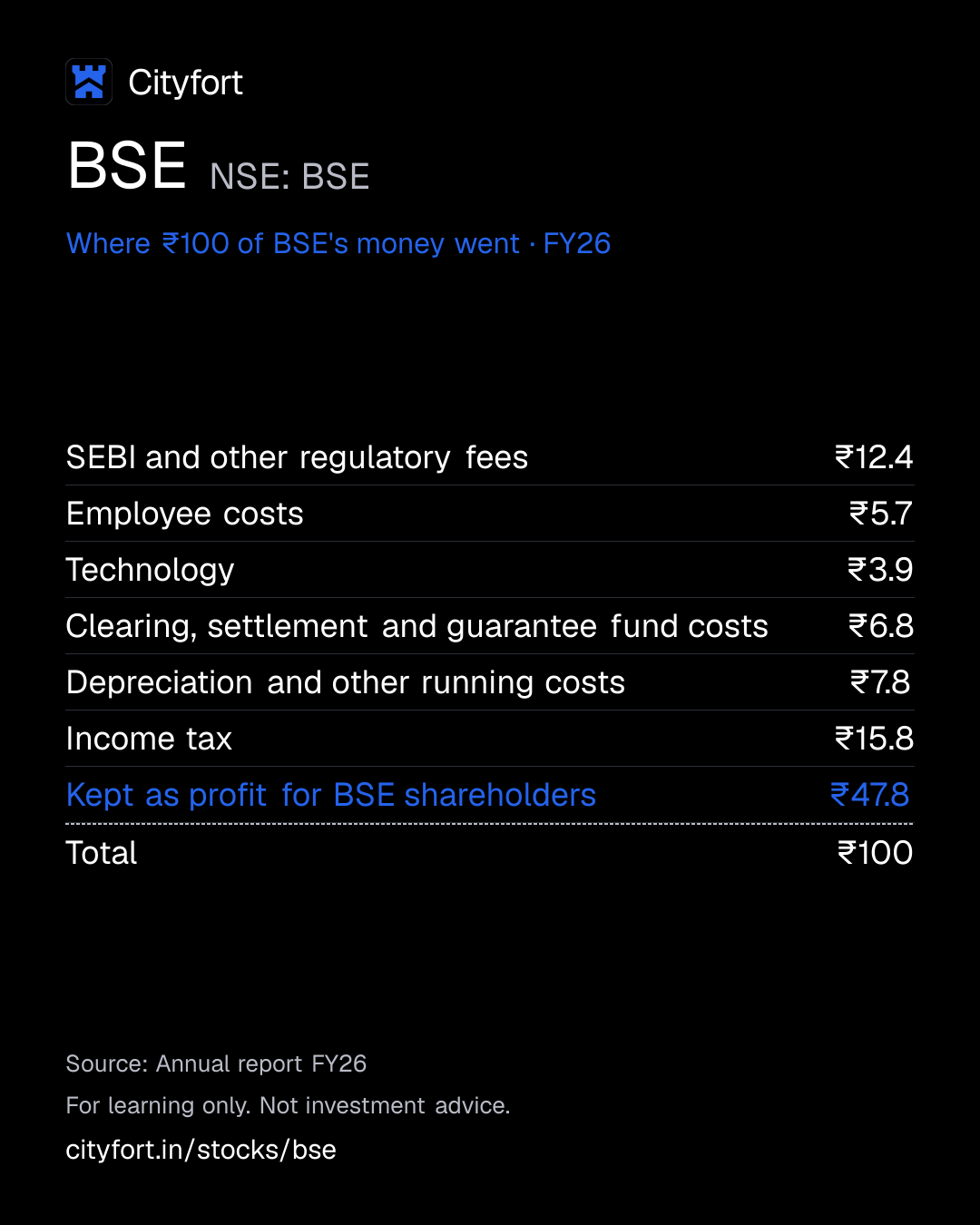
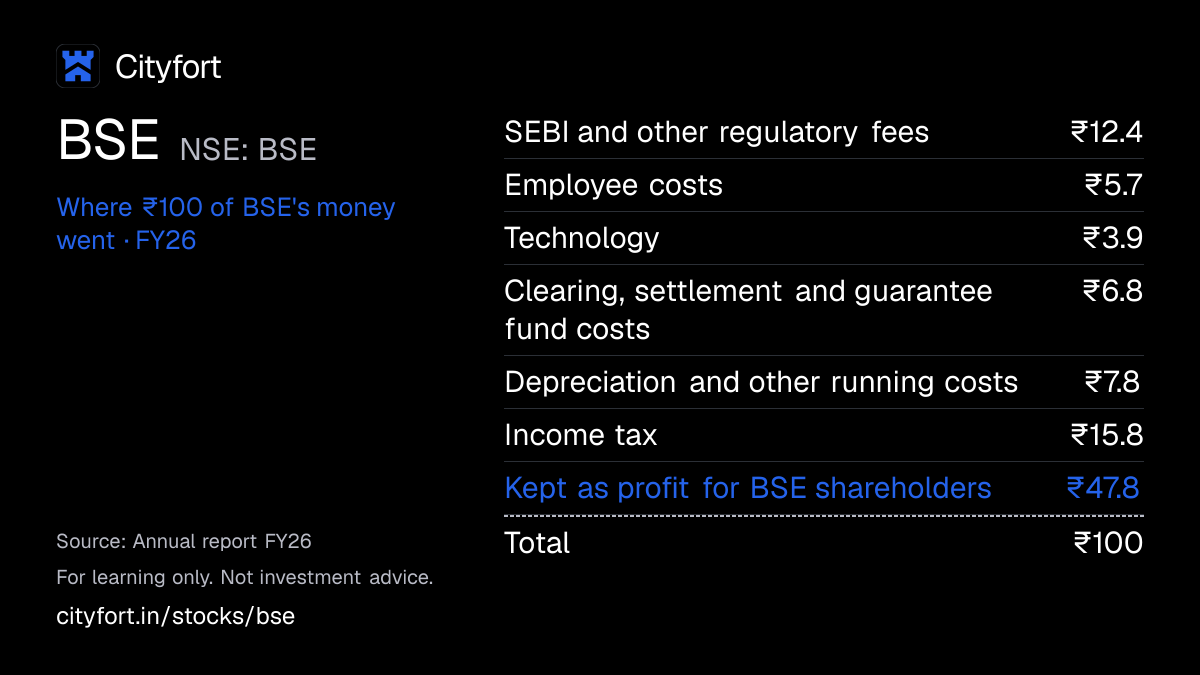
Where does ₹100 of BSE's money go?
BSE · FY26
Receipt for every ₹100
| SEBI and other regulatory fees | ₹12.4 |
|---|---|
| Employee costs | ₹5.7 |
| Technology | ₹3.9 |
| Clearing, settlement and guarantee fund costs | ₹6.8 |
| Depreciation and other running costs | ₹7.8 |
| Income tax | ₹15.8 |
| Kept as profit for BSE shareholders | ₹47.8 |
| Total | ₹100 |
Each line = amount ÷ total money in × 100. Lines may not add to exactly ₹100 because of rounding.
How this is worked out
Of every ₹100 that came in during FY26: revenue (₹4,834 crore), investment and other income (₹314 crore), share of part-owned companies' profit (₹65 crore) and profit from the sold training business (₹12 crore). Cityfort calculation: each line ÷ ₹5,225 crore total × 100, from the FY26 annual report (S1). Losses borne by minority partners in subsidiaries (₹10 crore) explain the small rounding gap.
Save this receipt as an image
Embed this receipt or the key numbers
Paste this code into a blog or website to show the card you choose, with a link back to this page.
Each week: the next company due to report results, explained in 5 points.
We'll email you once a week with what changed on Cityfort. Facts only, no tips. Unsubscribe any time.
We store your email address with Kit, our email provider, which also records when you sign up and whether you open or click our emails. We send a confirmation email first. See our privacy policy.
02The business in one line
What does BSE do?
Brokers pay BSE a fee on their clients' trades, mostly in Sensex options; in FY26, SEBI and other regulatory fees took ₹12.4 of every ₹100 that came in, tax ₹15.8, and ₹47.8 was profit.
- Transaction charges on trades were 78.5% of BSE's FY26 revenue; companies paying for listing services were 10.7%.
- Equity derivatives, which BSE relaunched on 15 May 2023, brought in ₹3,134 crore of its ₹4,470 crore standalone revenue in FY26.
03Who pays it
Who pays BSE?
Brokers paying transaction charges
78.5%
of revenue
Trading members pay a fee on their clients' trades in equity derivatives, shares and mutual fund orders, plus clearing charges. Share is of FY26 consolidated revenue.
Listed companies
10.7%
of revenue
Pay listing fees, book-building software fees during IPOs and other fees.
Interest on clearing and settlement funds
3.5%
of revenue
Interest earned on money held for clearing and settlement of trades (treasury income).
Brokers and firms buying other services
7.2%
of revenue
Colocation and connectivity (₹171 crore), market data (₹68 crore), index services (₹37 crore), subscriptions, software and auction charges.
- Brokers paying transaction charges78.5%
- Listed companies10.7%
- Interest on clearing and settlement funds3.5%
- Brokers and firms buying other services7.2%
How spread out the customers are
BSE does not disclose revenue by individual broker. 616 trading members took part in its equity derivatives market in Q2 FY27, according to its investor presentation.
04How it makes money
How does BSE make money?
Most of BSE's costs do not rise with every trade, so extra trading volume adds mostly to profit.
Revenue grew 5.9 times from FY23 to FY26, mainly from Sensex options. Employee and technology costs grew far less, so EBITDA (profit before interest, tax and depreciation) rose from ₹24.2 to ₹63.7 of every ₹100 of revenue. SEBI fees are the cost that rises with trading.
EBITDA per ₹100 of revenue (Cityfort calculation)
₹24.2₹63.7
FY23 to FY26
- Brokers send their clients' trades to BSE.
- BSE charges a fee on each trade, for example ₹3,250 per crore of options premium.
- More products and members bring more trades, such as Sensex options since May 2023.
- Staff and technology costs grew about 65% from FY23 to FY26, while revenue grew 5.9 times.
- So most extra fees become profit, after SEBI fees and tax.
- Profit pays for technology spending and dividends.
↺ Step 6 feeds back into step 1.
05Business segments · FY26
Which businesses make up BSE?
Transaction charges
78.5%Fees on trades in equity derivatives, shares and mutual fund orders, and clearing. BSE reports one segment, stock exchange services; these lines are its revenue note.
Revenue ₹3,795 cr
Listing services
10.7%Listing fees (₹389 crore), book-building software (₹104 crore) and other fees from companies.
Revenue ₹519 cr
Treasury income on clearing and settlement funds
3.5%Interest earned on money held for clearing and settlement.
Revenue ₹171 cr
Other operating income
7.2%Colocation and connectivity, data, index services, subscriptions, software and auctions.
Revenue ₹349 cr
How the mix changed
- Transaction charges
- Listing services
- Treasury income on clearing and settlement funds
- Other operating income
Revenue by segment, FY25 to FY26.
₹ crore
See the numbers
06The numbers · Consolidated · ₹ crore
How has BSE done?
Revenue
₹4,834 crFY26
Revenue rose from ₹743 crore in FY22 to ₹4,834 crore in FY26, and fell 8.5% from Q1 FY27 to ₹1,433 crore in Q2 FY27.
₹ crore
See the numbers
Net profit
₹2,497 crFY26
FY24 profit of ₹778 crore includes a ₹407 crore one-off gain from selling part of BSE's stake in CDSL, and FY26 profit was ₹2,497 crore.
₹ crore
See the numbers
Net profit for every ₹100 of revenue
₹51.7FY26
EBITDA per ₹100 of revenue rose from ₹24.2 in FY23 to ₹63.7 in FY26; FY24 includes a ₹170 crore provision for the SEBI fee difference for FY2006-07 to FY2023-24.
Net margin: ₹ of net profit per ₹100 of revenue
See the numbers
Free cash flow
₹2,589 crFY26
Operating cash flow includes changes in money held for clearing members, so it was −₹137 crore in FY23 and ₹3,104 crore in FY26.
₹ crore · cash from operations minus spending on plants and equipment
See the numbers
See all yearly numbers
EBITDA = profit before interest, tax and wear-and-tear of assets. Financial year runs April to March (March year end). Net profit is the share belonging to the company's owners.
Sources (19)
- Annual Report 2022-23 (FY23; zip on NSE)
- Consolidated results XBRL, Q4 FY22 and FY22 (audited)
- Annual Report 2023-24 (FY24)
- Consolidated results XBRL, Q4 FY23 and FY23 (audited)
- Annual Report 2024-25 (FY25)
- Annual Report 2025-26 (FY26)
- Consolidated results XBRL, Q4 FY26 and FY26 (audited)
- Consolidated results XBRL, Q3 FY24
- Consolidated results XBRL, Q4 FY24 and FY24 (audited)
- Consolidated results XBRL, Q1 FY25
- Consolidated results XBRL, Q2 FY25
- Consolidated results XBRL, Q3 FY25
- Consolidated results XBRL, Q4 FY25 and FY25 (audited)
- Consolidated results XBRL, Q1 FY26
- Consolidated results XBRL, Q2 FY26
- Consolidated results XBRL, Q3 FY26
- Consolidated results XBRL, Q1 FY27
- Consolidated results XBRL, Q2 FY27 (Jul-Sep 2026)
- Outcome of board meeting and results, Q2 FY27 (PDF)
07Who runs it
Who runs BSE, and did they deliver?
Sundararaman Ramamurthy
Managing Director & CEO
Deepak Goel
Chief Financial Officer
Saurabh Shukla
Executive Director
Gopalan S. Raghavan
Executive Director
Vishal Bhat
Company Secretary & Compliance Officer
What they said, and what happened
1 delivered · 2 too early to tell
Said on 9 Feb 2026
Allocate 80 more colocation racks, taking BSE to around 500 racks (MD & CEO, Q3 FY26 call).
DeliveredWhat happened
On the 7 May 2026 call the MD & CEO said colocation racks had increased from 300 to 500 over the year.
Said on 7 May 2026
Take the number of foreign portfolio investors trading on BSE to around 800, from 520 (MD & CEO, Q4 FY26 call).
Too early to tellWhat happened
On the 4 Aug 2026 call the MD & CEO said around 650 FPIs were participating, and the target was at least 800.
Said on 19 Aug 2026
Explore futures and options in India linked to MSCI indexes, subject to regulatory approvals.
Too early to tellWhat happened
On the 4 Nov 2026 call the MD & CEO said BSE had submitted applications to the regulators and was waiting for the final outcome.
Sources (6)
- Earnings call transcript, Q2 FY27 (call 4 Nov 2026)
- Annual Report 2025-26 (FY26)
- Earnings call transcript, Q3 FY26 (call 9 Feb 2026)
- Earnings call transcript, Q4 FY26 (call 7 May 2026)
- Earnings call transcript, Q1 FY27 (call 4 Aug 2026)
- Media release: BSE to explore derivatives linked to MSCI indexes (19 Aug 2026)
08What could go wrong
What could go wrong for BSE?
- Concentration
Most revenue comes from one product
Equity derivatives, mainly Sensex options, were about 70% of BSE's standalone revenue in FY26 (Cityfort calculation), up from about 54% in FY25. Average daily index options premium fell from ₹29,615 crore in Q1 FY27 to ₹22,531 crore in Q2 FY27. The MD & CEO cited "compressed market volatility and certain temporary structural shifts in participation".
Watch Index options premium turnover each quarter; the MD & CEO said it reached ₹35,481 crore a day in Oct 2026.
- Regulation
SEBI rules for derivatives and exchanges
BSE's FY26 annual report says regulatory decisions on fees and levies, ownership and how exchanges distribute profit will keep affecting its ability to compete. On the Q2 FY27 call, the MD & CEO said structural changes in the market had made participants hold back for a while.
Watch SEBI changes to derivatives expiry and trading rules, and BSE's volumes after them.
- Pricing
Regulatory fees rise with turnover
SEBI and other regulatory fees were ₹649.69 crore in FY26, ₹13.4 of every ₹100 of revenue. Since SEBI's 26 Apr 2024 letter, fees are charged on the notional value of options, and BSE provided ₹169.77 crore in FY24 for the fee difference from FY2006-07 to FY2023-24.
Watch Regulatory contribution each quarter (₹166.00 crore in Q2 FY27).
- Pricing
Charges may change
On the 4 Nov 2026 call the MD & CEO said BSE charges less than other participants in equity derivatives. He said BSE would revise its charges at an appropriate time, after taking market feedback.
Watch Any BSE notice revising transaction or colocation charges.
- Demand
Trading volumes depend on markets
BSE's FY26 annual report says many factors behind activity levels are beyond its control, and adverse economic or political events may dampen markets. Standalone equity cash transaction charges fell 18% in FY26, to ₹250.21 crore.
Watch Equity cash turnover and the number of IPOs listing on BSE each quarter.
- Technology
Technology and cyber attacks
BSE's FY26 annual report says capital markets remain prime targets for cybercriminals. Technology costs were ₹203 crore in FY26, and on the 4 Nov 2026 call the CFO said there was no plan to slow capex.
Watch Technology costs and capex (₹172.71 crore in H1 FY27).
- Legal
Regulatory and tax proceedings
A ₹3 crore SEBI penalty from 2022 is under appeal at SAT. BSE's subsidiary Indian Clearing Corporation was penalised by SEBI in Feb 2025, and a ₹7.25 crore GST demand is being appealed. Group contingent liabilities were ₹330 crore on 31 Mar 2026.
Watch SAT's decision on the 2022 order and BSE's GST appeal.
Sources (6)
- Annual Report 2025-26 (FY26)
- Earnings call transcript, Q2 FY27 (call 4 Nov 2026)
- Annual Report 2023-24 (FY24)
- Consolidated results XBRL, Q2 FY27 (Jul-Sep 2026)
- Intimation: SEBI order imposing penalty on subsidiary Indian Clearing Corporation Ltd (25 Feb 2025)
- Reg 30: CGST order (input tax credit, Apr 2021-Mar 2022), 17 Dec 2025
09Supporters and critics
What do supporters and critics point to?
What supporters point to
- BSE's revenue rose from ₹1,371 crore in FY24 to ₹4,834 crore in FY26, and EBITDA per ₹100 of revenue from ₹28.0 to ₹63.7.
- Q2 FY27 revenue was 34.1% higher than in Q2 FY26, and profit 44.9% higher.
- BSE had no borrowings in any year from FY22 to FY26.
- Colocation and connectivity revenue rose from ₹74 crore in FY25 to ₹171 crore in FY26, and StAR MF orders from 66.3 crore to 84.1 crore.
- BSE's MD & CEO said 26.8 crore investor accounts were registered on BSE, with 3.9 crore added in a year.
What critics point to
- Equity derivatives were about 70% of BSE's standalone revenue in FY26 (Cityfort calculation), up from about 54% in FY25.
- Revenue fell 8.5% from Q1 FY27 to Q2 FY27, as index options premium turnover fell from ₹29,615 crore to ₹22,531 crore a day.
- SEBI and other regulatory fees were ₹649.69 crore in FY26, ₹13.4 of every ₹100 of revenue.
- A 2022 SEBI penalty of ₹3 crore is under appeal, and SEBI fined BSE ₹25 lakh in Jun 2025.
- Standalone equity cash transaction charges fell 18% in FY26, to ₹250.21 crore.
10What to watch next
What should you watch next at BSE?
Next event
Q3 FY27 results
Date not announced yet.
Sensex options volumes
Index options premium turnover was ₹22,531 crore a day in Q2 FY27, down from ₹29,615 crore. The MD & CEO said it reached ₹35,481 crore in Oct 2026.
MSCI-linked derivatives
The MD & CEO said on 4 Nov 2026 that BSE had applied to regulators for futures and options on MSCI indexes and was waiting for the outcome.
Foreign investors and charges
The MD & CEO targets at least 800 FPIs, from around 650 in Aug 2026, and said on the 4 Nov 2026 call that charges would be revised after market feedback.
11Key facts
Key facts about BSE
- What does BSE do?
- BSE Limited, formerly the Bombay Stock Exchange and established in 1875, runs a stock exchange in Mumbai. On BSE, people trade shares, Sensex and Bankex options, and mutual fund units through its StAR MF platform. Its clearing corporation settles the trades. BSE's FY26 revenue from operations was ₹4,834 crore.
- How does BSE make money?
- BSE makes most of its money from transaction charges, a fee on each trade, which were 78.5% of its FY26 consolidated revenue (₹3,795 crore). Listing services for companies were 10.7%. In BSE's standalone accounts, equity derivatives brought in ₹3,134 crore of ₹4,470 crore of FY26 revenue.
- Who are BSE's customers?
- BSE's main customers are brokers (trading members), who pay transaction charges on their clients' trades; 616 members traded BSE's equity derivatives in Q2 FY27. Listed companies pay listing fees, and mutual fund distributors use the StAR MF platform. BSE's MD & CEO said on the Q2 FY27 call that 26.8 crore investor accounts were registered on BSE.
- How big is BSE?
- BSE's consolidated revenue from operations was ₹4,834 crore in FY26, up 63.5% from ₹2,957 crore in FY25. BSE's FY26 profit for shareholders was ₹2,497 crore. In Q2 FY27 (Jul–Sep 2026) BSE's revenue was ₹1,433 crore and profit ₹809 crore.
- Who owns BSE?
- BSE has no promoter. On 30 Sep 2026 Indian institutions held 25.89% of BSE, including mutual funds with 16.74% and insurers with 8.73%. Foreign portfolio investors held 17.10%, and individuals with up to ₹2 lakh of shares held 31.60%. LIC was the largest named holder of BSE, with 4.51%.
- Does BSE have debt?
- BSE had no borrowings on 31 Mar 2026 or in any year from FY22. On 31 Mar 2026 BSE held ₹8,473 crore of cash, bank balances and investments, part of which relates to money of clearing members and the ₹1,247 crore Core Settlement Guarantee Fund. BSE's FY26 annual report lists credit ratings as not applicable.
- What is BSE StAR MF?
- BSE StAR MF is BSE's platform for buying and selling mutual fund units through distributors and brokers. It handled 84.1 crore orders in FY26, up from 66.3 crore in FY25, and registered 4.74 crore new SIPs in FY26. BSE's standalone StAR MF transaction charges were ₹284.90 crore in FY26.
- What dividend did BSE pay for FY26?
- BSE declared a dividend of ₹10 per share for FY26, with a record date of 10 Jul 2026. That was after BSE's 2:1 bonus issue of May 2025, which gave two new shares for every share held. The FY25 dividend of ₹23 per share was paid before the bonus.
Sources (8)
- Annual Report 2025-26 (FY26)
- Intimation: SEBI order imposing penalty on subsidiary Indian Clearing Corporation Ltd (25 Feb 2025)
- Investor presentation, Q2 FY27
- Earnings call transcript, Q2 FY27 (call 4 Nov 2026)
- Consolidated results XBRL, Q2 FY27 (Jul-Sep 2026)
- Shareholding pattern 30 Sep 2026 (XBRL)
- Annual Report 2024-25 (FY25)
- Allotment of 27,07,52,718 bonus equity shares (26 May 2025)
Terms on this page
- Capital expenditure (capex)
- Dividend payout ratio
- EBITDA
- FII and DII holding
- Free cash flow
- Market capitalisation
- Net debt
- Net profit
- Operating margin
- Promoter holding
Each explains the term in plain English, with the same number from other companies on Cityfort.
Go deeper
More detail from the same filings. Open any section.
12What it sells
12What it sells
What does BSE sell?
Equity derivatives (Sensex and Bankex options)
Contracts linked to the Sensex and Bankex indices, used to hedge or speculate on index moves. BSE relaunched this market on 15 May 2023. From 1 Oct 2024 it charges ₹3,250 per crore of options premium traded.
Equity cash market
Buying and selling of listed shares. Average daily turnover was ₹10,494 crore in Q2 FY27, which BSE's MD & CEO called its highest for a quarter.
Listing for companies
Companies pay listing fees to have their shares traded on BSE, and pay for its book-building software during IPOs. BSE SME, its board for small companies, had 800 listed companies in Oct 2026.
StAR MF (mutual fund orders)
A platform distributors use to buy and sell mutual fund units for investors. It handled 84.1 crore orders in FY26.
Clearing and settlement
BSE's subsidiary Indian Clearing Corporation settles trades. BSE also earns interest on money held for clearing and settlement: ₹171 crore in FY26.
Colocation, data and indices
Brokers rent server space next to BSE's trading systems (colocation), firms buy market data, and its index arm Asia Index earns index fees. With other services these earned ₹349 crore in FY26.
Think of it like this
Like a toll road for trades: BSE earns a fixed fee every time a trade passes through its system, whoever wins or loses on it.
What it does
- Does: Runs trading platforms for shares, equity derivatives and mutual fund orders
- Does: Settles trades through its subsidiary Indian Clearing Corporation
- Does: Charges companies to list their shares and use its IPO book-building software
- Does: Earns from colocation racks, market data and index licensing
What it does not do
- Does not: List its own shares on its own exchange: BSE's shares are listed on NSE
- Does not: Have a promoter or parent company: its shares are spread among institutions and individuals
- Does not: Have borrowings: it had none on 31 Mar 2026
- Does not: Count interest on its own investments as revenue: that ₹290 crore of investment income in FY26 is shown separately
Sources (6)
- Investor presentation, Q2 FY27
- Revision in transaction charges, Sensex/Bankex options, from 1 Oct 2024 (27 Sep 2024)
- Earnings call transcript, Q2 FY27 (call 4 Nov 2026)
- Annual Report 2025-26 (FY26)
- Intimation: SEBI order imposing penalty on subsidiary Indian Clearing Corporation Ltd (25 Feb 2025)
- Acquisition of remaining 50% of Asia Index Pvt Ltd from SPDJ Singapore (27 May 2024)
13How the money flows
13How the money flows · FY26
How does money flow through BSE?
Money in
- Revenue from operations₹4,834 cr
- Share of profit from part-owned companies (mainly CDSL)₹65.4 cr
- Profit from the sold training business (BSE Institute)₹12 cr
- Investment and other income₹314 cr
The company
BSE
₹5,225 cr came in
Money out
- SEBI and other regulatory fees₹650 cr
- Employee costs₹298 cr
- Technology₹203 cr
- Clearing, settlement and guarantee fund costs₹357 cr
- Depreciation and other running costs₹406 cr
- Income tax₹824 cr
- Net profit for BSE shareholders₹2,497 cr
- In FY26 BSE brought in ₹4,834 crore of revenue, mostly transaction charges on trades.
- It also earned ₹314 crore of investment and other income, and ₹65 crore as its share of part-owned companies' profit, mainly CDSL.
- SEBI and other regulatory fees took ₹650 crore, clearing and guarantee fund costs ₹357 crore, employees ₹298 crore and technology ₹203 crore.
- Depreciation and other running costs took ₹406 crore, and income tax ₹824 crore.
- What was left for BSE's shareholders was ₹2,497 crore of profit.
Sources (1)
14What it needs to run
14What it needs to run
What does BSE need to run?
Trading technology
Technology costs were ₹203 crore in FY26, and BSE spent ₹515 crore on fixed assets such as systems that year.
SEBI recognition and rules
BSE is regulated by SEBI under the stock exchange and clearing corporation regulations. Regulatory fees and contributions were its largest cost in FY26, at ₹650 crore.
A clearing corporation and guarantee fund
Indian Clearing Corporation, a material subsidiary, settles trades. A Core Settlement Guarantee Fund of ₹1,247 crore on 31 Mar 2026 covers losses if a member fails to pay.
People and offices
850 permanent employees in the standalone company on 31 Mar 2026, and 28 offices in India. In Nov 2026 the board accepted MMRDA's offer of a plot at Bandra Kurla Complex for more premises, subject to final agreements.
Colocation racks
Server racks next to BSE's trading systems, rented to brokers. BSE's MD & CEO said in May 2026 that racks had increased from 300 to 500 over the year.
Sources (6)
- Annual Report 2025-26 (FY26)
- Reg 30: SEBI order 25 Jun 2025, penalty of Rs 25 lakh on BSE
- Intimation: SEBI order imposing penalty on subsidiary Indian Clearing Corporation Ltd (25 Feb 2025)
- Business Responsibility and Sustainability Report FY26
- Outcome of board meeting and results, Q2 FY27 (PDF)
- Earnings call transcript, Q4 FY26 (call 7 May 2026)
15Competitors and what protects it
15Competitors and what protects it
Who does BSE compete with?
National Stock Exchange of India (NSE)
Asked about market share on the Q1 FY27 call, BSE's MD & CEO compared BSE's premium volumes with NSE's Nifty trades and said market share is not BSE's primary goal. BSE's own shares are listed on NSE.
What protects the business
Each strength is scored 1 (weak) to 5 (strong) for the business, with the reason. It is not a rating of the share.
- Investor and broker reach4 of 5
BSE's MD & CEO said on the Q2 FY27 call that 26.8 crore investor accounts were registered on BSE. 616 trading members took part in its equity derivatives in Q2 FY27.
- Own indices for its derivatives4 of 5
BSE's options are on its Sensex and Bankex indices. In May 2024 it bought the remaining 50% of Asia Index, whose index services earned ₹36.61 crore in FY26.
- Mutual fund order platform3 of 5
StAR MF handled 84.1 crore orders in FY26, up from 41.1 crore in FY24, and registered 4.74 crore new SIPs in FY26.
- Listing business3 of 5
Listing fees were ₹388.71 crore in FY26. BSE SME had 800 listed companies in Oct 2026, up from 600 a year earlier, its MD & CEO said.
Weak spot
Dependence on Sensex options
Equity derivatives brought in ₹3,134 crore of BSE's ₹4,470 crore standalone revenue in FY26, about 70% (Cityfort calculation). Index options premium turnover fell from ₹29,615 crore a day in Q1 FY27 to ₹22,531 crore in Q2 FY27.
Sources (6)
- Earnings call transcript, Q1 FY27 (call 4 Aug 2026)
- Annual Report 2025-26 (FY26)
- Earnings call transcript, Q2 FY27 (call 4 Nov 2026)
- Investor presentation, Q2 FY27
- Revision in transaction charges, Sensex/Bankex options, from 1 Oct 2024 (27 Sep 2024)
- Acquisition of remaining 50% of Asia Index Pvt Ltd from SPDJ Singapore (27 May 2024)
16Where growth could come from
16Where growth could come from
Where could BSE's growth come from?
On the 7 May 2026 call, MD & CEO Sundararaman Ramamurthy said he would not give forward-looking numbers for volumes or market share. He said FPIs on BSE had grown from 100 to 520, and set a target of around 800.
Sensex and Bankex options
MixedStandalone revenue ₹3,134 crore in FY26, from ₹1,416 crore
Equity derivatives revenue more than doubled in FY26 (standalone). In Q2 FY27 it was ₹952 crore, against ₹1,155 crore in Q1 FY27, per BSE's presentation.
Status: Mixed, partly on track.
More foreign investors
WorkingAround 650 FPIs, Aug 2026
The MD & CEO said FPIs grew from 100 to 520 by May 2026 and around 650 by the 4 Aug 2026 call, against a target of at least 800.
Status: Working, on track against what the company said.
Colocation racks
Working₹171 crore in FY26, up 130%
Colocation and connectivity revenue rose from ₹74 crore in FY25 to ₹171 crore in FY26. In Feb 2026 the MD & CEO put colocation revenue at around ₹45–48 crore a quarter.
Status: Working, on track against what the company said.
StAR MF platform
Working84.1 crore orders in FY26
Orders rose from 66.3 crore in FY25 to 84.1 crore in FY26. Standalone StAR MF transaction charges rose 23% to ₹284.90 crore.
Status: Working, on track against what the company said.
Derivatives on MSCI indexes
EarlyAgreement announced 19 Aug 2026
BSE agreed with MSCI to explore futures and options on MSCI indexes in India, subject to regulatory approvals. On 4 Nov 2026 the MD & CEO said applications had been submitted to regulators.
Status: Early, too early to judge.
Status compares progress with what the company itself said it would do: Working = on track against what the company said; Mixed = partly on track; Behind = behind the company's own plan; New = recently announced; Early = too early to judge.
Sources (7)
- Earnings call transcript, Q4 FY26 (call 7 May 2026)
- Annual Report 2025-26 (FY26)
- Investor presentation, Q2 FY27
- Earnings call transcript, Q1 FY27 (call 4 Aug 2026)
- Earnings call transcript, Q3 FY26 (call 9 Feb 2026)
- Media release: BSE to explore derivatives linked to MSCI indexes (19 Aug 2026)
- Earnings call transcript, Q2 FY27 (call 4 Nov 2026)
17Financial strength and debt
17Financial strength · 31 Mar 2026
How much debt does BSE have?
- Total debt₹0 cr
- Cash and investments₹8,473 cr
- Net cash (cash minus debt)₹8,473 cr
- Net worth (shareholders' money)₹6,673 cr
- Debt to equity
- 0×
- ₹ of debt for every ₹1 of shareholders' money
- Contingent liabilities
- ₹330 cr
- possible future payments, e.g. disputed claims
- Cash and investments = cash, other bank balances, current investments and other non-current investments (Cityfort calculation from the FY26 annual report).
- On 31 Mar 2026 BSE owed ₹4,064 crore of other current financial liabilities, mainly clearing and settlement obligations and margins.
- The Core Settlement Guarantee Fund (₹1,247 crore), a fund that covers losses if a trading member fails to pay, is shown outside shareholders' equity.
- Lease liabilities were ₹0.02 crore. BSE's FY26 annual report lists credit ratings as not applicable, as it has no debt instruments or fixed deposit programme.
- Contingent liabilities (claims the group disputes) were ₹330 crore: income tax ₹135 crore, indirect tax ₹59 crore and other claims ₹136 crore. The group says it does not expect a material adverse effect.
Sources (1)
18Who owns it
18Who owns it · Q2 FY27
Who owns BSE?
- Foreign institutions (FII)17.1%
- Indian institutions (DII)25.9%
- Public and others57.0%
No promoter
BSE reports no promoter group in Q2 FY27: no founder family or parent company is filed as controlling it, so there are no promoter shares to pledge.
How ownership changed
Sources (10)
- Shareholding pattern 30 Sep 2026 (XBRL)
- Shareholding pattern 30 Jun 2026 (XBRL)
- Shareholding pattern 31 Mar 2026 (XBRL)
- Shareholding pattern 31 Dec 2025 (XBRL)
- Shareholding pattern 30 Sep 2025 (XBRL)
- Shareholding pattern 30 Jun 2025 (XBRL)
- Shareholding pattern 30 Sep 2024 (XBRL)
- Shareholding pattern 31 Mar 2024 (XBRL)
- Shareholding pattern 31 Dec 2023 (XBRL)
- NSE shareholding-pattern filings list for BSE (public % by quarter; Jun 2024, Dec 2024, Mar 2025 filed without XBRL)
19What it does with profit
19What it does with profit
What does BSE do with its profit?
Dividend per share
₹10.00FY26
Dividend paid for each share, by financial year.
₹ per share
See the numbers
No buybacks or fund raises in the period covered.
20Governance signals
20Governance signals
What do BSE's governance filings show?
- Auditor
- S.R. Batliboi & Co. LLP
- Auditor changes
- None in the period covered
- Audit qualifications
- None reported
- Related-party dealings
- BSE's FY26 annual report says all related-party transactions in FY26 were in the ordinary course of business and at arm's length. It says none was material enough to need shareholders' approval. BSE has no promoter group.
- Credit rating
- No public credit rating found
Flags to know about
regulatory · 12 Apr 2022
SEBI order on Karvy supervision, ₹3 crore (appeal pending)
SEBI's order of 12 Apr 2022 imposed a ₹3 crore penalty on BSE for what it found were violations of SEBI circulars in the inspection and supervision of Karvy Stock Broking Ltd. BSE appealed; the Securities Appellate Tribunal (SAT) stayed the order, and the appeal was pending per the FY26 annual report.
regulatory · 2 May 2025
SEBI order of Jul 2022, ₹3 lakh (set aside)
SEBI's order of 29 Jul 2022 imposed a ₹3 lakh penalty on BSE under the stock exchange and clearing corporation regulations, over what SEBI described as unrelated or non-incidental activities by BSE or its subsidiaries. SAT allowed BSE's appeal and set the order aside on 2 May 2025.
regulatory · 26 Apr 2024
SEBI fees on options notional value
SEBI's letter of 26 Apr 2024 asked BSE to pay regulatory fees on the notional value of options contracts, with 15% interest. BSE estimated about ₹68.64 crore plus GST for FY2006-07 to FY2022-23, including ₹30.34 crore of interest, and about ₹96.30 crore plus GST for FY24. It provided ₹169.77 crore in FY24. SEBI sent a further letter on 14 Aug 2024.
regulatory · 25 Feb 2025
SEBI order on Indian Clearing Corporation
On 25 Feb 2025 BSE disclosed a SEBI order imposing a penalty on its material subsidiary Indian Clearing Corporation Ltd. BSE's intimation links the order but does not state the amount.
regulatory · 25 Jun 2025
SEBI order of Jun 2025, ₹25 lakh (paid)
SEBI's order of 25 Jun 2025 imposed a ₹25 lakh penalty on BSE under Regulation 39(3) of the stock exchange regulations and SEBI circulars. It covered delays in disseminating information, client-code changes and error-account monitoring found in an inspection of 1 Feb 2021–30 Sep 2022. BSE paid it and reported no material impact.
other · 2 Mar 2025
ACB Court order on a 1994 listing
In Mar 2025 an ACB Court in Mumbai allowed an application seeking an FIR against certain SEBI officials and BSE's ex-chairman and its then MD & CEO, over alleged irregularities in the 1994 listing of Cals Refineries Ltd. BSE called the application "frivolous and vexatious" and said it was taking legal steps. Later status is not reported in the filings checked.
other · 16 Dec 2025
GST demand of ₹7.25 crore
A CGST order received on 16 Dec 2025 alleged that BSE availed excess input tax credit in Apr 2021–Mar 2022. It demands ₹6.59 crore of GST and a ₹0.66 crore penalty, with interest not quantified. BSE said it will appeal.
disclosure · 30 Sep 2025
Shareholding categories changed in Sep 2025
Until Jun 2025 the shareholding pattern showed trading members and their associates (20.57%–23.14%) as non-promoter non-public, the "Others" column here. From Sep 2025 they are in public, so the columns do not compare across that date. Jun 2024, Dec 2024 and Mar 2025 were filed without category detail (public 77.24%, 78.10%, 77.88%) and are left out.
disclosure · 26 May 2025
2:1 bonus changes per-share figures
BSE issued two bonus shares for every share held in May 2025 (record date 23 May 2025). Earnings per share are shown from FY25, which the FY26 annual report restated to ₹32.18; earlier figures were filed on the old share count and are left out.
disclosure
No credit rating
BSE's FY26 annual report lists credit ratings as not applicable, because it has no debt instruments or fixed deposit programme.
Sources (17)
- Annual Report 2025-26 (FY26)
- Shareholding pattern 30 Sep 2026 (XBRL)
- Litigation update: SAT set aside SEBI order of 29 Jul 2022 (6 May 2025)
- Reg 30: SEBI letter 26 Apr 2024 on regulatory fee on options notional value (cover letter; enclosure scanned)
- Reg 30: estimated impact of SEBI letter of 26 Apr 2024
- Reg 30: further SEBI letter dated 14 Aug 2024 (cover letter; enclosure scanned)
- Annual Report 2023-24 (FY24)
- Intimation: SEBI order imposing penalty on subsidiary Indian Clearing Corporation Ltd (25 Feb 2025)
- Reg 30: SEBI order 25 Jun 2025, penalty of Rs 25 lakh on BSE
- Press release on ACB Court, Mumbai order (2 Mar 2025)
- Reg 30: CGST order (input tax credit, Apr 2021-Mar 2022), 17 Dec 2025
- Shareholding pattern 30 Jun 2025 (XBRL)
- Shareholding pattern 30 Sep 2025 (XBRL)
- Shareholding pattern 30 Jun 2026 (XBRL)
- NSE shareholding-pattern filings list for BSE (public % by quarter; Jun 2024, Dec 2024, Mar 2025 filed without XBRL)
- Board approval of 2:1 bonus issue (30 Mar 2025)
- Allotment of 27,07,52,718 bonus equity shares (26 May 2025)
21What the market paid
21What the market paid · price as of 11 Nov 2026
What did the market pay for BSE on 11 Nov 2026?
Price as of 11 Nov 2026 (shown for education; prices change daily).
BSE's shares closed at ₹3,906.00 on NSE on 11 Nov 2026 (price as of 11 Nov 2026). Market value = that price × 40,78,84,077 shares (30 Sep 2026 shareholding pattern) = ₹159,320 crore, a Cityfort calculation. P/E is the price divided by earnings per share of the last four quarters (Q3 FY26–Q2 FY27, ₹74.82): 52.2 as of 11 Nov 2026, also a Cityfort calculation. It shows how many rupees buyers paid for each rupee of yearly profit on that date.
- Share price
- ₹3,906.00
- Market value (market cap)
- ₹159,320 cr
- P/E
- 52.2×
Source: NSE CM bhavcopy (full) 11 Nov 2026; Shareholding pattern 30 Sep 2026 (XBRL); Consolidated results XBRL, Q2 FY27 (Jul-Sep 2026) and 3 more
22How it got here
22How it got here
How did BSE get here?
1875
Milestone
Established in Bombay
BSE, formerly the Bombay Stock Exchange, was established in 1875, according to its FY26 annual report.
2023
Business-model change
Equity derivatives relaunched
BSE relaunched equity derivatives on 15 May 2023. Standalone derivatives revenue reached ₹3,134 crore in FY26.
2024
Crisis
SEBI fee on options notional value
SEBI's 26 Apr 2024 letter asked BSE to pay fees on options' notional value, with interest. BSE provided ₹169.77 crore in FY24.
2024
Milestone
Asia Index fully owned
In May 2024 BSE agreed to buy the remaining 50% of Asia Index from SPDJ Singapore, for up to ₹30 crore.
2024
Milestone
New Sensex options fee
From 1 Oct 2024 BSE charged ₹3,250 per crore of premium on Sensex and Bankex options.
2025
Milestone
Non-core units sold
On 2 May 2025 BSE agreed to sell BSE Institute Ltd for ₹16.90 crore. In Dec 2025 its subsidiary BSE Technologies sold its stake in Ebix Insuretech.
2025
Milestone
2:1 bonus shares
BSE allotted 27,07,52,718 bonus shares on 26 May 2025, two for every share held.
2026
Milestone
MSCI index agreement
On 19 Aug 2026 BSE announced an agreement with MSCI to explore derivatives on MSCI indexes, subject to approvals.
Sources (11)
- Annual Report 2025-26 (FY26)
- Investor presentation, Q2 FY27
- Reg 30: SEBI letter 26 Apr 2024 on regulatory fee on options notional value (cover letter; enclosure scanned)
- Annual Report 2023-24 (FY24)
- Acquisition of remaining 50% of Asia Index Pvt Ltd from SPDJ Singapore (27 May 2024)
- Revision in transaction charges, Sensex/Bankex options, from 1 Oct 2024 (27 Sep 2024)
- SPA to sell 100% of BSE Institute Ltd (2 May 2025)
- Sale of stake in Ebix Insuretech Pvt Ltd by BSE Technologies (9 Dec 2025)
- Board approval of 2:1 bonus issue (30 Mar 2025)
- Allotment of 27,07,52,718 bonus equity shares (26 May 2025)
- Media release: BSE to explore derivatives linked to MSCI indexes (19 Aug 2026)
23Sources and changes
Where every number on this page comes from
Sources (52 documents)
- S1Annual Report 2025-26 (FY26) · BSE Ltd (filed with NSE) · Tier 1: company or exchange filing · 23 Jul 2026
- S2Annual Report 2024-25 (FY25) · BSE Ltd (filed with NSE) · Tier 1: company or exchange filing · 24 Jul 2025
- S3Annual Report 2023-24 (FY24) · BSE Ltd (filed with NSE) · Tier 1: company or exchange filing · 20 Jun 2024
- S4Annual Report 2022-23 (FY23; zip on NSE) · BSE Ltd (filed with NSE) · Tier 1: company or exchange filing · 7 Aug 2023
- S5Consolidated results XBRL, Q2 FY27 (Jul-Sep 2026) · BSE Ltd (filed with NSE) · Tier 1: company or exchange filing · 4 Nov 2026
- S6Consolidated results XBRL, Q1 FY27 · BSE Ltd (filed with NSE) · Tier 1: company or exchange filing · 4 Aug 2026
- S7Consolidated results XBRL, Q4 FY26 and FY26 (audited) · BSE Ltd (filed with NSE) · Tier 1: company or exchange filing · 7 May 2026
- S8Consolidated results XBRL, Q3 FY26 · BSE Ltd (filed with NSE) · Tier 1: company or exchange filing · 9 Feb 2026
- S9Consolidated results XBRL, Q2 FY26 · BSE Ltd (filed with NSE) · Tier 1: company or exchange filing · 11 Nov 2025
- S10Consolidated results XBRL, Q1 FY26 · BSE Ltd (filed with NSE) · Tier 1: company or exchange filing · 7 Aug 2025
- S11Consolidated results XBRL, Q4 FY25 and FY25 (audited) · BSE Ltd (filed with NSE) · Tier 1: company or exchange filing · 6 May 2025
- S12Consolidated results XBRL, Q3 FY25 · BSE Ltd (filed with NSE) · Tier 1: company or exchange filing · 6 Feb 2025
- S13Consolidated results XBRL, Q2 FY25 · BSE Ltd (filed with NSE) · Tier 1: company or exchange filing · 12 Nov 2024
- S14Consolidated results XBRL, Q1 FY25 · BSE Ltd (filed with NSE) · Tier 1: company or exchange filing · 7 Aug 2024
- S15Consolidated results XBRL, Q4 FY24 and FY24 (audited) · BSE Ltd (filed with NSE) · Tier 1: company or exchange filing · 8 May 2024
- S16Consolidated results XBRL, Q3 FY24 · BSE Ltd (filed with NSE) · Tier 1: company or exchange filing · 5 Feb 2024
- S17Consolidated results XBRL, Q4 FY23 and FY23 (audited) · BSE Ltd (filed with NSE) · Tier 1: company or exchange filing · 12 May 2023
- S18Consolidated results XBRL, Q4 FY22 and FY22 (audited) · BSE Ltd (filed with NSE) · Tier 1: company or exchange filing · 11 May 2022
- S19Outcome of board meeting and results, Q2 FY27 (PDF) · BSE Ltd (filed with NSE) · Tier 1: company or exchange filing · 4 Nov 2026
- S20Investor presentation, Q2 FY27 · BSE Ltd (filed with NSE) · Tier 1: company or exchange filing · 4 Nov 2026
- S21Investor presentation, Q2 FY26 (revised) · BSE Ltd (filed with NSE) · Tier 1: company or exchange filing · 11 Nov 2025
- S22Earnings call transcript, Q2 FY27 (call 4 Nov 2026) · BSE Ltd (filed with NSE) · Tier 1: company or exchange filing · 11 Nov 2026
- S23Earnings call transcript, Q1 FY27 (call 4 Aug 2026) · BSE Ltd (filed with NSE) · Tier 1: company or exchange filing · 10 Aug 2026
- S24Earnings call transcript, Q4 FY26 (call 7 May 2026) · BSE Ltd (filed with NSE) · Tier 1: company or exchange filing · 13 May 2026
- S25Earnings call transcript, Q3 FY26 (call 9 Feb 2026) · BSE Ltd (filed with NSE) · Tier 1: company or exchange filing · 13 Feb 2026
- S26Shareholding pattern 30 Sep 2026 (XBRL) · BSE Ltd (filed with NSE) · Tier 1: company or exchange filing · 19 Oct 2026
- S27Shareholding pattern 30 Jun 2026 (XBRL) · BSE Ltd (filed with NSE) · Tier 1: company or exchange filing · 14 Jul 2026
- S28Shareholding pattern 31 Mar 2026 (XBRL) · BSE Ltd (filed with NSE) · Tier 1: company or exchange filing · 17 Apr 2026
- S29Shareholding pattern 31 Dec 2025 (XBRL) · BSE Ltd (filed with NSE) · Tier 1: company or exchange filing · 20 Jan 2026
- S30Shareholding pattern 30 Sep 2025 (XBRL) · BSE Ltd (filed with NSE) · Tier 1: company or exchange filing · 16 Oct 2025
- S31Shareholding pattern 30 Jun 2025 (XBRL) · BSE Ltd (filed with NSE) · Tier 1: company or exchange filing · 15 Jul 2025
- S32Shareholding pattern 30 Sep 2024 (XBRL) · BSE Ltd (filed with NSE) · Tier 1: company or exchange filing · 14 Oct 2024
- S33Shareholding pattern 31 Mar 2024 (XBRL) · BSE Ltd (filed with NSE) · Tier 1: company or exchange filing · 18 Apr 2024
- S34Shareholding pattern 31 Dec 2023 (XBRL) · BSE Ltd (filed with NSE) · Tier 1: company or exchange filing · 16 Jan 2024
- S35NSE shareholding-pattern filings list for BSE (public % by quarter; Jun 2024, Dec 2024, Mar 2025 filed without XBRL) · BSE Ltd (filed with NSE) · Tier 1: company or exchange filing · 11 Nov 2026
- S36Business Responsibility and Sustainability Report FY26 · BSE Ltd (filed with NSE) · Tier 1: company or exchange filing · 23 Jul 2026
- S37NSE CM bhavcopy (full) 11 Nov 2026 · BSE Ltd (filed with NSE) · Tier 1: company or exchange filing · 11 Nov 2026
- S38Reg 30: SEBI letter 26 Apr 2024 on regulatory fee on options notional value (cover letter; enclosure scanned) · BSE Ltd (filed with NSE) · Tier 1: company or exchange filing · 26 Apr 2024
- S39Reg 30: estimated impact of SEBI letter of 26 Apr 2024 · BSE Ltd (filed with NSE) · Tier 1: company or exchange filing · 28 Apr 2024
- S40Reg 30: further SEBI letter dated 14 Aug 2024 (cover letter; enclosure scanned) · BSE Ltd (filed with NSE) · Tier 1: company or exchange filing · 14 Aug 2024
- S41Intimation: SEBI order imposing penalty on subsidiary Indian Clearing Corporation Ltd (25 Feb 2025) · BSE Ltd (filed with NSE) · Tier 1: company or exchange filing · 25 Feb 2025
- S42Press release on ACB Court, Mumbai order (2 Mar 2025) · BSE Ltd (filed with NSE) · Tier 1: company or exchange filing · 2 Mar 2025
- S43Litigation update: SAT set aside SEBI order of 29 Jul 2022 (6 May 2025) · BSE Ltd (filed with NSE) · Tier 1: company or exchange filing · 6 May 2025
- S44Reg 30: SEBI order 25 Jun 2025, penalty of Rs 25 lakh on BSE · BSE Ltd (filed with NSE) · Tier 1: company or exchange filing · 25 Jun 2025
- S45Reg 30: CGST order (input tax credit, Apr 2021-Mar 2022), 17 Dec 2025 · BSE Ltd (filed with NSE) · Tier 1: company or exchange filing · 17 Dec 2025
- S46Media release: BSE to explore derivatives linked to MSCI indexes (19 Aug 2026) · BSE Ltd (filed with NSE) · Tier 1: company or exchange filing · 19 Aug 2026
- S47Sale of stake in Ebix Insuretech Pvt Ltd by BSE Technologies (9 Dec 2025) · BSE Ltd (filed with NSE) · Tier 1: company or exchange filing · 9 Dec 2025
- S48SPA to sell 100% of BSE Institute Ltd (2 May 2025) · BSE Ltd (filed with NSE) · Tier 1: company or exchange filing · 2 May 2025
- S49Acquisition of remaining 50% of Asia Index Pvt Ltd from SPDJ Singapore (27 May 2024) · BSE Ltd (filed with NSE) · Tier 1: company or exchange filing · 27 May 2024
- S50Revision in transaction charges, Sensex/Bankex options, from 1 Oct 2024 (27 Sep 2024) · BSE Ltd (filed with NSE) · Tier 1: company or exchange filing · 27 Sep 2024
- S51Board approval of 2:1 bonus issue (30 Mar 2025) · BSE Ltd (filed with NSE) · Tier 1: company or exchange filing · 30 Mar 2025
- S52Allotment of 27,07,52,718 bonus equity shares (26 May 2025) · BSE Ltd (filed with NSE) · Tier 1: company or exchange filing · 26 May 2025
Changes to this page (v1 · 11 Nov 2026)
- v1 · 11 Nov 2026First version. (first version)
Numbers come only from tier 1 and tier 2 sources. Read how we research.
Disclaimer
For learning only. Cityfort is not a SEBI-registered adviser and does not recommend buying or selling any security. Prices shown are dated and may be out of date.
Investing in securities involves risk, including loss of capital. Before making any investment decision, do your own research and consider consulting a SEBI-registered investment adviser.
Cityfort, its owners and contributors may or may not hold securities of companies covered. Content is not an offer or solicitation to buy or sell any security.
Read the full disclaimerHide the full disclaimer
Cityfort publishes educational content that explains how listed companies work. Cityfort is not registered with the Securities and Exchange Board of India (SEBI) as an Investment Adviser or Research Analyst and does not provide investment advice, recommendations, ratings, price targets or any opinion on whether to buy, sell or hold any security.
All information is taken from publicly available sources, mainly company filings on BSE and NSE, which are listed on each page with dates. We work to keep it accurate and correct errors publicly, but we do not guarantee that it is complete, accurate or up to date. Any market price or price-based ratio shown is dated, may be out of date by the time you read it, and is included only to explain concepts.
Statements by company management are reported as statements, with their date and source; they are not our forecasts.