Financial Services · NSE: MCX · BSE: 534091
MCX: how the business works
MCX runs an exchange where brokers' clients trade futures and options on gold, silver, crude oil, metals and other commodities, and its FY26 revenue was ₹2,302 crore.
Follow MCX
Email me when MCX's page is updated after results.
We store your email address with Kit, our email provider, which also records when you sign up and whether you open or click our emails. We send a confirmation email first. See our privacy policy.
Multi Commodity Exchange of India Limited · Mumbai, Maharashtra · Founded 2003
Updated for Q2 FY27 · checked
- Revenue, FY26
- ₹2,302 cr
- Profit to shareholders, FY26
- ₹1,332 cr
- Share of commodity futures market, FY26 (company figure)
- 99.07%
- Established
- 2003
- Promoter holding, Sep 2026 (no promoter)
- 0%
The short version
MCX in 5 points
1 · What it sells
MCX runs an exchange for futures and options on bullion, energy, base metals and farm commodities, and its FY26 revenue from operations was ₹2,302 crore.
2 · Who pays it
In FY26, transaction fees on members' trades were 90.8% of MCX's revenue, interest on members' margin money 6.7%, and connectivity, data, warehousing and membership fees 2.5%.
3 · What it keeps from ₹100
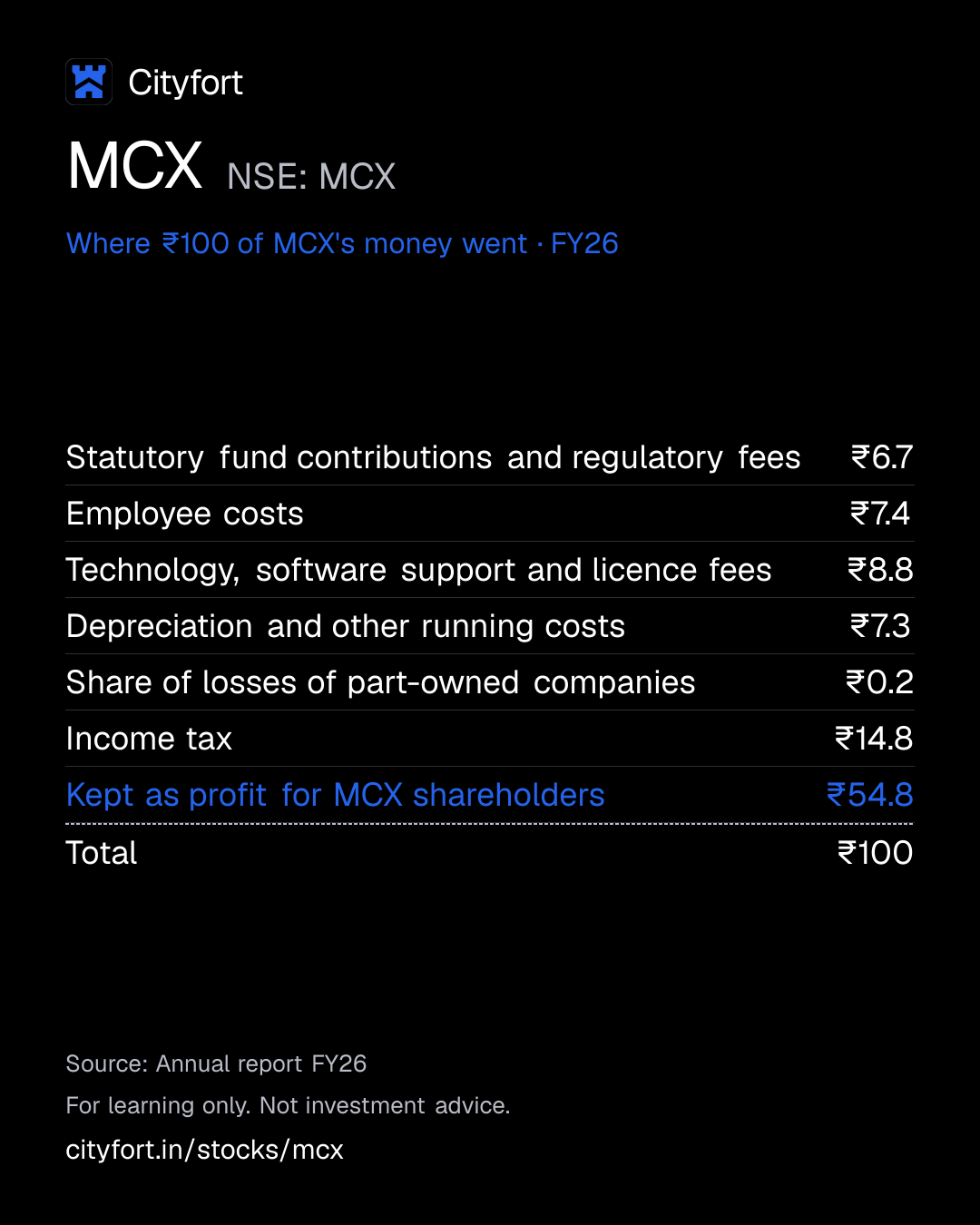
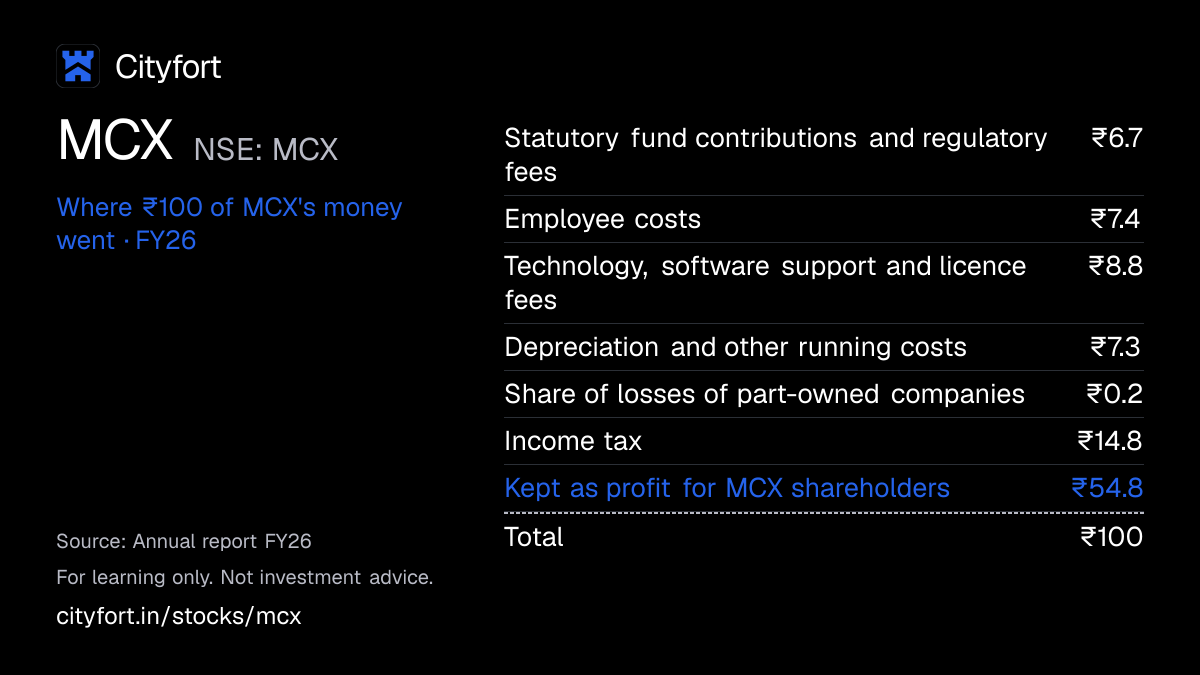
Of every ₹100 that came in during FY26, including ₹127 crore of non-operating investment and other income, MCX kept ₹54.8 as profit after ₹14.8 of tax, while its operating EBITDA was ₹71.5 per ₹100 of revenue.
4 · Where the operating profit comes from
Transaction fees rose from ₹962 crore in FY25 to ₹2,091 crore in FY26, and bullion and energy contracts made up 98.4% of MCX's average daily trading in Q2 FY27.
5 · The one thing to watch
MCX made no Core SGF contribution in Q2 FY27, against ₹32.32 crore in Q1 FY27, and its EBITDA per ₹100 of revenue was ₹76.4 in Q2 FY27, against ₹70.4 in Q1 FY27.
Sources: From MCX's FY26 annual report, its Q1 and Q2 FY27 results, its Q2 FY27 investor presentation and earnings call · checked
01Where the money goes · FY26
Where does ₹100 of MCX's money go?
MCX · FY26
Receipt for every ₹100
| Statutory fund contributions and regulatory fees | ₹6.7 |
|---|---|
| Employee costs | ₹7.4 |
| Technology, software support and licence fees | ₹8.8 |
| Depreciation and other running costs | ₹7.3 |
| Share of losses of part-owned companies | ₹0.2 |
| Income tax | ₹14.8 |
| Kept as profit for MCX shareholders | ₹54.8 |
| Total | ₹100 |
Each line = amount ÷ total money in × 100. Lines may not add to exactly ₹100 because of rounding.
How this is worked out
Of every ₹100 that came in during FY26: revenue (₹2,302 crore) and investment and other income (₹127 crore). Cityfort calculation: each line ÷ ₹2,429 crore total × 100, from the FY26 annual report (S1). Statutory fund contributions include payments into the Core Settlement Guarantee Fund.
Save this receipt as an image
Embed this receipt or the key numbers
Paste this code into a blog or website to show the card you choose, with a link back to this page.
Each week: the next company due to report results, explained in 5 points.
We'll email you once a week with what changed on Cityfort. Facts only, no tips. Unsubscribe any time.
We store your email address with Kit, our email provider, which also records when you sign up and whether you open or click our emails. We send a confirmation email first. See our privacy policy.
02The business in one line
What does MCX do?
Brokers pay MCX a fee on their clients' commodity futures and options trades; in FY26, of every ₹100 that came in, technology and licence fees took ₹8.8, tax ₹14.8, and ₹54.8 was profit.
- Transaction fees were 90.8% of MCX's FY26 revenue; interest on members' margin money held by its clearing corporation was 6.7%.
- Options carry most of the trading: in Q2 FY27, average daily options turnover (notional) was ₹1,200,129 crore, against ₹62,819 crore for futures.
03Who pays it
Who pays MCX?
Members paying transaction fees
90.8%
of revenue
Brokers (trading members) pay a fee on their clients' futures and options trades. Share is of FY26 consolidated revenue.
Interest on members' margin money
6.7%
of revenue
Interest the clearing corporation earns on the margin money members deposit to back their trades (₹154.59 crore).
Members and data users buying other services
2.5%
of revenue
Connectivity, data feeds, warehousing, membership and terminal fees, and recoveries from members (₹56.45 crore together).
- Members paying transaction fees90.8%
- Interest on members' margin money6.7%
- Members and data users buying other services2.5%
How spread out the customers are
MCX does not disclose revenue by member. Its Q2 FY27 presentation lists 613 members and 28,913 authorised persons in 652 cities and towns.
04How it makes money
How does MCX make money?
Most of MCX's costs do not rise with every trade, so extra trading adds mostly to profit.
Revenue grew 6.3 times from FY22 to FY26, from ₹367 crore to ₹2,302 crore, while employee costs grew 2.3 times. EBITDA (profit before interest, tax and depreciation, without other income) rose from ₹38.6 to ₹71.5 of every ₹100 of revenue. The CFO said the CME crude price licence fee is linked to turnover.
EBITDA per ₹100 of revenue (Cityfort calculation)
₹38.6₹71.5
FY22 to FY26
- Members' clients trade commodity futures and options on MCX.
- MCX charges a transaction fee on each trade.
- Its clearing corporation settles the trades and earns interest on members' margin money.
- Employee costs grew 2.3 times from FY22 to FY26, while revenue grew 6.3 times.
- Regulatory contributions and the crude price licence fee also grew with the business.
- What is left is profit: ₹1,332 crore in FY26.
↺ Step 6 feeds back into step 1.
05Business segments · FY26
Which businesses make up MCX?
Transaction fees
90.8%Fees on futures and options trades: ₹2,091 crore in FY26, up from ₹962 crore in FY25. MCX reports one segment, commodity exchange; these lines are its revenue note.
Revenue ₹2,091 cr
Interest on members' margin money
6.7%Interest the clearing corporation earns on members' margin money.
Revenue ₹155 cr
Other operating income
2.5%Connectivity, data feeds, warehousing, membership and terminal fees, and recoveries from members.
Revenue ₹56.5 cr
How the mix changed
- Transaction fees
- Interest on members' margin money
- Other operating income
Revenue by segment, FY25 to FY26.
₹ crore
See the numbers
06The numbers · Consolidated · ₹ crore
How has MCX done?
Revenue
₹2,302 crFY26
Revenue rose every year from ₹367 crore in FY22 to ₹2,302 crore in FY26; Q2 FY27 revenue was ₹800 crore, up 113.7% from Q2 FY26.
₹ crore
See the numbers
Net profit
₹1,332 crFY26
Profit fell to ₹83 crore in FY24, when MCX's FY24 annual report says software support charges and settlement guarantee fund contributions cut its margin, and reached ₹1,332 crore in FY26.
₹ crore
See the numbers
Net profit for every ₹100 of revenue
₹57.8FY26
EBITDA per ₹100 of revenue (Cityfort calculation, without other income) was ₹38.6 in FY22 (₹44.2 before a ₹20.43 crore impairment of a platform under development), ₹9.4 in FY24 and ₹71.5 in FY26, and ₹76.4 in Q2 FY27, a quarter with no Core SGF contribution, against ₹70.4 in Q1 FY27.
Net margin: ₹ of net profit per ₹100 of revenue
See the numbers
Free cash flow
₹2,962 crFY26
Operating cash flow moves with members' margin money: FY26's ₹3,035 crore includes a ₹1,261 crore rise in members' deposits and other current financial liabilities.
₹ crore · cash from operations minus spending on plants and equipment
See the numbers
See all yearly numbers
EBITDA = profit before interest, tax and wear-and-tear of assets. Financial year runs April to March (March year end). Net profit is the share belonging to the company's owners.
Sources (10)
- Annual Report 2021-22 (FY22)
- Annual Report 2023-24 (FY24)
- Annual Report 2024-25 (FY25)
- Integrated Annual Report 2025-26 (FY26; includes BRSR)
- Audited financial results, Q4 FY26 and FY26 (scanned)
- Unaudited financial results, Q2 FY26 (quarter ended 30 Sep 2025; scanned)
- Unaudited financial results, Q3 FY26 (quarter ended 31 Dec 2025)
- Unaudited financial results, Q1 FY27 (quarter ended 30 Jun 2026; scanned)
- Unaudited financial results, Q2 FY27 (quarter and half year ended 30 Sep 2026; scanned)
- Press release: results for Q2 FY27 and H1 FY27
07Who runs it
Who runs MCX, and did they deliver?
Praveena Rai
Managing Director & CEO · since 2024
MD & CEO from 31 Oct 2024.
Dr. Harsh Kumar Bhanwala
Chairman
Chandresh Shah
Chief Financial Officer
Manoj Jain
Executive Director, Regulatory, Compliance, Risk Management & Investor Grievance
Manisha Thakur
Company Secretary
What they said, and what happened
3 too early to tell
Said on 4 Nov 2026
No further Core SGF contribution foreseen "in coming few quarters", after SEBI's Aug 2026 circular cut the requirement (CFO Chandresh Shah, Q2 FY27 call).
Too early to tellWhat happened
Q2 FY27 had no Core SGF contribution, against ₹32.32 crore in Q1 FY27. Later quarters are not yet reported.
Said on 4 Nov 2026
Effective tax rate going forward "closer to 25%" (CFO Chandresh Shah, Q2 FY27 call).
Too early to tellWhat happened
Q2 FY27 tax was 28.9% of profit before tax (Cityfort calculation), after the clearing subsidiary re-estimated its yearly rate; the CFO said H1 FY27 was close to 25%.
Said on 5 Aug 2026
Build a coal exchange: MCX Coal Exchange of India was incorporated after regulator approval, with work "at a very early stage" (management, Q1 FY27 call).
Too early to tellWhat happened
MCX had invested ₹52.50 crore in the coal exchange subsidiary by 30 Sep 2026. No launch date has been filed.
Sources (6)
- Annual Report 2024-25 (FY25)
- Integrated Annual Report 2025-26 (FY26; includes BRSR)
- Transcript of Q2 FY27 earnings call (4 Nov 2026)
- Unaudited financial results, Q2 FY27 (quarter and half year ended 30 Sep 2026; scanned)
- Unaudited financial results, Q1 FY27 (quarter ended 30 Jun 2026; scanned)
- Transcript of Q1 FY27 earnings call (5 Aug 2026)
08What could go wrong
What could go wrong for MCX?
- Concentration
Bullion and energy make almost all the trading
Bullion was 66.9% and energy 31.5% of MCX's average daily futures and options turnover in Q2 FY27 (Cityfort calculation from the presentation). Options were ₹1,200,129 crore of the ₹1,262,948 crore daily total (notional).
Watch Turnover by commodity group in each quarterly presentation.
- Regulation
SEBI rules for commodity derivatives
MCX's FY26 annual report lists suspension or bans on derivative contracts (for example crude palm oil futures) and adverse regulatory or policy decisions among its risks. SEBI's 12 Aug 2026 circular changed Core SGF norms, and MCX made no contribution in Q2 FY27.
Watch SEBI's final circulars on FPI access to commodity derivatives, and any further change to guarantee fund norms.
- Competition
Rival exchanges with similar products
MCX's FY26 annual report lists liquidity fragmentation from near-identical products across exchanges as a business risk. On the 11 May 2026 call, management said a large competitor was focusing on commodities.
Watch MCX's futures market share in its next annual report (99.07% in FY26).
- Technology
Trading outages and technology costs
A 3-hour disruption on 28 Oct 2025 led to a ₹1 crore financial disincentive. In FY24, while its new platform was delayed, MCX's IT and related expenses were ₹385.07 crore. The FY26 annual report also lists cybersecurity threats.
Watch Exchange notices of outages, and IT expenses each quarter (₹34.63 crore in Q2 FY27).
- Pricing
Costs that grow with turnover
The CFO said on 4 Nov 2026 that the CME crude pricing licence fee is linked to turnover. Software support and licence fees rose from ₹69.42 crore in FY25 to ₹107.96 crore in FY26, and statutory fund contributions and regulatory fees from ₹79.45 crore to ₹163.73 crore.
Watch Licence fees each quarter (₹44.42 crore in Q2 FY27).
- Demand
Global market and currency risks
MCX's FY26 annual report lists geopolitical and trade risk, rupee fluctuation, a global economic slowdown and inflation among its market risks.
Watch Average daily futures turnover each quarter (₹62,819 crore in Q2 FY27).
- Legal
Tax and regulatory claims
On 31 Mar 2026 the group disputed income tax demands of ₹153.28 crore, GST demands of ₹13.41 crore and legal and regulatory claims of ₹45.79 crore. Management does not expect a material adverse effect.
Watch Contingent liabilities in the FY27 annual report.
Sources (6)
09Supporters and critics
What do supporters and critics point to?
What supporters point to
- MCX's revenue rose from ₹367 crore in FY22 to ₹2,302 crore in FY26, and EBITDA per ₹100 of revenue from ₹38.6 to ₹71.5 (Cityfort calculation).
- MCX's FY26 annual report puts its share of the commodity futures market at 99.07%, up from 98.1% in FY25.
- Clients who traded rose from 13 lakh in FY25 to 20.9 lakh in FY26, and management said 19.8 lakh traded in H1 FY27.
- Q2 FY27 revenue was 113.7% higher than in Q2 FY26, and profit 130.2% higher.
- MCX had no borrowings on 30 Sep 2026.
What critics point to
- Bullion and energy were 98.4% of MCX's average daily futures and options turnover in Q2 FY27 (Cityfort calculation).
- Profit fell to ₹83 crore in FY24, when MCX's new trading platform was delayed and it kept paying its old vendor.
- Q2 FY27 had no Core SGF contribution after SEBI's 12 Aug 2026 circular, against ₹32.32 crore in Q1 FY27.
- SEBI fined MCX ₹25 lakh in May 2025 over late disclosure of its old vendor's contract extension, and a 3-hour disruption on 28 Oct 2025 cost a ₹1 crore disincentive.
- Software support and licence fees rose from ₹69.42 crore in FY25 to ₹107.96 crore in FY26.
10What to watch next
What should you watch next at MCX?
Next event
Q3 FY27 results
Date not announced yet.
Guarantee fund contributions
MCX made no Core SGF contribution in Q2 FY27, against ₹32.32 crore in Q1 FY27. The CFO said on 4 Nov 2026 he did not foresee more in the coming few quarters.
Foreign investors
Management said on 4 Nov 2026 that about 250 FPIs were onboarded and trading energy contracts, with final SEBI circulars on wider access awaited.
Options turnover
Average daily options turnover (notional) was ₹1,200,129 crore in Q2 FY27, up from ₹989,691 crore in Q1 FY27.
11Key facts
Key facts about MCX
- What does MCX do?
- Multi Commodity Exchange of India (MCX), established in 2003 and based in Mumbai, runs an exchange for futures and options on bullion, energy, base metals and farm commodities. Its subsidiary MCX Clearing Corporation settles the trades. MCX's FY26 consolidated revenue from operations was ₹2,302 crore.
- How does MCX make money?
- MCX makes most of its money from transaction fees that members pay on trades, which were ₹2,091 crore or 90.8% of its FY26 consolidated revenue. Interest on members' margin money held by its clearing corporation was ₹155 crore (6.7%). Connectivity, data, warehousing and membership fees made up the remaining 2.5%.
- Who are MCX's customers?
- MCX's customers are its members (brokers), who pay transaction fees on their clients' trades; MCX had 613 members and 28,913 authorised persons in Q2 FY27, per its investor presentation. Clients who traded MCX futures and options rose from 13 lakh in FY25 to 20.9 lakh in FY26.
- How big is MCX?
- MCX's consolidated revenue from operations was ₹2,302 crore in FY26, up 106.9% from ₹1,113 crore in FY25, and its FY26 profit for shareholders was ₹1,332 crore. In Q2 FY27 (Jul–Sep 2026) MCX's revenue was ₹800 crore and its profit ₹455 crore.
- Who owns MCX?
- MCX has no promoter. On 30 Sep 2026 mutual funds held 33.95% of MCX, foreign portfolio investors 27.07% and resident individuals 14.33%. Kotak Mahindra Bank, filed among associates of trading members, was MCX's largest holder with 14.99%. MCX's presentation says rules let foreign exchanges, depositories, banks or insurers hold up to 15% of an exchange.
- Does MCX have debt?
- MCX had no borrowings on 30 Sep 2026, only lease liabilities of ₹9.08 crore. MCX's ₹6,236 crore of cash, bank balances and investments on that date includes margin money and deposits of members, and backs a ₹1,472 crore Core Settlement Guarantee Fund. Members' margins and other current financial liabilities were ₹1,891 crore.
- What does MCX trade most?
- In Q2 FY27, bullion contracts made up ₹844,513 crore of MCX's ₹1,262,948 crore average daily futures and options turnover (notional), and energy contracts ₹397,820 crore, according to MCX's investor presentation. Base metals were ₹20,605 crore.
- Did MCX split its shares?
- Yes. MCX split each ₹10 share into five ₹2 shares, with a record date of 2 Jan 2026, taking its share count from 50,998,369 to 254,991,845. MCX's FY26 earnings per share were ₹52.22 on the new ₹2 shares, and it declared a dividend of ₹8 per share for FY26.
Terms on this page
- Capital expenditure (capex)
- Dividend payout ratio
- EBITDA
- FII and DII holding
- Free cash flow
- Market capitalisation
- Net debt
- Net profit
- Operating margin
- Promoter holding
Each explains the term in plain English, with the same number from other companies on Cityfort.
Go deeper
More detail from the same filings. Open any section.
12What it sells
12What it sells
What does MCX sell?
Bullion futures and options
Contracts on gold and silver, including small sizes such as gold 10 grams and silver 100 grams. Bullion averaged ₹844,513 crore of turnover a day in Q2 FY27 (notional), the largest group.
Energy futures and options
Contracts on crude oil, natural gas and, since 10 Jul 2025, electricity. Energy averaged ₹397,820 crore a day in Q2 FY27, mostly options.
Base metals and farm commodities
Contracts on metals such as copper, zinc and aluminium, and a few farm products. Base metals averaged ₹20,605 crore a day in Q2 FY27; farm contracts ₹10 crore.
Clearing and settlement
Its subsidiary MCX Clearing Corporation settles trades and holds members' margin money. Interest on that money was ₹155 crore of revenue in FY26.
Connectivity, data and warehousing
Fees for connecting to the exchange (₹14.82 crore in FY26), price data feeds (₹14.88 crore) and warehouse services (₹10.70 crore).
Think of it like this
Like a toll road for commodity trades: MCX earns a fee every time a contract passes through its system, whoever wins or loses on it.
What it does
- Does: Runs trading for futures and options on bullion, energy, base metals and farm commodities
- Does: Settles trades and guarantees them through its clearing corporation
- Does: Arranges physical delivery of some contracts, such as 5.68 tonnes of gold in Q2 FY27
- Does: Earns interest on members' margin money and income on its own investments
What it does not do
- Does not: Buy or sell commodities for itself: it only runs the marketplace
- Does not: Have a promoter or parent company: its shares are spread among funds, banks and individuals
- Does not: Have borrowings: it had none on 30 Sep 2026
- Does not: Count interest on its own investments as revenue: that ₹127 crore of other income in FY26 is shown separately
13How the money flows
13How the money flows · FY26
How does money flow through MCX?
Money in
- Revenue from operations₹2,302 cr
- Investment and other income₹127 cr
The company
MCX
₹2,429 cr came in
Money out
- Statutory fund contributions and regulatory fees₹164 cr
- Employee costs₹180 cr
- Technology, software support and licence fees₹213 cr
- Depreciation and other running costs₹177 cr
- Share of losses of part-owned companies₹4.9 cr
- Income tax₹359 cr
- Net profit for MCX shareholders₹1,332 cr
- In FY26 MCX brought in ₹2,302 crore of revenue, mostly transaction fees on trades.
- It also earned ₹127 crore of investment and other income.
- Technology, software support and licence fees took ₹213 crore, employees ₹180 crore, and contributions to statutory funds and regulatory fees ₹164 crore.
- Depreciation and other running costs took ₹177 crore, part-owned companies' losses ₹5 crore and income tax ₹359 crore.
- What was left for MCX's shareholders was ₹1,332 crore of profit.
14What it needs to run
14What it needs to run
What does MCX need to run?
Trading technology
MCX moved to a new trading platform built by TCS on 16 Oct 2023. IT expenses were ₹104.74 crore in FY26, and management said on 4 Nov 2026 it had nearly doubled capacity in recent months.
Price licences
Software support and product licence fees were ₹107.96 crore in FY26. The CFO said on 4 Nov 2026 that the licence fee for crude oil pricing from CME is linked to MCX's turnover.
SEBI recognition and contributions
MCX is a SEBI-regulated market infrastructure institution. Contributions to statutory funds and regulatory fees were ₹163.73 crore in FY26.
A clearing corporation and guarantee fund
MCX Clearing Corporation settles trades. A Core Settlement Guarantee Fund of ₹1,472 crore on 30 Sep 2026 covers losses if a member fails to pay.
People
The exchange (standalone) had 468 employees on 31 Mar 2026; employee costs for the group were ₹180.11 crore in FY26.
15Where growth could come from
15Where growth could come from
Where could MCX's growth come from?
On the 4 Nov 2026 call, CFO Chandresh Shah said MCX did not foresee further Core SGF contributions "in coming few quarters", after SEBI's Aug 2026 circular. He said the effective tax rate going forward would be "closer to 25%".
Commodity options
Working₹1,200,129 crore a day in Q2 FY27, from ₹369,512 crore
Average daily options turnover (notional) more than tripled from Q2 FY26 to Q2 FY27, per MCX's presentation. Options premium turnover rose from ₹4,096 crore to ₹10,291 crore a day.
Status: Working, on track against what the company said.
More clients trading
Working20.9 lakh traded clients in FY26, from 13 lakh
Management said on 4 Nov 2026 that 19.8 lakh clients had traded in H1 FY27, close to the full FY26 figure.
Status: Working, on track against what the company said.
Electricity futures
EarlyAbout ₹37 crore a day in Q1 FY27
Launched on 10 Jul 2025. The MD & CEO said on 5 Aug 2026 that MCX had about 55% of electricity futures daily turnover in Q1 FY27.
Status: Early, too early to judge.
Foreign portfolio investors
EarlyAbout 250 FPIs onboarded, Nov 2026
Management said on 4 Nov 2026 that about 250 FPIs were onboarded and trading the cash-settled energy contracts they are allowed in, while final SEBI circulars are awaited.
Status: Early, too early to judge.
Coal exchange
New₹52.50 crore invested by 30 Sep 2026
MCX Coal Exchange of India was incorporated on 11 Jun 2026 after regulator approval. Management called the work "at a very early stage" on 5 Aug 2026.
Status: New, recently announced.
Status compares progress with what the company itself said it would do: Working = on track against what the company said; Mixed = partly on track; Behind = behind the company's own plan; New = recently announced; Early = too early to judge.
Sources (6)
- Transcript of Q2 FY27 earnings call (4 Nov 2026)
- Investor presentation Q2 FY27
- Integrated Annual Report 2025-26 (FY26; includes BRSR)
- Transcript of Q1 FY27 earnings call (5 Aug 2026)
- Unaudited financial results, Q1 FY27 (quarter ended 30 Jun 2026; scanned)
- Unaudited financial results, Q2 FY27 (quarter and half year ended 30 Sep 2026; scanned)
16Financial strength and debt
16Financial strength · 30 Sep 2026
How much debt does MCX have?
- Total debt₹0 cr
- Cash and investments₹6,236 cr
- Net cash (cash minus debt)₹6,236 cr
- Net worth (shareholders' money)₹3,512 cr
- Debt to equity
- 0×
- ₹ of debt for every ₹1 of shareholders' money
- Cash and investments = cash, other bank balances, current investments and non-current investments (Cityfort calculation from the Q2 FY27 results). It is not free cash: it includes money members deposit as margin and deposits held by the clearing corporation.
- On 30 Sep 2026 MCX owed ₹1,891 crore of other current financial liabilities, which include members' margins and deposits; on 31 Mar 2026 the figure was ₹2,459 crore.
- The Core Settlement Guarantee Fund (₹1,472 crore), a fund that covers losses if a member fails to pay, is shown outside shareholders' equity.
- Lease liabilities were ₹9.08 crore, the only debt-like item. MCX's FY26 annual report says it has no secured loans.
- Contingent liabilities on 31 Mar 2026 (claims the group disputes) were income tax ₹153.28 crore, GST ₹13.41 crore and legal and regulatory matters ₹45.79 crore. Management does not expect a material adverse effect.
17Who owns it
17Who owns it · Q2 FY27
Who owns MCX?
- Foreign institutions (FII)27.1%
- Indian institutions (DII)34.0%
- Public24.0%
- Kotak Mahindra Bank (filed among associates of trading members)15.0%
No promoter
MCX reports no promoter group in Q2 FY27: no founder family or parent company is filed as controlling it, so there are no promoter shares to pledge.
How ownership changed
* Others = Kotak Mahindra Bank (filed among associates of trading members).
Sources (12)
- Shareholding pattern (SECC Reg. 31 format) as on 2026-09-30
- Shareholding pattern (SECC Reg. 31 format) as on 2026-06-30
- Shareholding pattern (SECC Reg. 31 format) as on 2026-03-31
- Shareholding pattern (SECC Reg. 31 format) as on 2025-12-31
- Shareholding pattern (SECC Reg. 31 format) as on 2025-09-30
- Shareholding pattern (SECC Reg. 31 format) as on 2025-06-30
- Shareholding pattern (SECC Reg. 31 format) as on 2025-03-31
- Shareholding pattern (SECC Reg. 31 format) as on 2024-12-31
- Shareholding pattern (SECC Reg. 31 format) as on 2024-06-30
- Shareholding pattern (SECC Reg. 31 format) as on 2024-03-31
- Shareholding pattern (SECC Reg. 31 format) as on 2023-12-31
- Investor presentation Q2 FY27
18What it does with profit
18What it does with profit
What does MCX do with its profit?
Dividend per share
₹8.00FY26
Dividend paid for each share, by financial year.
₹ per share
See the numbers
No buybacks or fund raises in the period covered.
19Governance signals
19Governance signals
What do MCX's governance filings show?
- Auditor
- V. Sankar Aiyar & Co., since 2025
- Auditor changes
- 12 Sep 2025: Shah Gupta & Co. → V. Sankar Aiyar & Co. (Shah Gupta & Co.'s five-year term ended at the 23rd AGM. The board approved V. Sankar Aiyar & Co. on 8 May 2025 for five years from that AGM, subject to shareholders' approval.)
- Audit qualifications
- None reported
- Related-party dealings
- MCX's FY26 annual report says all related-party transactions in FY26 were in the ordinary course of business and at arm's length, and were approved by the audit committee. MCX has no promoter group; its related parties are mainly its subsidiaries and associates.
- Credit rating
- No public credit rating found
Flags to know about
regulatory · 4 Jan 2023
SEBI order of Jan 2023, ₹2 lakh (paid after appeal)
SEBI's order of 4 Jan 2023 imposed a ₹2 lakh penalty on MCX for indirectly engaging in unrelated or non-incidental activity, allegedly in violation of the SECC Regulations. The Securities Appellate Tribunal dismissed MCX's appeal on 5 Dec 2024, and MCX paid on 27 Dec 2024.
regulatory · 28 Feb 2023
SEBI order of Feb 2023, ₹6 lakh (paid)
SEBI's order of 28 Feb 2023 imposed a ₹6 lakh penalty on MCX for alleged violations: no systems to verify Sikkim-based clients exempt from PAN, and penalties levied by the MD & CEO when, under SEBI's terms, the core settlement guarantee fund committee should have levied them. A special audit found no mala fide intent by management. MCX paid on 12 Apr 2023.
regulatory · 25 Jan 2024
RBI compounding fee, ₹4.50 lakh
MCX paid a ₹4.50 lakh compounding fee to RBI under an order of 25 Jan 2024. It had sold 500 shares of the Dubai Gold Exchange in 2018 without the RBI's prior approval required under FEMA rules.
regulatory · 1 Apr 2025
SEBI settlement by the clearing subsidiary, ₹2.70 crore
SEBI passed a settlement order on 1 Apr 2025 on MCX Clearing Corporation's own (suo motu) settlement application over the alleged violation of a 2016 SEBI circular on additional risk management norms. It settled without admitting or denying the findings of fact and conclusions of law and paid ₹2.70 crore; the company said there was no material impact on operations.
regulatory · 26 May 2025
SEBI order of May 2025, ₹25 lakh (paid)
On a 2023 show-cause notice about SEBI's outsourcing circular, SEBI's order of 26 May 2025 dropped the allegations against three past and one current key managers. It held only MCX liable, for not making timely disclosure of the extension of its old technology vendor's software services (Oct 2022–Jun 2023), and imposed ₹25 lakh, which MCX paid.
regulatory · 23 Jan 2026
Market disruption and financial disincentives
MCX's FY26 consolidated financial statements say a business disruption on 28 Oct 2025 was restored after 3 hours. Under a SEBI master circular, MCX paid a ₹1 crore financial disincentive on 23 Jan 2026, and MCX Clearing Corporation put ₹1.50 crore into its settlement guarantee fund corpus for disruptions on 29 Oct 2025, 23 Dec 2025 and 28 Jan 2026. The report's corporate governance section mentions a ₹50 lakh deposit by MCX Clearing Corporation for one technical glitch.
other
ROC compounding over a late dividend deposit
The FY22 dividend was deposited in a separate bank account on 3 Oct 2022 instead of 2 Oct 2022, a national holiday. The Registrar of Companies levied ₹11,000 each on MCX, its MD & CEO, CFO and company secretary, paid in Oct 2024.
disclosure · 30 Sep 2026
Shareholding is filed in the exchange format
MCX files its shareholding pattern in the format of SEBI's stock exchange regulations: trading members, their associates and the public. Here, foreign institutions are FPIs, Indian institutions are mutual funds only, and Kotak Mahindra Bank (14.99%, filed among associates of trading members) is shown on its own; insurers, other institutions, companies and individuals are in public. Cityfort calculation from the filed share counts. The Sep 2024 pattern could not be read and is left out.
disclosure · 2 Jan 2026
1:5 split changes per-share figures
MCX split each ₹10 share into five ₹2 shares (record date 2 Jan 2026). FY22–FY24 and Q2 FY25 earnings per share are shown per ₹2 share: Cityfort calculation, as filed ÷ 5 (FY24: ₹16.30 → ₹3.26). FY25's ₹21.96 is as restated in the FY26 annual report (₹109.82 as first filed).
disclosure · 26 Aug 2026
MCX's own EBITDA includes other income
MCX's FY26 annual report gives EBITDA of ₹1,773.63 crore, 73.0% of total income, including other income. This page uses Cityfort's calculation without other income: ₹1,646.58 crore, 71.5% of revenue.
disclosure
Result filings are scanned images
MCX's quarterly result filings checked for this page are scanned images with no text layer, and no machine-readable results were found on the exchanges. Figures were read from the page images and checked by row totals.
disclosure
No credit rating
No credit rating was found for MCX; its FY26 annual report says it has no secured loans, and it had no borrowings on 30 Sep 2026.
Sources (8)
- Integrated Annual Report 2025-26 (FY26; includes BRSR)
- Annual Report 2024-25 (FY25)
- Shareholding pattern (SECC Reg. 31 format) as on 2026-09-30
- Investor presentation Q2 FY27
- Unaudited financial results, Q2 FY26 (quarter ended 30 Sep 2025; scanned)
- Unaudited financial results, Q2 FY27 (quarter and half year ended 30 Sep 2026; scanned)
- Unaudited financial results, Q1 FY27 (quarter ended 30 Jun 2026; scanned)
- Audited financial results, Q4 FY26 and FY26 (scanned)
20What the market paid
20What the market paid · price as of 11 Nov 2026
What did the market pay for MCX on 11 Nov 2026?
Price as of 11 Nov 2026 (shown for education; prices change daily).
MCX's shares closed at ₹3,628.50 on BSE on 11 Nov 2026 (price as of 11 Nov 2026). Market value = that price × 254,991,845 shares (30 Sep 2026 shareholding pattern) = ₹92,524 crore, a Cityfort calculation. P/E is the price divided by earnings per share of the last four quarters (Q3 FY26–Q2 FY27, ₹70.55): 51.4 as of 11 Nov 2026, also a Cityfort calculation. It shows how many rupees buyers paid for each rupee of yearly profit on that date. P/B is market value ÷ shareholders' equity of ₹3,511.96 crore on 30 Sep 2026: 26.3 as of 11 Nov 2026 (Cityfort calculation).
- Share price
- ₹3,628.50
- Market value (market cap)
- ₹92,524 cr
- P/E
- 51.4×
- P/B
- 26.3×
Source: BSE equity bhavcopy, 11 Nov 2026 (MCX, scrip 534091); Shareholding pattern (SECC Reg. 31 format) as on 2026-09-30; Unaudited financial results, Q2 FY27 (quarter and half year ended 30 Sep 2026; scanned) and 2 more
Sources (5)
- BSE equity bhavcopy, 11 Nov 2026 (MCX, scrip 534091)
- Shareholding pattern (SECC Reg. 31 format) as on 2026-09-30
- Unaudited financial results, Q2 FY27 (quarter and half year ended 30 Sep 2026; scanned)
- Unaudited financial results, Q1 FY27 (quarter ended 30 Jun 2026; scanned)
- Audited financial results, Q4 FY26 and FY26 (scanned)
21How it got here
21How it got here
How did MCX get here?
2003
Milestone
Trading begins
MCX was incorporated in 2002 and began operations on 10 Nov 2003, its FY26 annual report says.
2018
Milestone
Own clearing corporation
MCX Clearing Corporation, incorporated on 1 Aug 2008, began operations on 3 Sep 2018 and clears MCX's trades.
2023
Crisis
New trading platform, a year late
TCS was to deliver MCX's new platform by 30 Sep 2022. MCX paid its old vendor, 63 Moons, to keep running trading: ₹60 crore for Oct–Dec 2022 and ₹81 crore a quarter to Jun 2023 (plus taxes), then ₹125 crore a quarter from 1 Jul 2023, until the new platform went live on 16 Oct 2023.
2024
Milestone
New MD & CEO
Praveena Rai became MD & CEO on 31 Oct 2024.
2025
Milestone
Electricity futures
MCX launched electricity futures on 10 Jul 2025, which it calls India's first exchange-traded electricity derivative.
2026
Milestone
1:5 share split
Each ₹10 share became five ₹2 shares (record date 2 Jan 2026), taking the share count to 254,991,845.
2026
Business-model change
Coal exchange subsidiary
MCX Coal Exchange of India was incorporated on 11 Jun 2026 after regulator approval; MCX had invested ₹52.50 crore in it by 30 Sep 2026.
2026
Milestone
SEBI changes guarantee fund norms
SEBI's 12 Aug 2026 circular revised minimum Core SGF norms, and MCX made no Core SGF contribution in Q2 FY27.
Sources (6)
- Integrated Annual Report 2025-26 (FY26; includes BRSR)
- Annual Report 2023-24 (FY24)
- Annual Report 2024-25 (FY25)
- Shareholding pattern (SECC Reg. 31 format) as on 2026-09-30
- Unaudited financial results, Q1 FY27 (quarter ended 30 Jun 2026; scanned)
- Unaudited financial results, Q2 FY27 (quarter and half year ended 30 Sep 2026; scanned)
22Sources and changes
Where every number on this page comes from
Sources (27 documents)
- S1Integrated Annual Report 2025-26 (FY26; includes BRSR) · Multi Commodity Exchange of India Ltd (company IR site; filed with BSE) · Tier 1: company or exchange filing · 26 Aug 2026
- S2Annual Report 2024-25 (FY25) · Multi Commodity Exchange of India Ltd (company IR site; filed with BSE) · Tier 1: company or exchange filing · 20 Aug 2025
- S3Annual Report 2023-24 (FY24) · Multi Commodity Exchange of India Ltd (company IR site; filed with BSE) · Tier 1: company or exchange filing · 3 Sep 2024
- S4Annual Report 2022-23 (FY23; financial statements are scanned images) · Multi Commodity Exchange of India Ltd (company IR site; filed with BSE) · Tier 1: company or exchange filing · 2 Sep 2023
- S5Annual Report 2021-22 (FY22) · Multi Commodity Exchange of India Ltd (company IR site; filed with BSE) · Tier 1: company or exchange filing · 2 Sep 2022
- S6Unaudited financial results, Q2 FY27 (quarter and half year ended 30 Sep 2026; scanned) · Multi Commodity Exchange of India Ltd (company IR site; filed with BSE) · Tier 1: company or exchange filing · 3 Nov 2026
- S7Unaudited financial results, Q1 FY27 (quarter ended 30 Jun 2026; scanned) · Multi Commodity Exchange of India Ltd (company IR site; filed with BSE) · Tier 1: company or exchange filing · 4 Aug 2026
- S8Audited financial results, Q4 FY26 and FY26 (scanned) · Multi Commodity Exchange of India Ltd (company IR site; filed with BSE) · Tier 1: company or exchange filing · 8 May 2026
- S9Unaudited financial results, Q3 FY26 (quarter ended 31 Dec 2025) · Multi Commodity Exchange of India Ltd (company IR site; filed with BSE) · Tier 1: company or exchange filing · 23 Jan 2026
- S10Unaudited financial results, Q2 FY26 (quarter ended 30 Sep 2025; scanned) · Multi Commodity Exchange of India Ltd (company IR site; filed with BSE) · Tier 1: company or exchange filing · 6 Nov 2025
- S11Press release: results for Q2 FY27 and H1 FY27 · Multi Commodity Exchange of India Ltd (company IR site; filed with BSE) · Tier 1: company or exchange filing · 3 Nov 2026
- S12Investor presentation Q2 FY27 · Multi Commodity Exchange of India Ltd (company IR site; filed with BSE) · Tier 1: company or exchange filing · 4 Nov 2026
- S13Transcript of Q2 FY27 earnings call (4 Nov 2026) · Multi Commodity Exchange of India Ltd (company IR site; filed with BSE) · Tier 1: company or exchange filing · 11 Nov 2026
- S14Transcript of Q1 FY27 earnings call (5 Aug 2026) · Multi Commodity Exchange of India Ltd (company IR site; filed with BSE) · Tier 1: company or exchange filing · 11 Aug 2026
- S15Transcript of Q4 FY26 earnings call (11 May 2026) · Multi Commodity Exchange of India Ltd (company IR site; filed with BSE) · Tier 1: company or exchange filing · 18 May 2026
- S17Shareholding pattern (SECC Reg. 31 format) as on 2026-09-30 · Multi Commodity Exchange of India Ltd (company IR site; filed with BSE) · Tier 1: company or exchange filing · 15 Oct 2026
- S18Shareholding pattern (SECC Reg. 31 format) as on 2026-06-30 · Multi Commodity Exchange of India Ltd (company IR site; filed with BSE) · Tier 1: company or exchange filing · 15 Jul 2026
- S19Shareholding pattern (SECC Reg. 31 format) as on 2026-03-31 · Multi Commodity Exchange of India Ltd (company IR site; filed with BSE) · Tier 1: company or exchange filing · 15 Apr 2026
- S20Shareholding pattern (SECC Reg. 31 format) as on 2025-12-31 · Multi Commodity Exchange of India Ltd (company IR site; filed with BSE) · Tier 1: company or exchange filing · 14 Jan 2026
- S21Shareholding pattern (SECC Reg. 31 format) as on 2025-09-30 · Multi Commodity Exchange of India Ltd (company IR site; filed with BSE) · Tier 1: company or exchange filing · 15 Oct 2025
- S22Shareholding pattern (SECC Reg. 31 format) as on 2025-06-30 · Multi Commodity Exchange of India Ltd (company IR site; filed with BSE) · Tier 1: company or exchange filing · 15 Jul 2025
- S23Shareholding pattern (SECC Reg. 31 format) as on 2025-03-31 · Multi Commodity Exchange of India Ltd (company IR site; filed with BSE) · Tier 1: company or exchange filing · 15 Apr 2025
- S24Shareholding pattern (SECC Reg. 31 format) as on 2024-12-31 · Multi Commodity Exchange of India Ltd (company IR site; filed with BSE) · Tier 1: company or exchange filing · 15 Jan 2025
- S25Shareholding pattern (SECC Reg. 31 format) as on 2024-06-30 · Multi Commodity Exchange of India Ltd (company IR site; filed with BSE) · Tier 1: company or exchange filing · 15 Jul 2024
- S26Shareholding pattern (SECC Reg. 31 format) as on 2024-03-31 · Multi Commodity Exchange of India Ltd (company IR site; filed with BSE) · Tier 1: company or exchange filing · 15 Apr 2024
- S27Shareholding pattern (SECC Reg. 31 format) as on 2023-12-31 · Multi Commodity Exchange of India Ltd (company IR site; filed with BSE) · Tier 1: company or exchange filing · 23 Jan 2024
- S28BSE equity bhavcopy, 11 Nov 2026 (MCX, scrip 534091) · BSE Ltd · Tier 1: company or exchange filing · 11 Nov 2026
Changes to this page (v1 · 12 Nov 2026)
- v1 · 12 Nov 2026First version. (first version)
Numbers come only from tier 1 and tier 2 sources. Read how we research.
Disclaimer
For learning only. Cityfort is not a SEBI-registered adviser and does not recommend buying or selling any security. Prices shown are dated and may be out of date.
Investing in securities involves risk, including loss of capital. Before making any investment decision, do your own research and consider consulting a SEBI-registered investment adviser.
Cityfort, its owners and contributors may or may not hold securities of companies covered. Content is not an offer or solicitation to buy or sell any security.
Read the full disclaimerHide the full disclaimer
Cityfort publishes educational content that explains how listed companies work. Cityfort is not registered with the Securities and Exchange Board of India (SEBI) as an Investment Adviser or Research Analyst and does not provide investment advice, recommendations, ratings, price targets or any opinion on whether to buy, sell or hold any security.
All information is taken from publicly available sources, mainly company filings on BSE and NSE, which are listed on each page with dates. We work to keep it accurate and correct errors publicly, but we do not guarantee that it is complete, accurate or up to date. Any market price or price-based ratio shown is dated, may be out of date by the time you read it, and is included only to explain concepts.
Statements by company management are reported as statements, with their date and source; they are not our forecasts.