Financial Services · NSE: PAYTM · BSE: 543396
Paytm: how the business works
Paytm runs a payments app, gives shops Soundbox speakers and card machines on subscription, and sells loans made by partner lenders; FY26 revenue was ₹8,437 crore.
Follow Paytm
Email me when Paytm's page is updated after results.
We store your email address with Kit, our email provider, which also records when you sign up and whether you open or click our emails. We send a confirmation email first. See our privacy policy.
One 97 Communications Limited · Noida, Uttar Pradesh · Founded 2000
Updated for Q2 FY27 · checked
- Revenue, FY26
- ₹8,437 cr
- Profit to shareholders, FY26
- ₹553 cr
- Subscription merchants (devices), 30 Sep 2026
- 1.64 crore
- Incorporated
- 2000
- Promoter holding, Sep 2026
- None (no promoter)
The short version
Paytm in 5 points
1 · What it sells
Paytm's payment services, from its app to shop devices and payment gateways, brought in 55.1% of FY26 revenue, and distributing loans, insurance and investments 30.7%, on total FY26 revenue of ₹8,437 crore.
2 · Who pays it
In FY26 shops and app users paid 55.1% of Paytm's revenue for payment services, lenders, insurers and investors 30.7% for financial services, marketing-services buyers 11.3%, and other operating revenue made up 2.9%.
3 · What it keeps from ₹100
Of every ₹100 that came in during FY26, Paytm kept ₹5.9 as profit, but ₹9.2 of that ₹100 was other income, and its FY26 EBITDA was ₹316 crore (₹502 crore before one-off items, Cityfort calculation).
4 · Where the operating profit comes from
Paytm reports a single business segment with no profit by revenue line, and its FY26 EBITDA of ₹316 crore (₹502 crore before one-off items, Cityfort calculation) was smaller than its ₹854 crore of other income.
5 · The one thing to watch
Financial services revenue was ₹912 crore in Q2 FY27, up 49% from a year earlier, and Paytm said on 26 Oct 2026 that default loss guarantee costs "will increase materially from Q3 FY 2027".
Sources: From Paytm's FY26 annual report and its Q2 FY27 results and earnings release · checked
01Where the money goes · FY26
Where does ₹100 of Paytm's money go?
Paytm · FY26
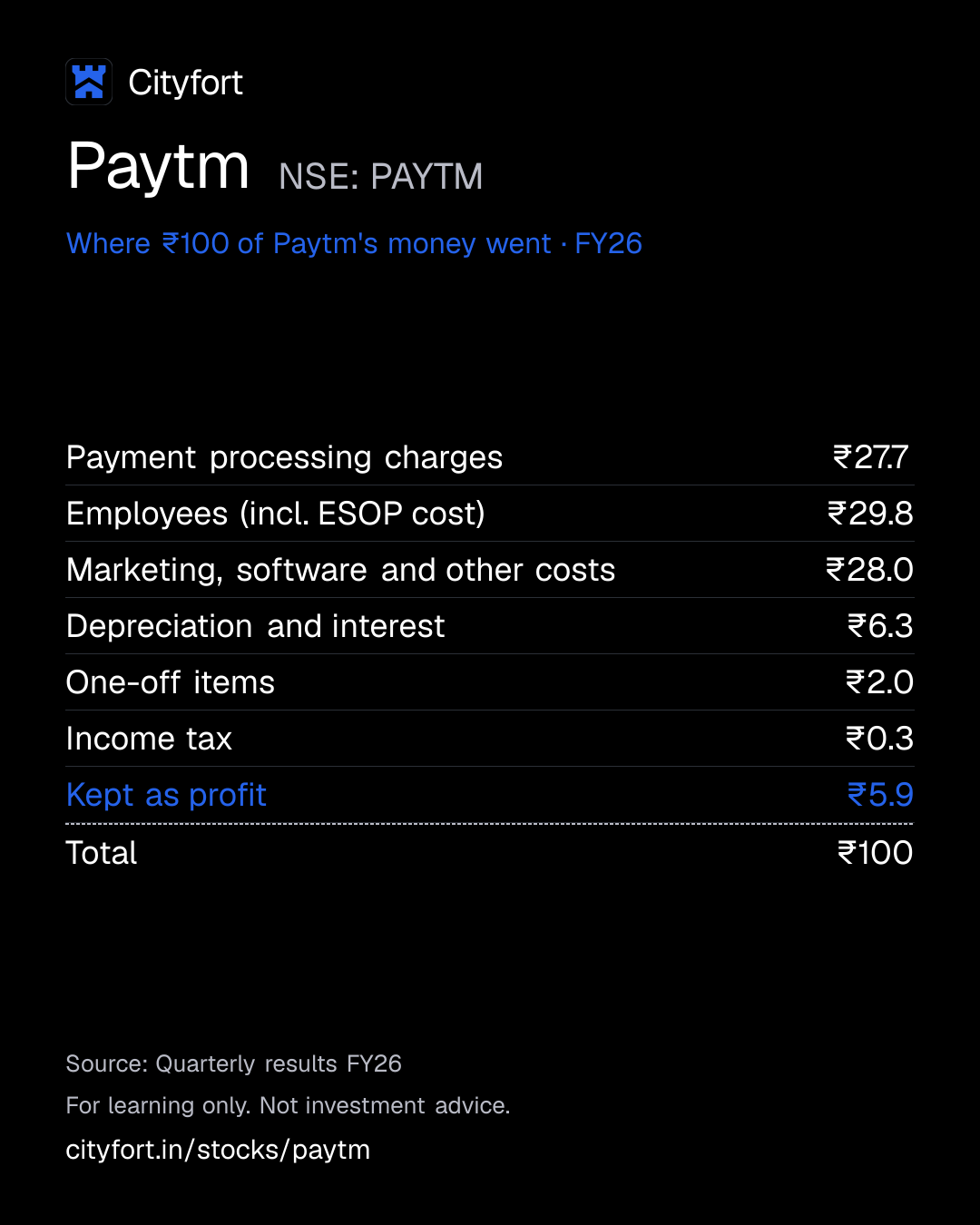
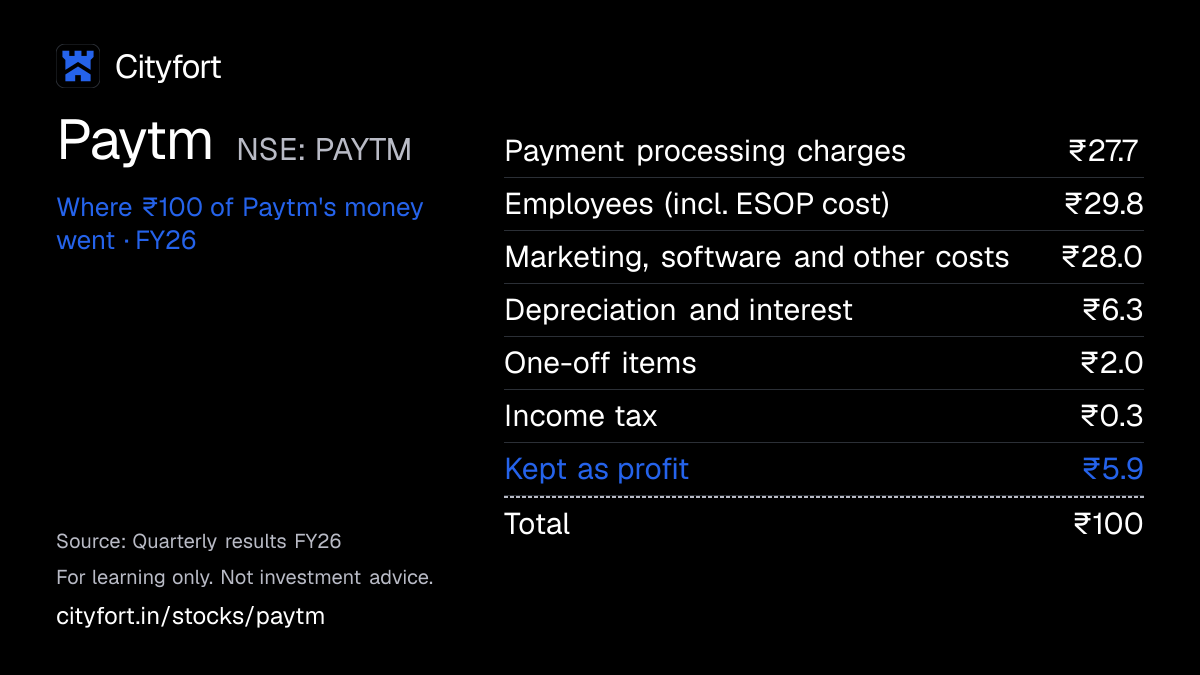
Receipt for every ₹100
| Payment processing charges | ₹27.7 |
|---|---|
| Employees (incl. ESOP cost) | ₹29.8 |
| Marketing, software and other costs | ₹28.0 |
| Depreciation and interest | ₹6.3 |
| One-off items | ₹2.0 |
| Income tax | ₹0.3 |
| Kept as profit | ₹5.9 |
| Total | ₹100 |
Each line = amount ÷ total money in × 100. Lines may not add to exactly ₹100 because of rounding.
How this is worked out
Cityfort calculation from the FY26 annual report: each line ÷ total money in (revenue of ₹8,437 crore plus ₹854 crore of other income = ₹9,291 crore) × 100. Other income was ₹9.2 of every ₹100 that came in. One-off items = net exceptional items (−₹186 crore) and share of associates (−₹2 crore).
Save this receipt as an image
Embed this receipt or the key numbers
Paste this code into a blog or website to show the card you choose, with a link back to this page.
Each week: the next company due to report results, explained in 5 points.
We'll email you once a week with what changed on Cityfort. Facts only, no tips. Unsubscribe any time.
We store your email address with Kit, our email provider, which also records when you sign up and whether you open or click our emails. We send a confirmation email first. See our privacy policy.
02The business in one line
What does Paytm do?
Shops, app users and partner lenders pay Paytm for payments and for selling loans and other financial products; payment processing charges and staff took ₹57.5 of every ₹100 that came in during FY26, and ₹5.9 was left as profit.
- Payment services were 55.1% of Paytm's FY26 revenue, financial services distribution 30.7%, marketing services 11.3% and other operating revenue 2.9% (Cityfort calculation).
- Paytm does not lend from its own balance sheet: partner lenders approve and hold the loans, and Paytm earns for finding borrowers, collections and technology.
03Who pays it
Who pays Paytm?
Shops, online businesses and app users (payment services)
55.1%
of revenue
Merchants pay device subscriptions and payment processing fees; the line also covers payment services for consumers. ₹4,646 crore in FY26.
Lenders, insurers and investors (financial services distribution)
30.7%
of revenue
Banks and finance companies pay for finding borrowers and collecting loans; the line also holds insurance, mutual fund and broking income. ₹2,594 crore in FY26.
Advertisers and ticket and deal buyers (marketing services)
11.3%
of revenue
Advertising, travel ticketing, deals and gift vouchers, and credit card distribution for merchants. ₹952 crore in FY26.
Other operating revenue
2.9%
of revenue
Incentive income and other items, ₹245 crore in FY26. The company says Q2 FY26 included Payments Infrastructure Development Fund (PIDF) incentives, received until Dec 2025.
- Shops, online businesses and app users (payment services)55.1%
- Lenders, insurers and investors (financial services distribution)30.7%
- Advertisers and ticket and deal buyers (marketing services)11.3%
- Other operating revenue2.9%
How spread out the customers are
Paytm does not disclose revenue from its largest customers. It reported 5.2 crore registered merchants on 30 Sep 2026 and 8.5 crore average monthly transacting users in Q2 FY27 (company measures).
04How it makes money
How does Paytm make money?
Payments bring shops and users to Paytm; it earns more by selling them loans and other financial products.
Paytm describes its model as winning customers through payments and earning from financial services. Financial services distribution rose from 20.1% of revenue in FY24 to 30.7% in FY26 (Cityfort calculation). Partner lenders hold the loans, so Paytm needs little capital for them.
Financial services distribution as a share of revenue (Cityfort calculation)
20.1%30.7%
FY24 to FY26
- Shops take a Soundbox or card machine on subscription: 1.64 crore did by 30 Sep 2026.
- Shops and app users pay through Paytm: GMV was ₹710,000 crore in Q2 FY27 (company measure, Cityfort conversion to crore).
- Daily payments show Paytm which merchants and users could take loans, the company says.
- Partner lenders make the loans; Paytm earns for distribution and collections.
- Financial services revenue was ₹912 crore in Q2 FY27, up 49% from Q2 FY26.
- Indirect expenses fell from 52% of revenue in Q2 FY26 to 46% in Q2 FY27 (company figures).
↺ Step 6 feeds back into step 1.
05Business segments · FY26
Which businesses make up Paytm?
Payment Services
55.1%Paytm reports one business segment; these are its revenue lines. Payments for shops and consumers. Up to FY23 this was reported as "payments to consumers" and "payments to merchants" (old categories).
Revenue ₹4,646 cr
Distribution of Financial Services
30.7%Loan, insurance, mutual fund and broking distribution; ₹912 crore in Q2 FY27. Called "Financial Services and others" in the FY26 annual report; up to FY23 it sat in "others (including financial services)".
Revenue ₹2,594 cr
Marketing Services
11.3%Ticketing, deals, gift vouchers, advertising and merchant credit card distribution. Movie and event ticketing left in Aug 2024. Up to FY23 the line was "commerce and cloud" (old categories).
Revenue ₹952 cr
Other operating revenue
2.9%Incentive income and other items; ₹15 crore in Q2 FY27.
Revenue ₹245 cr
How the mix changed
- Payment Services
- Distribution of Financial Services
- Marketing Services
- Other operating revenue
Revenue by segment, FY24 to FY26.
₹ crore
See the numbers
Sources (7)
- Annual Report FY25 (2024-25), incl. consolidated financial statements (INR million)
- Annual Report FY26 (2025-26), incl. consolidated financial statements (INR crore)
- Outcome of board meeting 26 Oct 2026: Q2 FY27 results, PCTL investment, NPCI MDR update, DLG update
- Annual Report FY23 (2022-23), incl. consolidated financial statements (INR million)
- Earnings Release Q2 FY27
- Outcome of board meeting: sale of entertainment ticketing business to Zomato Ltd for Rs 2,048 crore
- Annual Report FY24 (2023-24), incl. consolidated financial statements (INR million)
06The numbers · Consolidated · ₹ crore
How has Paytm done?
Revenue
₹8,437 crFY26
Revenue rose from ₹4,974 crore in FY22 to ₹9,978 crore in FY24, fell 30.8% to ₹6,900 crore in FY25, the first full year after the RBI's curbs on Paytm Payments Bank took effect in Mar 2024, and reached ₹8,437 crore in FY26.
₹ crore
See the numbers
Net profit
₹553 crFY26
Paytm lost money each year from FY22 to FY25 and earned ₹553 crore in FY26; FY25 includes a ₹1,345 crore gain on selling its ticketing business, booked in Q2 FY25, and a ₹492 crore charge for the founder's cancelled ESOPs.
₹ crore
See the numbers
Net profit for every ₹100 of revenue
₹6.6FY26
EBITDA was −47.1% of revenue in FY22 and 3.7% in FY26 (Cityfort calculation on reported profit before tax, after exceptional items); before FY26's −₹186 crore of exceptional items, mainly a ₹190 crore impairment of a loan to a joint venture, it was ₹502 crore or 5.9% (Cityfort calculation), equal to the company's own EBITDA.
Net margin: ₹ of net profit per ₹100 of revenue
See the numbers
Free cash flow
−₹1,222 crFY26
FY26 operating cash flow was −₹743 crore despite a ₹553 crore profit; that figure includes −₹1,992 crore from the change in escrow balances held for merchants, and free cash flow was −₹1,222 crore.
₹ crore · cash from operations minus spending on plants and equipment
See the numbers
See all yearly numbers
EBITDA = profit before interest, tax and wear-and-tear of assets. Financial year runs April to March (March year end). Net profit is the share belonging to the company's owners.
Sources (18)
- Annual Report FY23 (2022-23), incl. consolidated financial statements (INR million)
- Q4 FY22 and FY22 audited consolidated financial results, XBRL
- Annual Report FY24 (2023-24), incl. consolidated financial statements (INR million)
- Q4 FY23 and FY23 audited consolidated financial results, XBRL
- Annual Report FY25 (2024-25), incl. consolidated financial statements (INR million)
- Q4 FY24 and FY24 audited consolidated financial results, XBRL
- Annual Report FY26 (2025-26), incl. consolidated financial statements (INR crore)
- Q4 FY25 and FY25 audited consolidated financial results, XBRL (integrated filing)
- Q4 FY26 and FY26 audited consolidated financial results, XBRL (integrated filing)
- Q3 FY24 consolidated financial results, XBRL
- Q1 FY25 consolidated financial results, XBRL
- Q2 FY25 consolidated financial results, XBRL
- Q3 FY25 consolidated financial results, XBRL
- Q1 FY26 consolidated financial results, XBRL (integrated filing)
- Q2 FY26 consolidated financial results, XBRL (integrated filing)
- Q3 FY26 consolidated financial results, XBRL (integrated filing)
- Q1 FY27 consolidated financial results, XBRL (integrated filing)
- Q2 FY27 consolidated financial results, XBRL (integrated filing)
07Who runs it
Who runs Paytm, and did they deliver?
Vijay Shekhar Sharma
Chairman, Managing Director and CEO
Founder. Held 9.02% directly on 30 Sep 2026; Resilient Asset Management B.V., which he owns 100%, held 7.19%.
Madhur Deora
Executive Director, President and Group CFO
Spoke for the company on the Q2 FY27 earnings call (27 Oct 2026).
Sunil Kumar Bansal
Company Secretary and Compliance Officer
Signs Paytm's exchange filings.
What they said, and what happened
1 delivered · 3 too early to tell
Said on 20 Jan 2025
Paytm guided a payment processing margin of 3 basis points, excluding UPI incentives, as its Q3 FY25 earnings release restated.
DeliveredWhat happened
The Q2 FY27 earnings release gives a payment processing margin above 4 basis points.
Said on 6 May 2026
In its Q4 FY26 earnings release Paytm said it expects FY27 ESOP costs of ₹250–300 crore.
Too early to tellWhat happened
Share-based payment expense was ₹97 crore in H1 FY27 (Apr–Sep 2026).
Said on 27 Oct 2026
On the Q2 FY27 call Vijay Shekhar Sharma said Paytm's "EBITDA margin is not going down" as default loss guarantee costs rise.
Too early to tellWhat happened
The company's own EBITDA was ₹270 crore in Q2 FY27, 10.2% of revenue (Cityfort calculation).
Said on 26 Oct 2026
Paytm said Paytm Postpaid should bring meaningful revenue and EBITDA from FY28.
Too early to tellWhat happened
Due from FY28 (Apr 2027–Mar 2028).
Sources (8)
- Annual Report FY26 (2025-26), incl. consolidated financial statements (INR crore)
- Shareholding pattern as of 30 Sep 2026, XBRL
- Q2 FY27 earnings call transcript (call 27 Oct 2026)
- Disclosure: RBI cancels banking licence of PPBL w.e.f. close of business 24 Apr 2026; no exposure, investment already impaired
- Earnings Release Q3 FY25
- Earnings Release Q2 FY27
- Earnings Release Q4 FY26
- Q2 FY27 consolidated financial results, XBRL (integrated filing)
08What could go wrong
What could go wrong for Paytm?
- Regulation
Rules set by the RBI and NPCI
After the RBI's 2024 curbs on its associate PPBL, OCL moved its payments to other banks, and FY25 revenue was 30.8% below FY24. NPCI decides the UPI merchant fee, up to 0.4% above ₹2,000, from a date still to be notified.
Watch NPCI's start date for UPI merchant fees, and any RBI or NPCI action on Paytm's licences.
- Other
Guarantees on loans it distributes
Partner lenders hold the loans, but under default loss guarantees Paytm covers part of their losses, up to a permitted 5%. Paytm said on 26 Oct 2026 that these costs will rise materially from Q3 FY27, after resuming them with its largest lending partner.
Watch Default loss guarantee costs and the company's EBITDA margin (10.2% in Q2 FY27).
- Other
Profit leans on other income
FY26 other income of ₹854 crore was larger than profit before tax of ₹582 crore. FY26 EBITDA was ₹316 crore (₹502 crore before one-off items, Cityfort calculation), against ₹568 crore of depreciation.
Watch EBITDA before exceptional items against depreciation in each quarter's results.
- Legal
Open regulatory notices
OCL has disclosed a Directorate of Enforcement show cause notice (27 Feb 2025) on alleged FEMA contraventions, and a SEBI show cause notice (11 Aug 2026) to its key managers on a 2023 disclosure.
Watch Further orders or settlements disclosed to the exchanges.
- Competition
Customers can switch easily
The 2021 prospectus said barriers to entry are low, switching costs are low and some rivals cross-subsidise payments with other services. Monthly transacting users were 8.5 crore in Q2 FY27, against 10.0 crore in Q3 FY24.
Watch Monthly transacting users and subscription merchants (1.64 crore on 30 Sep 2026) each quarter.
- Other
ESOP costs and new shares
Share-based payment expense was ₹1,466 crore in FY24 and ₹174 crore in FY26; Paytm said on 6 May 2026 that it expects FY27 ESOP costs of ₹250–300 crore. On 26 Oct 2026 it had 64.2 crore shares, and 67.9 crore counting options granted and the unused ESOP pool.
Watch Share-based payment expense (₹97 crore in H1 FY27) and the share count.
Sources (15)
- RBI press release 2023-2024/1774: Action against Paytm Payments Bank Ltd under Section 35A of the Banking Regulation Act, 1949
- Disclosure: RBI directions to associate Paytm Payments Bank; OCL to work only with other banks; worst-case EBITDA impact Rs 300-500 cr
- Disclosure: NPCI approves OCL as UPI third-party application provider (multi-bank: Axis, HDFC Bank, SBI, YES Bank)
- Annual Report FY26 (2025-26), incl. consolidated financial statements (INR crore)
- Disclosure: NPCI circular of 15 Sep 2026 introducing MDR up to 0.4% on UPI P2M payments above Rs 2,000
- Outcome of board meeting 26 Oct 2026: Q2 FY27 results, PCTL investment, NPCI MDR update, DLG update
- Earnings Release Q2 FY27
- Disclosure: Directorate of Enforcement show cause notice (FEMA, 2015-2019, Little Internet and Nearbuy acquisitions)
- Disclosure: RBI FEMA compounding order (fee Rs 18.76 lakh, Little Internet)
- Disclosure: SEBI show cause notice of 11 Aug 2026 to KMPs on timing of disclosure of 6 Dec 2023 announcement
- Red Herring Prospectus dated 26 Oct 2021 (filed with RoC 28 Oct 2021)
- Earnings Release Q3 FY25
- Q4 FY24 and FY24 audited consolidated financial results, XBRL
- Earnings Release Q4 FY26
- Q2 FY27 consolidated financial results, XBRL (integrated filing)
09Supporters and critics
What do supporters and critics point to?
What supporters point to
- Revenue was ₹2,648 crore in Q2 FY27, 28.5% above Q2 FY26, and FY26 profit was ₹553 crore after losses in each year from FY22 to FY25.
- Financial services distribution revenue rose 49% to ₹912 crore in Q2 FY27, and partner lenders hold the loans.
- Subscription merchants rose from 1.07 crore in Mar 2024 to 1.64 crore in Sep 2026.
- Paytm had no borrowings on 30 Sep 2026 and a company-reported cash balance of ₹13,617 crore.
- Mutual funds held 21.17% of Paytm in Sep 2026, against 4.99% in Dec 2023.
What critics point to
- FY26 other income of ₹854 crore was larger than profit before tax of ₹582 crore.
- FY26 operating cash flow was −₹743 crore and free cash flow −₹1,222 crore, though both include escrow balances held for merchants.
- Paytm said on 26 Oct 2026 that default loss guarantee costs will rise materially from Q3 FY27.
- Monthly transacting users were 8.5 crore in Q2 FY27, against 10.0 crore in Q3 FY24.
- OCL has disclosed show cause notices from the Directorate of Enforcement (Feb 2025, alleged FEMA contraventions) and SEBI (Aug 2026, to its key managers).
10What to watch next
What should you watch next at Paytm?
Next event
Q3 FY27 results (date not announced)
Date not announced yet.
UPI merchant fees
NPCI allowed a fee of up to 0.4% on UPI payments to merchants above ₹2,000, to start after Diwali on a date to be notified. Paytm said on 26 Oct 2026 it expects an indicative uplift of about 2.5 basis points in its overall payment processing margin.
Default loss guarantee costs
Paytm said on 26 Oct 2026 that these costs will rise materially from Q3 FY27. Its own EBITDA was ₹270 crore in Q2 FY27, 10.2% of revenue.
Open notices
Any order on SEBI's Aug 2026 show cause notice to OCL's key managers, or on the Directorate of Enforcement's Feb 2025 notice.
ESOP costs
Paytm said on 6 May 2026 that it expects FY27 ESOP costs of ₹250–300 crore; share-based payment expense was ₹97 crore in H1 FY27.
11Key facts
Key facts about Paytm
- What does Paytm do?
- One 97 Communications Ltd, incorporated in 2000, runs the Paytm brand. Paytm gives shops QR codes, Soundbox speakers and card machines, runs a payments app and payment gateways, and distributes loans, insurance and investments. Paytm had 1.64 crore subscription merchants on 30 Sep 2026.
- How does Paytm make money?
- Payment services brought in 55.1% of Paytm's FY26 revenue of ₹8,437 crore, distribution of financial services such as loans 30.7%, marketing services 11.3% and other operating revenue 2.9% (Cityfort calculation from the FY26 annual report).
- Does Paytm lend money itself?
- No. Paytm's Q2 FY27 earnings release (26 Oct 2026) says partner lenders underwrite and hold the loans Paytm distributes, while Paytm handles distribution, insights, collections and technology. Under default loss guarantee (DLG) arrangements, Paytm covers part of some lenders' losses, up to a permitted limit of 5%.
- Who are Paytm's customers?
- Paytm's customers are shops and online businesses, app users, and the lenders, insurers and fund houses whose products it distributes. Paytm reported 5.2 crore registered merchants on 30 Sep 2026 and 8.5 crore average monthly transacting users in Q2 FY27 (company measures).
- How big is Paytm?
- Paytm's FY26 revenue was ₹8,437 crore and its profit for shareholders ₹553 crore, against ₹6,900 crore of revenue and a ₹659 crore loss in FY25. Paytm's gross merchandise value (GMV, a company measure of payments made through it) was ₹710,000 crore in Q2 FY27 (Cityfort conversion of the company's figure to crore).
- Who owns Paytm?
- Paytm has no promoter. On 30 Sep 2026 foreign investors held 43.52% of Paytm, Indian institutions 29.51% (mutual funds 21.17%) and others, including individuals, 26.96%. Founder Vijay Shekhar Sharma held 9.02% directly and 7.19% through Resilient Asset Management B.V., which he owns.
- How did Paytm do in Q2 FY27?
- In Q2 FY27 (Jul–Sep 2026) Paytm's revenue was ₹2,648 crore, up 28.5% from ₹2,061 crore in Q2 FY26, and its profit for shareholders was ₹226 crore, against ₹21 crore a year earlier.
- Does Paytm have debt?
- Paytm had no borrowings on 30 Sep 2026. Paytm's own cash balance measure, which leaves out money held for merchants and Paytm Money customers, was ₹13,617 crore on that date.
- Who runs Paytm?
- Founder Vijay Shekhar Sharma is Paytm's Chairman, Managing Director and CEO. Madhur Deora is Paytm's Executive Director, President and Group CFO.
Sources (6)
- Red Herring Prospectus dated 26 Oct 2021 (filed with RoC 28 Oct 2021)
- Business Responsibility and Sustainability Report FY26
- Earnings Release Q2 FY27
- Annual Report FY26 (2025-26), incl. consolidated financial statements (INR crore)
- Shareholding pattern as of 30 Sep 2026, XBRL
- Q2 FY27 consolidated financial results, XBRL (integrated filing)
Terms on this page
- Capital expenditure (capex)
- EBITDA
- FII and DII holding
- Free cash flow
- Market capitalisation
- Net debt
- Net profit
- Operating margin
- Promoter holding
- Public shareholding
Each explains the term in plain English, with the same number from other companies on Cityfort.
Go deeper
More detail from the same filings. Open any section.
12What it sells
12What it sells
What does Paytm sell?
Payments for shops and online businesses
QR codes, Soundbox speakers that announce each payment, card machines, and payment gateways for online businesses. Shops pay a subscription for devices. Payment services were 55.1% of FY26 revenue.
Payments app for consumers
The Paytm app for UPI payments, bill payments and money transfers. It had 8.5 crore average monthly transacting users in Q2 FY27 (company measure).
Loan distribution
Merchant loans, personal loans and Paytm Postpaid, a credit line used through UPI. Partner lenders approve and hold the loans; Paytm finds borrowers, shares insights, collects repayments and runs the technology.
Insurance, funds and broking
Insurance through Paytm Insurance Broking, and mutual funds, share broking, margin trade funding and Paytm Gold through Paytm Money. With loans, financial services distribution was 30.7% of FY26 revenue.
Marketing services
Travel tickets, deals and gift vouchers, advertising, and credit card distribution for merchants. This line was 11.3% of FY26 revenue; movie and event ticketing was sold to Zomato in 2024.
What it does
- Does: Gives shops QR codes, Soundbox speakers and card machines, and charges a subscription for the devices
- Does: Runs payment gateways through its subsidiary Paytm Payments Services (PPSL), an RBI-authorised payment aggregator
- Does: Finds borrowers for banks and finance companies and collects repayments for them
- Does: Sells insurance, mutual funds and share broking through subsidiaries such as Paytm Money
What it does not do
- Does not: Does not hold the loans it distributes: partner lenders do, though Paytm covers part of some losses under default loss guarantees
- Does not: Is not a bank: Paytm Payments Bank was a separate associate company, whose licence the RBI cancelled on 24 Apr 2026
- Does not: No longer sells movie and event tickets, a business it sold to Zomato in 2024
- Does not: Has no promoter: the company says it is professionally managed
13How the money flows
13How the money flows · FY26
How does money flow through Paytm?
Money in
- Revenue from operations₹8,437 cr
- Other income₹854 cr
The company
Paytm
₹9,291 cr came in
Money out
- Payment processing charges₹2,573 cr
- Employee costs (incl. ₹174 crore of ESOP cost)₹2,765 cr
- Marketing, software, cloud and other running costs₹2,597 cr
- Depreciation and interest₹586 cr
- One-off (exceptional) items and share of associates₹188 cr
- Income tax₹30 cr
- Net profit (₹553 crore for Paytm's shareholders after minority holders' share)₹552 cr
- In FY26 Paytm earned ₹8,437 crore from payments, financial services distribution and marketing services, plus ₹854 crore of other income.
- Payment processing charges took ₹2,573 crore, and employees ₹2,765 crore, including ₹174 crore of ESOP cost.
- Marketing and promotion took ₹536 crore, software and cloud ₹643 crore, and other running costs ₹1,418 crore.
- Depreciation and interest took ₹586 crore, and one-off items ₹186 crore, mainly a ₹190 crore impairment of a loan to a joint venture.
- After ₹30 crore of income tax, ₹552 crore was left as profit; ₹553 crore belonged to Paytm's shareholders.
14What it needs to run
14What it needs to run
What does Paytm need to run?
Partner banks for UPI
On 14 Mar 2024 NPCI approved Paytm as a UPI third-party app working with Axis Bank, HDFC Bank, SBI and YES Bank, and the @paytm handle moved to YES Bank. In Feb 2024 OCL moved its nodal (escrow) account to Axis Bank.
Payment aggregator licence
The RBI authorised the subsidiary PPSL as an online payment aggregator on 26 Nov 2025, and for offline and cross-border payments on 17 Dec 2025. Offline merchant payments moved from OCL to PPSL from 30 Nov 2025.
Payment devices
Soundbox speakers and card machines at 1.64 crore subscription merchants on 30 Sep 2026. Capital spending was ₹479 crore in FY26 and ₹434 crore in H1 FY27 (Apr–Sep 2026).
Lending partners
Banks and finance companies approve and hold the loans Paytm distributes. Since Q1 FY26 a growing share of disbursements has been under default loss guarantees, which the company says widens its lender base.
Sales and service staff
An average of 51,832 sales employees in Q2 FY27; sales and service employee costs were ₹370 crore (company measures). The FY26 sustainability report counts 10,587 permanent employees at OCL and PPSL.
Sources (8)
- Disclosure: NPCI approves OCL as UPI third-party application provider (multi-bank: Axis, HDFC Bank, SBI, YES Bank)
- Press release: nodal account shifted to Axis Bank (escrow); RBI FAQ on QR/Soundbox/card machines
- Press release: OCL partners with Axis Bank for escrow account
- Disclosure: RBI authorises PPSL as payment aggregator for offline and cross-border payments (online PA authorisation 26 Nov 2025)
- Business Responsibility and Sustainability Report FY26
- Earnings Release Q2 FY27
- Annual Report FY26 (2025-26), incl. consolidated financial statements (INR crore)
- Q2 FY27 consolidated financial results, XBRL (integrated filing)
15Where growth could come from
15Where growth could come from
Where could Paytm's growth come from?
In its Q2 FY27 earnings release (26 Oct 2026), Paytm said it expects UPI merchant fees to lift its overall payment processing margin by about 2.5 basis points, and Paytm Postpaid to bring meaningful revenue and EBITDA from FY28. It said default loss guarantee costs "will increase materially from Q3 FY 2027".
Merchant and personal loan distribution
WorkingFinancial services revenue ₹912 crore, Q2 FY27 (+49%)
Revenue from distributing loans, insurance and investments rose from ₹611 crore in Q2 FY26. Key financial services customers were 8.8 lakh in Sep 2026, up 2.3 lakh from a year earlier (company measure).
Status: Working, on track against what the company said.
Device subscriptions
Working1.64 crore subscription merchants, 30 Sep 2026 (1.37 crore a year earlier)
Net payment revenue was ₹644 crore in Q2 FY27, up 8% as reported and 21% excluding PIDF incentives (company figures).
Status: Working, on track against what the company said.
UPI merchant fees (MDR)
NewUp to 0.4% on UPI payments to merchants above ₹2,000
NPCI's circular of 15 Sep 2026 set the fee from 15 Oct 2026; on 13 Oct NPCI said it would start after Diwali on a date to be notified. Paytm said on 26 Oct 2026 that the fee is an upside, not the base of its model.
Status: New, recently announced.
Paytm Postpaid
EarlyMeaningful revenue and EBITDA expected from FY28 (company, 26 Oct 2026)
Postpaid is a credit line used through UPI, funded by lending partners. The company said in Oct 2026 that it had completed one year since its relaunch.
Status: Early, too early to judge.
Consumer users
Mixed8.5 crore monthly transacting users, Q2 FY27 (10.0 crore in Q3 FY24)
Average monthly transacting users fell to 7.0 crore in Q3 FY25 and rose in every quarter after that (company measure).
Status: Mixed, partly on track.
Status compares progress with what the company itself said it would do: Working = on track against what the company said; Mixed = partly on track; Behind = behind the company's own plan; New = recently announced; Early = too early to judge.
16Financial strength and debt
16Financial strength · 30 Sep 2026
How much debt does Paytm have?
- Total debt₹0 cr
- Cash and investments₹18,008 cr
- Net cash (cash minus debt)₹18,008 cr
- Net worth (shareholders' money)₹16,604 cr
- Debt to equity
- 0×
- ₹ of debt for every ₹1 of shareholders' money
- Escrow money is cash Paytm collects for merchants before paying it out to them. Since FY25 Paytm shows these balances in full, in bank balances and, as money owed, in other financial liabilities.
- Mar 2024 was restated on this basis, which raised its total assets from ₹17,139 crore to ₹18,693 crore. Mar 2022 and Mar 2023 are on the old netted basis, so total assets are not comparable across the change.
- Operating cash flow includes the change in these escrow balances: −₹1,992 crore in FY26, −₹913 crore in FY25 and −₹1,554 crore in FY24.
- Paytm's own "cash balance" measure leaves out escrow money and Paytm Money customers' funds. It was ₹13,617 crore on 30 Sep 2026, including ₹700 crore prefunded into a PPSL escrow account.
- Cash and investments here = cash, other bank balances, and current and non-current investments on the 30 Sep 2026 balance sheet (Cityfort calculation from the Q2 FY27 results).
- Lease liabilities were ₹172 crore on 31 Mar 2026 and are not counted as borrowings. Net worth = equity belonging to Paytm's shareholders, ₹16,604 crore on 30 Sep 2026.
- Interest coverage is left blank because there are no borrowings; finance costs were ₹18 crore in FY26.
Sources (5)
- Q2 FY27 consolidated financial results, XBRL (integrated filing)
- Annual Report FY26 (2025-26), incl. consolidated financial statements (INR crore)
- Annual Report FY25 (2024-25), incl. consolidated financial statements (INR million)
- Annual Report FY24 (2023-24), incl. consolidated financial statements (INR million)
- Earnings Release Q2 FY27
17Who owns it
17Who owns it · Q2 FY27
Who owns Paytm?
- Foreign institutions (FII)43.5%
- Indian institutions (DII)29.5%
- Public and others27.0%
No promoter
Paytm reports no promoter group in Q2 FY27: no founder family or parent company is filed as controlling it, so there are no promoter shares to pledge.
How ownership changed
Sources (12)
- Shareholding pattern as of 30 Sep 2026, XBRL
- Shareholding pattern as of 30 Jun 2026, XBRL
- Shareholding pattern as of 31 Mar 2026, XBRL
- Shareholding pattern as of 31 Dec 2025, XBRL
- Shareholding pattern as of 30 Sep 2025, XBRL
- Shareholding pattern as of 30 Jun 2025, XBRL
- Shareholding pattern as of 31 Mar 2025, XBRL
- Shareholding pattern as of 31 Dec 2024, XBRL
- Shareholding pattern as of 30 Sep 2024, XBRL
- Shareholding pattern as of 30 Jun 2024, XBRL
- Shareholding pattern as of 31 Mar 2024, XBRL
- Shareholding pattern as of 31 Dec 2023, XBRL
18Governance signals
18Governance signals
What do Paytm's governance filings show?
- Auditor
- S.R. Batliboi & Associates LLP, since 2023
- Auditor changes
- None in the period covered
- Audit qualifications
- None reported
- Related-party dealings
- Paytm has no promoter group. Paytm Payments Bank (PPBL), in which OCL owned 49% according to its 2021 prospectus, was its main related company. On 1 Mar 2024 the board approved ending inter-company agreements with PPBL, and on 24 Apr 2026 OCL said it had no exposure to PPBL and no material business arrangements with it.
- Credit rating
- No public credit rating found
Flags to know about
other
No promoter
Paytm's 2021 prospectus and FY26 annual report say it is professionally managed and has no identifiable promoter. Its shareholding patterns show no promoter holding, so no promoter pledge applies.
other · 30 Sep 2026
The founder's holdings, as filed
On 30 Sep 2026 Vijay Shekhar Sharma held 9.02% directly. Resilient Asset Management B.V., which the FY26 annual report says he owns 100%, held 7.19%, against 10.20% on 30 Jun 2026. Axis Trustee Services held 4.83%; the 2021 prospectus says it holds on behalf of the Sharma Family Trust.
disclosure
No credit rating disclosed
Paytm's filings disclose no credit rating. It had no borrowings on 31 Mar 2026 or 30 Sep 2026.
regulatory · 31 Jan 2024
RBI action on Paytm Payments Bank, 2022–2024
The RBI told PPBL, then an OCL associate, to stop onboarding new customers on 11 Mar 2022. On 31 Jan 2024 it said audits "revealed persistent non-compliances and continued material supervisory concerns" in the bank. It barred new deposits, top-ups and credits in PPBL accounts, wallets and FASTags after 29 Feb 2024, later moved to 15 Mar 2024, and ordered OCL's and PPSL's nodal accounts at PPBL closed by 29 Feb 2024. On 2 Mar 2024 OCL disclosed a ₹5.49 crore FIU-IND penalty on PPBL.
regulatory · 24 Apr 2026
PPBL banking licence cancelled, 24 Apr 2026
OCL told the exchanges that the RBI cancelled PPBL's banking licence with effect from close of business on 24 Apr 2026. OCL said it has no exposure to PPBL and had impaired its investment by 31 Mar 2024 (₹227 crore loss in FY24). PPBL's board and shareholders approved its winding-up on 25 Apr 2026.
regulatory · 8 May 2025
SEBI settlement order, 8 May 2025
A SEBI show cause notice of 9 Feb 2024 alleged that the IPO documents wrongly showed Vijay Shekhar Sharma as a non-promoter, and that ESOPs granted to him and his brother Ajay Shekhar Sharma breached SEBI's share-benefit rules. OCL and the two settled "without admitting or denying the findings of fact and conclusions of law". Terms: cancellation of 2.1 crore ESOPs of Vijay Shekhar Sharma and 222,862 of Ajay Shekhar Sharma, ₹1.11 crore each from OCL and Vijay Shekhar Sharma, ₹0.57 crore from Ajay Shekhar Sharma, disgorgement of ₹0.36 crore (₹3,586,452) by Ajay Shekhar Sharma with respect to the sale of 3,720 OCL shares obtained on exercising ESOPs, and a 3-year bar on Vijay Shekhar Sharma taking fresh ESOPs from any listed company.
regulatory · 17 Jan 2025
SEBI settlement with past and present directors, 17 Jan 2025
SEBI settled proceedings with certain past and present directors and a past officer over alleged breaches of listing rules (LODR Regulations 4(2) and 6(2)) and IPO rules (ICDR Regulation 245). The applicants paid ₹3.32 crore; the company said there was no impact on it.
related party · 15 Jul 2024
SEBI administrative warning, 15 Jul 2024
SEBI sent OCL an administrative warning letter about related-party transaction rules (LODR Regulation 23 read with 4(1)(h)). OCL said it believes it has consistently complied, and that there is no impact on its finances or operations.
regulatory · 27 Feb 2025
Enforcement Directorate show cause notice, Feb 2025
A Directorate of Enforcement notice dated 27 Feb 2025 concerns alleged FEMA contraventions in 2015–2019 linked to OCL's acquisitions of Little Internet and Nearbuy, and names certain directors and officers. OCL said some alleged contraventions relate to a time before the two were its subsidiaries. Through RBI compounding, OCL was charged fees of about ₹0.04 crore (Nearbuy, Q3 FY26) and ₹0.19 crore (Little Internet, order of 2 Feb 2026).
regulatory · 11 Aug 2026
SEBI show cause notice to key managers, Aug 2026
On 11 Aug 2026 SEBI issued a show cause notice to OCL's key managerial personnel about the timing of disclosure of certain information, and its classification as unpublished price-sensitive information, concerning OCL's 6 Dec 2023 announcement. The company said it expects no financial impact.
other · 30 Sep 2026
How Cityfort groups the shareholders
Foreign investors (43.52%) = foreign direct investment holders such as SAIF and Resilient (18.43%) plus foreign portfolio investors (25.09%). Indian institutions (29.51%) include mutual funds (21.17%). Others (26.96%) include individuals, companies and directors, among them the founder's direct stake.
Sources (19)
- Annual Report FY26 (2025-26), incl. consolidated financial statements (INR crore)
- Red Herring Prospectus dated 26 Oct 2021 (filed with RoC 28 Oct 2021)
- Disclosure: OCL board approves discontinuing inter-company agreements with PPBL and simplifying the PPBL shareholders agreement
- Disclosure: RBI cancels banking licence of PPBL w.e.f. close of business 24 Apr 2026; no exposure, investment already impaired
- Shareholding pattern as of 30 Sep 2026, XBRL
- Shareholding pattern as of 30 Jun 2026, XBRL
- Q2 FY27 consolidated financial results, XBRL (integrated filing)
- RBI press release 2023-2024/1774: Action against Paytm Payments Bank Ltd under Section 35A of the Banking Regulation Act, 1949
- RBI press release: Action against Paytm Payments Bank Ltd under Section 35A (partial modification, deadlines to 15 Mar 2024)
- Disclosure: FIU-IND penalty of Rs 5.49 crore on PPBL
- Disclosure: PPBL board and shareholders approve winding-up
- Annual Report FY25 (2024-25), incl. consolidated financial statements (INR million)
- Disclosure: SEBI settlement order of 8 May 2025 (SCN of 9 Feb 2024, IPO promoter classification and ESOPs)
- SEBI settlement order dated 8 May 2025 in the matter of One97 Communications Ltd
- Disclosure: SEBI settlement order of 17 Jan 2025 with certain past/present directors and a past officer (Rs 3.32 crore)
- Disclosure: SEBI administrative warning letter dated 15 Jul 2024 (related-party transaction rules)
- Disclosure: Directorate of Enforcement show cause notice (FEMA, 2015-2019, Little Internet and Nearbuy acquisitions)
- Disclosure: RBI FEMA compounding order (fee Rs 18.76 lakh, Little Internet)
- Disclosure: SEBI show cause notice of 11 Aug 2026 to KMPs on timing of disclosure of 6 Dec 2023 announcement
19What the market paid
19What the market paid · price as of 11 Nov 2026
What did the market pay for Paytm on 11 Nov 2026?
Price as of 11 Nov 2026 (shown for education; prices change daily).
Price as of 11 Nov 2026: ₹1,793.80, the NSE closing price. Market value = price × 641,607,824 shares (30 Sep 2026 shareholding pattern) = ₹115,092 crore (Cityfort calculation). P/E (price ÷ earnings) = market value ÷ profit for shareholders over Q3 FY26 to Q2 FY27 (₹855 crore, including ₹17 crore of net exceptional gains) = 134.6 (Cityfort calculation). P/B (price ÷ book value) = market value ÷ shareholders' equity of ₹16,604 crore on 30 Sep 2026 = 6.93 (Cityfort calculation).
- Share price
- ₹1,793.80
- Market value (market cap)
- ₹115,092 cr
- P/E
- 134.6×
- P/B
- 6.9×
Source: NSE historical price data, PAYTM (EQ), 2-11 Nov 2026; close on 11 Nov 2026; Shareholding pattern as of 30 Sep 2026, XBRL; Q2 FY27 consolidated financial results, XBRL (integrated filing) and 3 more
Sources (6)
- NSE historical price data, PAYTM (EQ), 2-11 Nov 2026; close on 11 Nov 2026
- Shareholding pattern as of 30 Sep 2026, XBRL
- Q2 FY27 consolidated financial results, XBRL (integrated filing)
- Q1 FY27 consolidated financial results, XBRL (integrated filing)
- Q4 FY26 and FY26 audited consolidated financial results, XBRL (integrated filing)
- Q3 FY26 consolidated financial results, XBRL (integrated filing)
20How it got here
20How it got here
How did Paytm get here?
2000
Milestone
Incorporated
One 97 Communications was incorporated on 22 Dec 2000 and became a public company in May 2010.
2021
Milestone
IPO and listing
Paytm sold shares at ₹2,150 in an ₹18,300 crore IPO (₹8,300 crore of new shares, ₹10,000 crore sold by existing holders) and listed on 18 Nov 2021.
2022
Crisis
PPBL told to stop new customers
On 11 Mar 2022 the RBI directed Paytm Payments Bank, an OCL associate, to stop onboarding new customers.
2024
Crisis
RBI curbs on PPBL
PPBL was barred from new deposits and top-ups, including wallets and FASTags, after 15 Mar 2024. OCL booked a ₹227 crore impairment of its PPBL investment in FY24.
2024
Business-model change
UPI with four banks
On 14 Mar 2024 NPCI approved OCL as a UPI third-party app with Axis Bank, HDFC Bank, SBI and YES Bank. NPCI let it add new UPI users again on 22 Oct 2024.
2024
Business-model change
Ticketing sold to Zomato
On 21 Aug 2024 the board approved selling the movie and events ticketing business to Zomato for ₹2,048 crore; the ₹1,345 crore gain was booked in FY25.
2025
Crisis
SEBI settlement
On 8 May 2025 OCL, its founder and his brother settled SEBI's IPO-classification and ESOP case without admitting or denying the findings. The founder had given up his 2.1 crore ESOPs on 16 Apr 2025.
2025
Milestone
Own payment aggregator licence
The RBI authorised the subsidiary PPSL as an online payment aggregator on 26 Nov 2025, and for offline and cross-border payments on 17 Dec 2025.
2026
Crisis
PPBL licence cancelled
The RBI cancelled PPBL's banking licence from close of business on 24 Apr 2026; PPBL approved its winding-up the next day.
2026
Milestone
Profit after losses in each year from FY22 to FY25
FY26 profit for shareholders was ₹553 crore, after losses in each year from FY22 to FY25.
Sources (16)
- Red Herring Prospectus dated 26 Oct 2021 (filed with RoC 28 Oct 2021)
- Annual Report FY22 (2021-22) (INR million)
- RBI press release 2023-2024/1774: Action against Paytm Payments Bank Ltd under Section 35A of the Banking Regulation Act, 1949
- RBI press release: Action against Paytm Payments Bank Ltd under Section 35A (partial modification, deadlines to 15 Mar 2024)
- Annual Report FY25 (2024-25), incl. consolidated financial statements (INR million)
- Disclosure: NPCI approves OCL as UPI third-party application provider (multi-bank: Axis, HDFC Bank, SBI, YES Bank)
- Disclosure: NPCI letter of 22 Oct 2024 allowing OCL to onboard new UPI users
- Outcome of board meeting: sale of entertainment ticketing business to Zomato Ltd for Rs 2,048 crore
- Q4 FY26 and FY26 audited financial results (PDF), note on exceptional items
- Disclosure: SEBI settlement order of 8 May 2025 (SCN of 9 Feb 2024, IPO promoter classification and ESOPs)
- SEBI settlement order dated 8 May 2025 in the matter of One97 Communications Ltd
- Disclosure: founder forgoes 2.1 crore ESOPs; one-time non-cash charge of Rs 492 crore in Q4 FY25
- Disclosure: RBI authorises PPSL as payment aggregator for offline and cross-border payments (online PA authorisation 26 Nov 2025)
- Disclosure: RBI cancels banking licence of PPBL w.e.f. close of business 24 Apr 2026; no exposure, investment already impaired
- Disclosure: PPBL board and shareholders approve winding-up
- Annual Report FY26 (2025-26), incl. consolidated financial statements (INR crore)
21Sources and changes
Where every number on this page comes from
Sources (63 documents)
- S1Annual Report FY26 (2025-26), incl. consolidated financial statements (INR crore) · NSE (company filing, nsearchives.nseindia.com) · Tier 1: company or exchange filing · 21 Aug 2026
- S2Annual Report FY25 (2024-25), incl. consolidated financial statements (INR million) · NSE (company filing, nsearchives.nseindia.com) · Tier 1: company or exchange filing · 5 Aug 2025
- S3Annual Report FY24 (2023-24), incl. consolidated financial statements (INR million) · NSE (company filing, nsearchives.nseindia.com) · Tier 1: company or exchange filing · 21 Aug 2024
- S4Annual Report FY23 (2022-23), incl. consolidated financial statements (INR million) · NSE (company filing, nsearchives.nseindia.com) · Tier 1: company or exchange filing · 21 Aug 2023
- S5Annual Report FY22 (2021-22) (INR million) · NSE (company filing, nsearchives.nseindia.com) · Tier 1: company or exchange filing · 28 Jul 2022
- S6Q2 FY27 consolidated financial results, XBRL (integrated filing) · NSE (company filing, nsearchives.nseindia.com) · Tier 1: company or exchange filing · 26 Oct 2026
- S7Q1 FY27 consolidated financial results, XBRL (integrated filing) · NSE (company filing, nsearchives.nseindia.com) · Tier 1: company or exchange filing · 20 Jul 2026
- S8Q4 FY26 and FY26 audited consolidated financial results, XBRL (integrated filing) · NSE (company filing, nsearchives.nseindia.com) · Tier 1: company or exchange filing · 6 May 2026
- S9Q3 FY26 consolidated financial results, XBRL (integrated filing) · NSE (company filing, nsearchives.nseindia.com) · Tier 1: company or exchange filing · 29 Jan 2026
- S10Q2 FY26 consolidated financial results, XBRL (integrated filing) · NSE (company filing, nsearchives.nseindia.com) · Tier 1: company or exchange filing · 4 Nov 2025
- S11Q1 FY26 consolidated financial results, XBRL (integrated filing) · NSE (company filing, nsearchives.nseindia.com) · Tier 1: company or exchange filing · 22 Jul 2025
- S12Q4 FY25 and FY25 audited consolidated financial results, XBRL (integrated filing) · NSE (company filing, nsearchives.nseindia.com) · Tier 1: company or exchange filing · 6 May 2025
- S13Q3 FY25 consolidated financial results, XBRL · NSE (company filing, nsearchives.nseindia.com) · Tier 1: company or exchange filing · 20 Jan 2025
- S14Q2 FY25 consolidated financial results, XBRL · NSE (company filing, nsearchives.nseindia.com) · Tier 1: company or exchange filing · 22 Oct 2024
- S15Q1 FY25 consolidated financial results, XBRL · NSE (company filing, nsearchives.nseindia.com) · Tier 1: company or exchange filing · 19 Jul 2024
- S16Q4 FY24 and FY24 audited consolidated financial results, XBRL · NSE (company filing, nsearchives.nseindia.com) · Tier 1: company or exchange filing · 22 May 2024
- S17Q3 FY24 consolidated financial results, XBRL · NSE (company filing, nsearchives.nseindia.com) · Tier 1: company or exchange filing · 19 Jan 2024
- S18Q4 FY23 and FY23 audited consolidated financial results, XBRL · NSE (company filing, nsearchives.nseindia.com) · Tier 1: company or exchange filing · 5 May 2023
- S19Q4 FY22 and FY22 audited consolidated financial results, XBRL · NSE (company filing, nsearchives.nseindia.com) · Tier 1: company or exchange filing · 20 May 2022
- S20Outcome of board meeting 26 Oct 2026: Q2 FY27 results, PCTL investment, NPCI MDR update, DLG update · NSE (company filing, nsearchives.nseindia.com) · Tier 1: company or exchange filing · 26 Oct 2026
- S22Q4 FY26 and FY26 audited financial results (PDF), note on exceptional items · NSE (company filing, nsearchives.nseindia.com) · Tier 1: company or exchange filing · 6 May 2026
- S23Earnings Release Q2 FY27 · NSE (company filing, nsearchives.nseindia.com) · Tier 1: company or exchange filing · 26 Oct 2026
- S25Earnings Release Q4 FY26 · NSE (company filing, nsearchives.nseindia.com) · Tier 1: company or exchange filing · 6 May 2026
- S26Earnings Release Q3 FY26 · NSE (company filing, nsearchives.nseindia.com) · Tier 1: company or exchange filing · 29 Jan 2026
- S30Earnings Release Q3 FY25 · NSE (company filing, nsearchives.nseindia.com) · Tier 1: company or exchange filing · 20 Jan 2025
- S31Q2 FY27 earnings call transcript (call 27 Oct 2026) · NSE (company filing, nsearchives.nseindia.com) · Tier 1: company or exchange filing · 30 Oct 2026
- S35Shareholding pattern as of 30 Sep 2026, XBRL · NSE (company filing, nsearchives.nseindia.com) · Tier 1: company or exchange filing · 14 Oct 2026
- S36Shareholding pattern as of 30 Jun 2026, XBRL · NSE (company filing, nsearchives.nseindia.com) · Tier 1: company or exchange filing · 15 Jul 2026
- S37Shareholding pattern as of 31 Mar 2026, XBRL · NSE (company filing, nsearchives.nseindia.com) · Tier 1: company or exchange filing · 14 Apr 2026
- S38Shareholding pattern as of 31 Dec 2025, XBRL · NSE (company filing, nsearchives.nseindia.com) · Tier 1: company or exchange filing · 12 Jan 2026
- S39Shareholding pattern as of 30 Sep 2025, XBRL · NSE (company filing, nsearchives.nseindia.com) · Tier 1: company or exchange filing · 10 Oct 2025
- S40Shareholding pattern as of 30 Jun 2025, XBRL · NSE (company filing, nsearchives.nseindia.com) · Tier 1: company or exchange filing · 12 Jul 2025
- S41Shareholding pattern as of 31 Mar 2025, XBRL · NSE (company filing, nsearchives.nseindia.com) · Tier 1: company or exchange filing · 10 Apr 2025
- S42Shareholding pattern as of 31 Dec 2024, XBRL · NSE (company filing, nsearchives.nseindia.com) · Tier 1: company or exchange filing · 9 Jan 2025
- S43Shareholding pattern as of 30 Sep 2024, XBRL · NSE (company filing, nsearchives.nseindia.com) · Tier 1: company or exchange filing · 12 Oct 2024
- S44Shareholding pattern as of 30 Jun 2024, XBRL · NSE (company filing, nsearchives.nseindia.com) · Tier 1: company or exchange filing · 12 Jul 2024
- S45Shareholding pattern as of 31 Mar 2024, XBRL · NSE (company filing, nsearchives.nseindia.com) · Tier 1: company or exchange filing · 9 Apr 2024
- S46Shareholding pattern as of 31 Dec 2023, XBRL · NSE (company filing, nsearchives.nseindia.com) · Tier 1: company or exchange filing · 12 Jan 2024
- S47Business Responsibility and Sustainability Report FY26 · NSE (company filing, nsearchives.nseindia.com) · Tier 1: company or exchange filing · 21 Aug 2026
- S48Red Herring Prospectus dated 26 Oct 2021 (filed with RoC 28 Oct 2021) · SEBI (sebi.gov.in, Public Issues) · Tier 1: company or exchange filing · 26 Oct 2021
- S49RBI press release 2023-2024/1774: Action against Paytm Payments Bank Ltd under Section 35A of the Banking Regulation Act, 1949 · Reserve Bank of India · Tier 2: rating agency or regulator · 31 Jan 2024
- S50RBI press release: Action against Paytm Payments Bank Ltd under Section 35A (partial modification, deadlines to 15 Mar 2024) · Reserve Bank of India · Tier 2: rating agency or regulator · 16 Feb 2024
- S51Disclosure: RBI directions to associate Paytm Payments Bank; OCL to work only with other banks; worst-case EBITDA impact Rs 300-500 cr · NSE (company filing, nsearchives.nseindia.com) · Tier 1: company or exchange filing · 1 Feb 2024
- S53Press release: nodal account shifted to Axis Bank (escrow); RBI FAQ on QR/Soundbox/card machines · NSE (company filing, nsearchives.nseindia.com) · Tier 1: company or exchange filing · 16 Feb 2024
- S54Press release: OCL partners with Axis Bank for escrow account · NSE (company filing, nsearchives.nseindia.com) · Tier 1: company or exchange filing · 17 Feb 2024
- S56Disclosure: OCL board approves discontinuing inter-company agreements with PPBL and simplifying the PPBL shareholders agreement · NSE (company filing, nsearchives.nseindia.com) · Tier 1: company or exchange filing · 1 Mar 2024
- S57Disclosure: FIU-IND penalty of Rs 5.49 crore on PPBL · NSE (company filing, nsearchives.nseindia.com) · Tier 1: company or exchange filing · 2 Mar 2024
- S58Disclosure: NPCI approves OCL as UPI third-party application provider (multi-bank: Axis, HDFC Bank, SBI, YES Bank) · NSE (company filing, nsearchives.nseindia.com) · Tier 1: company or exchange filing · 14 Mar 2024
- S59Disclosure: SEBI administrative warning letter dated 15 Jul 2024 (related-party transaction rules) · NSE (company filing, nsearchives.nseindia.com) · Tier 1: company or exchange filing · 15 Jul 2024
- S60Outcome of board meeting: sale of entertainment ticketing business to Zomato Ltd for Rs 2,048 crore · NSE (company filing, nsearchives.nseindia.com) · Tier 1: company or exchange filing · 21 Aug 2024
- S61Disclosure: NPCI letter of 22 Oct 2024 allowing OCL to onboard new UPI users · NSE (company filing, nsearchives.nseindia.com) · Tier 1: company or exchange filing · 22 Oct 2024
- S63Disclosure: SEBI settlement order of 17 Jan 2025 with certain past/present directors and a past officer (Rs 3.32 crore) · NSE (company filing, nsearchives.nseindia.com) · Tier 1: company or exchange filing · 18 Jan 2025
- S64Disclosure: Directorate of Enforcement show cause notice (FEMA, 2015-2019, Little Internet and Nearbuy acquisitions) · NSE (company filing, nsearchives.nseindia.com) · Tier 1: company or exchange filing · 1 Mar 2025
- S65Disclosure: founder forgoes 2.1 crore ESOPs; one-time non-cash charge of Rs 492 crore in Q4 FY25 · NSE (company filing, nsearchives.nseindia.com) · Tier 1: company or exchange filing · 16 Apr 2025
- S66Disclosure: SEBI settlement order of 8 May 2025 (SCN of 9 Feb 2024, IPO promoter classification and ESOPs) · NSE (company filing, nsearchives.nseindia.com) · Tier 1: company or exchange filing · 8 May 2025
- S68Disclosure: RBI authorises PPSL as payment aggregator for offline and cross-border payments (online PA authorisation 26 Nov 2025) · NSE (company filing, nsearchives.nseindia.com) · Tier 1: company or exchange filing · 17 Dec 2025
- S69Disclosure: RBI FEMA compounding order (fee Rs 18.76 lakh, Little Internet) · NSE (company filing, nsearchives.nseindia.com) · Tier 1: company or exchange filing · 3 Feb 2026
- S70Disclosure: RBI cancels banking licence of PPBL w.e.f. close of business 24 Apr 2026; no exposure, investment already impaired · NSE (company filing, nsearchives.nseindia.com) · Tier 1: company or exchange filing · 24 Apr 2026
- S71Disclosure: PPBL board and shareholders approve winding-up · NSE (company filing, nsearchives.nseindia.com) · Tier 1: company or exchange filing · 25 Apr 2026
- S72Disclosure: SEBI show cause notice of 11 Aug 2026 to KMPs on timing of disclosure of 6 Dec 2023 announcement · NSE (company filing, nsearchives.nseindia.com) · Tier 1: company or exchange filing · 12 Aug 2026
- S73Disclosure: NPCI circular of 15 Sep 2026 introducing MDR up to 0.4% on UPI P2M payments above Rs 2,000 · NSE (company filing, nsearchives.nseindia.com) · Tier 1: company or exchange filing · 15 Sep 2026
- S75SEBI settlement order dated 8 May 2025 in the matter of One97 Communications Ltd · SEBI (sebi.gov.in) · Tier 2: rating agency or regulator · 8 May 2025
- S76NSE historical price data, PAYTM (EQ), 2-11 Nov 2026; close on 11 Nov 2026 · NSE (nseindia.com historical data) · Tier 1: company or exchange filing · 11 Nov 2026
Changes to this page (v1 · 12 Nov 2026)
- v1 · 12 Nov 2026First version. (first version)
Numbers come only from tier 1 and tier 2 sources. Read how we research.
Disclaimer
For learning only. Cityfort is not a SEBI-registered adviser and does not recommend buying or selling any security. Prices shown are dated and may be out of date.
Investing in securities involves risk, including loss of capital. Before making any investment decision, do your own research and consider consulting a SEBI-registered investment adviser.
Cityfort, its owners and contributors may or may not hold securities of companies covered. Content is not an offer or solicitation to buy or sell any security.
Read the full disclaimerHide the full disclaimer
Cityfort publishes educational content that explains how listed companies work. Cityfort is not registered with the Securities and Exchange Board of India (SEBI) as an Investment Adviser or Research Analyst and does not provide investment advice, recommendations, ratings, price targets or any opinion on whether to buy, sell or hold any security.
All information is taken from publicly available sources, mainly company filings on BSE and NSE, which are listed on each page with dates. We work to keep it accurate and correct errors publicly, but we do not guarantee that it is complete, accurate or up to date. Any market price or price-based ratio shown is dated, may be out of date by the time you read it, and is included only to explain concepts.
Statements by company management are reported as statements, with their date and source; they are not our forecasts.