Information Technology · NSE: PERSISTENT · BSE: 533179
Persistent Systems: how the business works
Persistent Systems, from Pune, builds and updates software for software companies, banks and healthcare firms, mostly in North America. FY26 revenue was ₹14,748 crore.
Follow Persistent Systems
Email me when Persistent Systems's page is updated after results.
We store your email address with Kit, our email provider, which also records when you sign up and whether you open or click our emails. We send a confirmation email first. See our privacy policy.
Persistent Systems Limited · Pune, Maharashtra · Founded 1990
Updated for Q2 FY27 · checked
- Revenue, FY26
- ₹14,748 cr
- Net profit, FY26
- ₹1,865 cr
- Clients billed US$1 mn+ a year, Q2 FY27
- 218
- Employees, 30 Sep 2026
- 29,598
- Promoter holding, 26 Oct 2026
- 28.82%
The short version
Persistent Systems in 5 points
1 · What it sells
Persistent Systems builds, updates and runs software for other companies, earning ₹14,748 crore of revenue in FY26, 80.6% of it from North America.
2 · Who pays it
In FY26, software, hi-tech and emerging-industry clients paid 39.9% of Persistent's revenue; banks, financial services and insurers 34.5%; and healthcare and life sciences firms 25.6%.
3 · What it keeps from ₹100
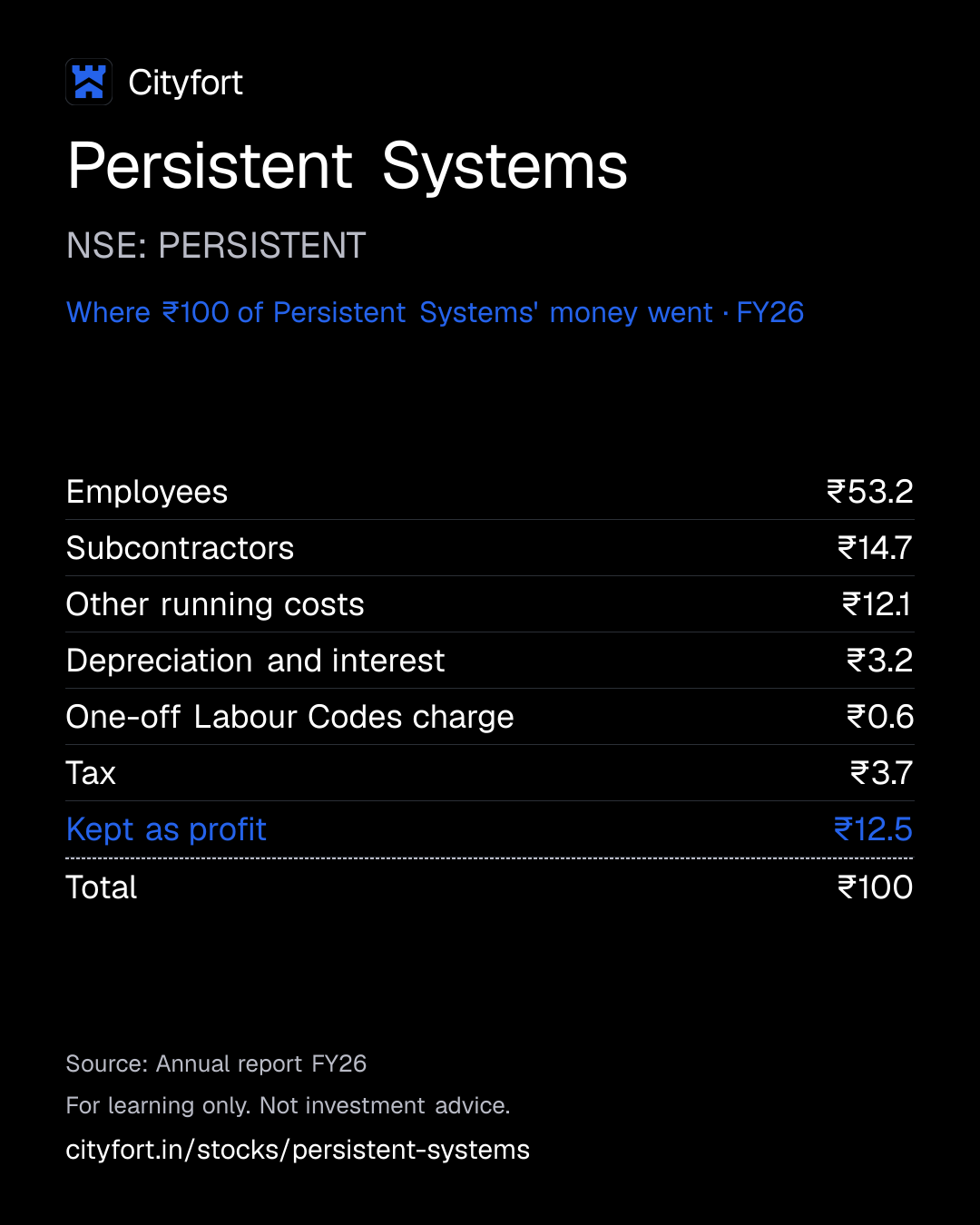
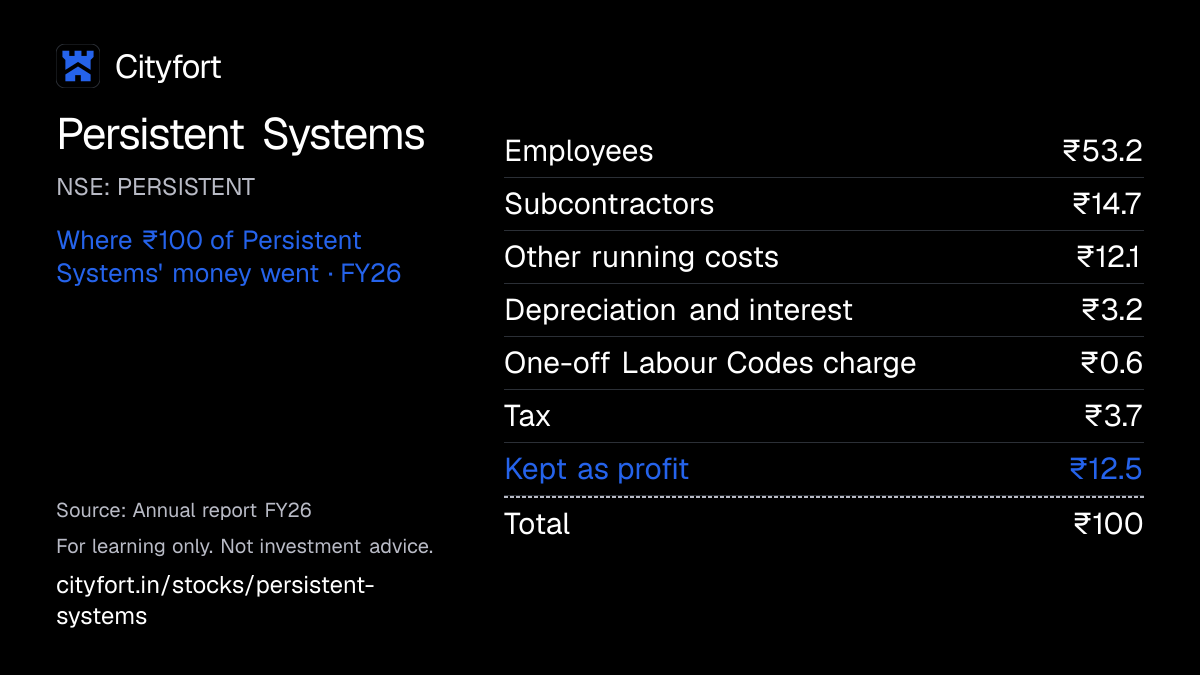
Of every ₹100 that came in during FY26, Persistent kept ₹12.5 as profit, after ₹53.2 for employees, ₹14.7 for subcontractors and ₹0.6 for a one-off Labour Codes charge.
4 · Where the operating profit comes from
In FY26, software and hi-tech clients gave the largest segment result (before depreciation, interest and shared costs), ₹2,059 crore, against ₹1,769 crore from banking and insurance and ₹1,403 crore from healthcare.
5 · The one thing to watch
Persistent had secured about 94.04% of Germany's Nagarro by 6 Oct 2026, with settlement still pending, and allotted ₹7,000 crore of bonds on 4 Nov 2026 to help pay for it.
Sources: From Persistent's FY26 annual report and results, its Q2 FY27 investor presentation and its Oct–Nov 2026 exchange filings · checked
Sources (5)
01Where the money goes · FY26
Where does ₹100 of Persistent Systems' money go?
Persistent Systems · FY26
Receipt for every ₹100
| Employees | ₹53.2 |
|---|---|
| Subcontractors | ₹14.7 |
| Other running costs | ₹12.1 |
| Depreciation and interest | ₹3.2 |
| One-off Labour Codes charge | ₹0.6 |
| Tax | ₹3.7 |
| Kept as profit | ₹12.5 |
| Total | ₹100 |
Each line = amount ÷ total money in × 100. Lines may not add to exactly ₹100 because of rounding.
How this is worked out
Of every ₹100 that came in during FY26 (revenue ₹14,748 crore plus other income ₹180 crore): each line ÷ ₹14,929 crore × 100.
Save this receipt as an image
Embed this receipt or the key numbers
Paste this code into a blog or website to show the card you choose, with a link back to this page.
Each week: the next company due to report results, explained in 5 points.
We'll email you once a week with what changed on Cityfort. Facts only, no tips. Unsubscribe any time.
We store your email address with Kit, our email provider, which also records when you sign up and whether you open or click our emails. We send a confirmation email first. See our privacy policy.
02The business in one line
What does Persistent Systems do?
Companies, mostly in North America, pay Persistent Systems for engineers who build and run their software. Most of the money goes on salaries and subcontractors, and about ₹12.5 of every ₹100 is left as profit.
- Software and technology companies paid 39.9% of FY26 revenue, banks and insurers 34.5% and healthcare firms 25.6%.
- In FY26, employees took ₹53.2 and subcontractors ₹14.7 of every ₹100 that came in.
03Who pays it
Who pays Persistent Systems?
Software, hi-tech and emerging industries
39.9%
of revenue
Software and technology companies, plus other industries the company groups here. Revenue ₹5,883 crore in FY26.
Banking, financial services and insurance
34.5%
of revenue
Banks, other financial services firms and insurers. Revenue ₹5,093 crore in FY26.
Healthcare and life sciences
25.6%
of revenue
Healthcare and life sciences companies. Revenue ₹3,772 crore in FY26.
- Software, hi-tech and emerging industries39.9%
- Banking, financial services and insurance34.5%
- Healthcare and life sciences25.6%
Customer concentration
In Q2 FY27 the five largest clients gave 38.1% of revenue, up from 33.2% in Q1 FY27, after the large US contract began. One customer was 10.5% of FY25 revenue; none passed 10% in FY26. The company does not name its clients.
- Top 5 customers
- 38%
- Top 10 customers
- 47%
04How it makes money
How does Persistent Systems make money?
It sells engineers' time; profit depends on billing more of it at better prices
Staff and subcontractors took about ₹68 of every ₹100 in FY26. Most revenue comes from North America, while 85.7% of FY26 work was delivered in India. EBITDA per ₹100 of revenue rose from ₹16.8 in FY22 to ₹18.4 in FY26.
EBITDA per ₹100 of revenue
₹16.8₹18.4
FY22 to FY26
- A client hires Persistent for a software project
- Teams, mostly in India, do the work
- The client pays for staff time or a fixed-price project
- Salaries in rupees are the biggest cost
- Clients that stay give more work: US$1 mn+ clients rose to 218
- Profit pays dividends and funds acquisitions
↺ Step 6 feeds back into step 1.
05Business segments · FY26
Which businesses make up Persistent Systems?
Software, hi-tech and emerging industries
39.9%Software and technology firms and other industries. Segment result (before depreciation, interest and shared costs) was ₹2,059 crore, 35.0% of its revenue.
Revenue ₹5,883 cr
Banking, financial services and insurance
34.5%Banks, lenders and insurers. Segment result was ₹1,769 crore, 34.7% of its revenue.
Revenue ₹5,093 cr
Healthcare and life sciences
25.6%Healthcare and drug companies. Segment result was ₹1,403 crore, 37.2% of its revenue, down from 51.2% in FY22.
Revenue ₹3,772 cr
How the mix changed
- Software, hi-tech and emerging industries
- Banking, financial services and insurance
- Healthcare and life sciences
Revenue by segment, FY22 to FY26.
₹ crore
See the numbers
06The numbers · Consolidated · ₹ crore
How has Persistent Systems done?
Revenue
₹14,748 crFY26
Revenue grew every year, from ₹5,711 crore in FY22 to ₹14,748 crore in FY26; Q2 FY27 revenue rose 30.3%, or 20.0% in US dollars, as the rupee weakened.
₹ crore
See the numbers
Net profit
₹1,865 crFY26
Net profit rose every year to ₹1,865 crore in FY26; Q2 FY27 profit fell 25.4% to ₹352 crore after ₹185.3 crore of Nagarro deal costs.
₹ crore
See the numbers
Net profit for every ₹100 of revenue
₹12.6FY26
EBITDA per ₹100 of revenue was ₹16.8 in FY22 and ₹18.4 in FY26, then ₹13.6 in Q2 FY27, or ₹17.6 before the Nagarro deal costs.
Net margin: ₹ of net profit per ₹100 of revenue
See the numbers
Free cash flow
₹1,559 crFY26
Free cash flow rose from ₹460 crore in FY22 to ₹1,559 crore in FY26 and was below net profit in every year.
₹ crore · cash from operations minus spending on plants and equipment
See the numbers
See all yearly numbers
EBITDA = profit before interest, tax and wear-and-tear of assets. Financial year runs April to March (March year end). Net profit is the share belonging to the company's owners.
Sources (9)
- Q4 FY23 and FY23 audited consolidated results (FY22 comparatives)
- Annual Report FY23
- Annual Report FY24
- Annual Report FY25
- Annual Report FY26 (incl. consolidated financial statements)
- Q4 FY26 and FY26 audited consolidated results
- Q2 FY26 audited consolidated results
- Q3 FY26 audited consolidated results
- Q2 FY27 audited consolidated results (quarter and half year ended 30 Sep 2026)
07Who runs it
Who runs Persistent Systems, and did they deliver?
Dr. Anand Deshpande
Founder, Chairman and Managing Director · since 1990
Started Persistent in 1990. With his family he makes up the promoter group, which held 28.82% after the Oct 2026 QIP.
Sandeep Kalra
Executive Director and Chief Executive Officer
Shareholders approved his term as Executive Director from 1 Oct 2025 to 30 Sep 2028.
Vinit Teredesai
Executive Director and Chief Financial Officer
Executive Director from 24 Apr 2025 to 30 Sep 2028, as confirmed by shareholders on 21 Jul 2025.
Amit Atre
Company Secretary
What they said, and what happened
4 too early to tell
Said on 21 Apr 2026
Reach a US$2 billion yearly revenue run rate by March 2027: about US$500 million in the Q4 FY27 quarter (an "aspiration", not guidance).
Too early to tellWhat happened
Q2 FY27 revenue was US$487.6 million, up from US$406.2 million in Q2 FY26 (company-reported).
Said on 21 Apr 2026
An EBIT margin (the company's own operating profit measure) in the 16–17% range, described as an aspiration, not guidance.
Too early to tellWhat happened
Company-reported EBIT margin was 15.6% in FY26 and 15.0% in Q2 FY27.
Said on 15 Oct 2026
Close the Nagarro deal by Q4 CY26 or Q1 CY27.
Too early to tellWhat happened
About 94.04% of Nagarro's shares were secured by 6 Oct 2026; settlement awaited RBI and Austrian and Spanish investment approvals.
Said on 15 Oct 2026
One-time Nagarro deal costs of about US$50 million, spread over three to four quarters.
Too early to tellWhat happened
Q2 FY27 results included ₹185.3 crore of these costs in other expenses.
Sources (8)
- Annual Report FY26 (incl. consolidated financial statements)
- Shareholding pattern (summary statement) as on 26 Oct 2026, after the QIP allotment
- Q3 FY26 earnings call transcript
- Q4 FY26 earnings call transcript (call of 21 Apr 2026; company website copy linked from the BSE filing of 28 Apr 2026)
- Investor presentation, October 2026 (Q2 FY27)
- Q2 FY27 earnings call transcript (call of 15 Oct 2026)
- Update on the Nagarro takeover offer: ~94.04% secured after the additional acceptance period
- Q2 FY27 audited consolidated results (quarter and half year ended 30 Sep 2026)
08What could go wrong
What could go wrong for Persistent Systems?
- Debt
New debt for the Nagarro purchase
Persistent had no borrowings on 30 Sep 2026. It then allotted ₹7,000 crore of bonds at 8.95% a year and holds a EUR 1.4 billion bridge loan facility. ICRA and Crisil put their AA+ ratings on watch in Oct 2026.
Watch Borrowings and finance costs in the Q3 FY27 results; any rating action by ICRA or Crisil.
- Execution
Nagarro deal still to close
About 94.04% of Nagarro was secured by 6 Oct 2026, but settlement waits for RBI and Austrian and Spanish investment approvals. Management expects about US$50 million of one-time costs over three to four quarters.
Watch The settlement announcement, and deal costs in each quarter's other expenses.
- Concentration
More revenue from a few clients
The five largest clients gave 38.1% of Q2 FY27 revenue, up from 32.9% a year earlier. One customer was 10.5% of FY25 revenue. The company lists client concentration among its risks.
Watch Top-5 client share in each quarter's fact sheet.
- Currency
Dependence on North America and the rupee
North America gave 81.4% of Q2 FY27 revenue. Rupee revenue rose 30.3% but dollar revenue 20.0%, as the rupee averaged 95.7 to the dollar against 88.2. Hedges of US$500 million were outstanding.
Watch Dollar revenue growth against rupee growth; hedges outstanding.
- Execution
Lower profit margin
EBITDA per ₹100 of revenue fell from ₹19.1 in Q2 FY26 to ₹13.6 in Q2 FY27, after ₹185.3 crore of deal costs. Management said licences for the large contract add about US$4 million of amortisation a quarter.
Watch EBITDA margin before deal costs; depreciation and amortisation each quarter.
- Other
Staff costs and keeping engineers
Employees took ₹53.2 of every ₹100 that came in during FY26. Its listed risks include wage increases in India and keeping skilled staff. Attrition was 11.9% in Q2 FY27.
Watch Employee cost per ₹100 of revenue; utilisation and attrition each quarter.
Sources (9)
- Q2 FY27 audited consolidated results (quarter and half year ended 30 Sep 2026)
- Allotment of INR 7,000 crore NCDs (8.95%, 2-5 years)
- ICRA rating letters, 22 Oct 2026: issuer AA+ on watch negative; A1+ on INR 1,000 cr CP; AA+ on INR 7,000 cr NCDs (filed with BSE)
- Crisil Ratings letter, 21 Oct 2026: Crisil AA+ on proposed NCDs, watch with developing implications (filed with BSE)
- Update on the Nagarro takeover offer: ~94.04% secured after the additional acceptance period
- Q2 FY27 earnings call transcript (call of 15 Oct 2026)
- Investor presentation, October 2026 (Q2 FY27)
- Annual Report FY25
- Annual Report FY26 (incl. consolidated financial statements)
09Supporters and critics
What do supporters and critics point to?
What supporters point to
- Revenue grew every year from FY22 to FY26, from ₹5,711 crore to ₹14,748 crore.
- Dollar revenue grew for 26 quarters in a row to Q2 FY27, the company reported.
- No single customer was above 10% of FY26 revenue. Clients billed over US$1 million rose from 191 to 218 in the year to Q2 FY27.
- Free cash flow was ₹1,559 crore in FY26, and there were no borrowings on 30 Sep 2026.
What critics point to
- Q2 FY27 net profit fell 25.4% from a year earlier, to ₹352 crore.
- The company allotted ₹7,000 crore of bonds at 8.95% in Nov 2026, and ICRA and Crisil put their ratings on watch.
- The five largest clients gave 38.1% of Q2 FY27 revenue, up from 32.9% a year earlier.
- Part of the rupee growth came from a weaker rupee: Q2 FY27 revenue rose 30.3% in rupees and 20.0% in dollars.
10What to watch next
What should you watch next at Persistent Systems?
Next event
Q3 FY27 results (date not announced; Q3 FY26 results came on 20 Jan 2026)
Date not announced yet.
Nagarro settlement
Settlement waits for RBI and Austrian and Spanish approvals. Management said on 15 Oct 2026 it expects closing by Q4 CY26 or Q1 CY27. Nagarro's numbers will then join the accounts.
Debt and ratings
The Q3 FY27 balance sheet will be the first to show the ₹7,000 crore of bonds. ICRA and Crisil ratings are on watch.
Margin and client mix
Q2 FY27 EBITDA was ₹13.6 per ₹100 of revenue after deal costs. The top 5 clients' share rose to 38.1%.
11Key facts
Key facts about Persistent Systems
- What does Persistent Systems do?
- Persistent Systems is a Pune-based IT services company that builds, updates and runs software for other companies. In FY26, North American clients gave it 80.6% of its revenue.
- How does Persistent Systems make money?
- Persistent Systems charges clients for its engineers' work on software projects and support. In FY26, employees and subcontractors took ₹67.9 of every ₹100 that came in, and ₹12.5 was left as profit.
- Who are Persistent Systems' customers?
- In FY26, software, hi-tech and emerging-industry clients gave Persistent Systems 39.9% of its revenue; banks, financial services and insurers 34.5%; and healthcare and life sciences firms 25.6%. No single customer was above 10% of FY26 revenue.
- How big is Persistent Systems?
- Persistent Systems reported FY26 revenue of ₹14,748 crore, up 23.5% from ₹11,939 crore in FY25, and net profit of ₹1,865 crore. It had 29,598 employees on 30 Sep 2026.
- Who owns Persistent Systems?
- The promoter group, founder Dr. Anand Deshpande and his family, held 30.29% of Persistent Systems on 30 Sep 2026 and 28.82% after the 26 Oct 2026 share issue, with no shares pledged. On 30 Sep 2026, mutual funds held 21.79% of Persistent Systems and foreign portfolio investors 20.79%.
- Does Persistent Systems have debt?
- Persistent Systems had no borrowings on 30 Sep 2026, and ₹2,359 crore of cash and liquid investments. On 4 Nov 2026 it allotted ₹7,000 crore of bonds at 8.95% a year, raised for its purchase of Nagarro.
- What is Persistent Systems' Nagarro deal?
- Persistent Systems offered €81 a share in cash for Nagarro SE, a Munich-based digital engineering company. It had secured about 94.04% of Nagarro's shares by 6 Oct 2026. Settlement was still pending in the company's filings up to 16 Nov 2026.
- How did Persistent Systems do in Q2 FY27?
- In Q2 FY27 (July to September 2026), Persistent Systems' revenue rose 30.3% from a year earlier to ₹4,664 crore. Net profit fell 25.4% to ₹352 crore, after ₹185.3 crore of Nagarro deal costs.
Sources (11)
- Annual Report FY26 (incl. consolidated financial statements)
- Investor presentation, October 2026 (Q2 FY27)
- Q4 FY26 and FY26 audited consolidated results
- Shareholding pattern (summary statement), quarter ended 2026-09-30
- Shareholding pattern (summary statement) as on 26 Oct 2026, after the QIP allotment
- Shareholding pattern, Table III public shareholders, quarter ended 30 Sep 2026
- Q2 FY27 audited consolidated results (quarter and half year ended 30 Sep 2026)
- Allotment of INR 7,000 crore NCDs (8.95%, 2-5 years)
- Terms of NCDs up to INR 8,000 crore and commercial paper for the Nagarro financing
- Reg 30: BidCo set up; agreement for 21% of Nagarro SE at EUR 81/share; board approval for 100% takeover offer
- Update on the Nagarro takeover offer: ~94.04% secured after the additional acceptance period
Terms on this page
- Capital expenditure (capex)
- Credit rating
- Customer concentration
- EBITDA
- FII and DII holding
- Free cash flow
- Market capitalisation
- Net debt
- Net profit
- Operating margin
Each explains the term in plain English, with the same number from other companies on Cityfort.
Go deeper
More detail from the same filings. Open any section.
12What it sells
12What it sells
What does Persistent Systems sell?
Building software for technology companies
Product development for software and hi-tech firms: writing, testing and supporting the products they sell. Software, hi-tech and emerging-industry clients paid ₹5,883 crore, 39.9% of FY26 revenue.
Modernising systems for banks, insurers and healthcare firms
Rebuilding and running older systems for banks, insurers and healthcare companies. These two client groups paid ₹8,865 crore, 60.1% of FY26 revenue.
Running software and cloud services
Day-to-day operation and support of clients' software. In Jun 2026 a US technology company gave it enterprise cloud services to run. The 6.5-year deal is worth over US$650 million.
What it does
- Does: Bills clients for engineering teams, mostly working from India: 85.7% of FY26 effort was delivered in India.
- Does: Earns most of its money abroad: North America gave 80.6% of FY26 revenue.
- Does: Builds and supports software that clients sell or use themselves.
What it does not do
- Does not: Does not earn most of its money in India: India was 8.8% of FY26 revenue.
- Does not: Has no customer above 10% of revenue in FY26, though one was 10.5% in FY25.
- Does not: Did not have any borrowings on 30 Sep 2026, but it allotted ₹7,000 crore of bonds on 4 Nov 2026.
13How the money flows
13How the money flows · FY26
How does money flow through Persistent Systems?
Money in
- Revenue from operations₹14,748 cr
- Other income (interest, investment gains and other)₹180 cr
The company
Persistent Systems
₹14,929 cr came in
Money out
- Employee costs₹7,950 cr
- Subcontractors₹2,199 cr
- Other running costs₹1,805 cr
- Depreciation and interest₹476 cr
- One-off Labour Codes charge₹89 cr
- Tax₹546 cr
- Net profit₹1,865 cr
- Clients paid ₹14,748 crore for software work in FY26. Other income, such as interest and investment gains, added ₹180 crore.
- Salaries and staff benefits took ₹7,950 crore, the biggest cost.
- Outside contractors cost ₹2,199 crore, and other running costs ₹1,805 crore.
- Wear and tear of assets and interest took ₹476 crore, and a one-off charge for India's new Labour Codes ₹89 crore.
- After ₹546 crore of tax, ₹1,865 crore was left as profit.
14What it needs to run
14What it needs to run
What does Persistent Systems need to run?
Engineers
29,598 employees on 30 Sep 2026, of whom 27,814 were technical staff. Attrition (staff who left in the past 12 months) was 11.9%.
Billable time
Utilisation (the share of staff time billed to clients, trainees included) was 85.8% in Q2 FY27, down from 88.2% a year earlier.
Subcontractors
Outside contractors cost ₹2,199 crore in FY26, up from ₹1,043 crore in FY23.
Offices
23 offices in India and 46 abroad (FY26 BRSR, parent company), with staff in 21 countries. Rent owed under leases was ₹575 crore on 30 Sep 2026.
Sources (5)
- Investor presentation, October 2026 (Q2 FY27)
- Annual Report FY26 (incl. consolidated financial statements)
- Annual Report FY24
- Business Responsibility and Sustainability Report FY26 (company website copy linked from the BSE filing of 11 Jul 2026)
- Q2 FY27 audited consolidated results (quarter and half year ended 30 Sep 2026)
15Where it sells
15Where it sells · FY26
Where does Persistent Systems sell?
- North America80.6%
- India8.8%
- Europe8.7%
- Rest of world1.9%
16Where growth could come from
16Where growth could come from
Where could Persistent Systems' growth come from?
Management says it does not give forward-looking guidance. On 20 Jan 2026 the CEO repeated an "aspiration of $2 billion by March 2027" and $5 billion by March 2031. On 21 Apr 2026 management said the $2 billion is a run rate: about US$500 million in the Q4 FY27 quarter. On 15 Oct 2026 it repeated an aspiration of a 16–17% EBIT margin (the company's own measure of operating profit per ₹100 of revenue).
Software and hi-tech clients
WorkingUS$ revenue +28.5% (Q2 FY27, year on year)
This segment grew fastest in Q2 FY27, the company reported, against 16.2% for banking and insurance and 12.0% for healthcare. Its rupee revenue was ₹1,994 crore.
Status: Working, on track against what the company said.
Large contract with a US technology company
NewUS$650 mn total contract value over 6.5 years
Signed on 27 Jun 2026 to run a portfolio of enterprise cloud services. Management said it adds US$125 million of annual contract value; the client is not named.
Status: New, recently announced.
Nagarro purchase
NewAbout 94.04% of shares secured (6 Oct 2026)
Nagarro, based in Munich, had CY2025 revenue of €999.3 million and about 18,500 employees, the company said. Settlement of the offer was pending on 16 Nov 2026.
Status: New, recently announced.
New contracts signed
WorkingUS$1,964.8 mn annual contract value in 12 months to Sep 2026
Total contract value of deals signed was US$1,146.2 million in Q1 FY27 (including the large contract) and US$633.5 million in Q2 FY27 (company-reported).
Status: Working, on track against what the company said.
Europe
MixedEurope revenue −8.5% (Q2 FY27, year on year)
Europe's share of revenue fell to 7.1% in Q2 FY27 from 9.3% a year earlier. Management cited one client being acquired and a fixed-price project winding down.
Status: Mixed, partly on track.
Status compares progress with what the company itself said it would do: Working = on track against what the company said; Mixed = partly on track; Behind = behind the company's own plan; New = recently announced; Early = too early to judge.
Sources (8)
- Q3 FY26 earnings call transcript
- Q4 FY26 earnings call transcript (call of 21 Apr 2026; company website copy linked from the BSE filing of 28 Apr 2026)
- Q2 FY27 earnings call transcript (call of 15 Oct 2026)
- Q2 FY27 audited consolidated results (quarter and half year ended 30 Sep 2026)
- Reg 30: long-term agreement with a global technology leader headquartered in the US
- Update on the Nagarro takeover offer: ~94.04% secured after the additional acceptance period
- Reg 30: BidCo set up; agreement for 21% of Nagarro SE at EUR 81/share; board approval for 100% takeover offer
- Investor presentation, October 2026 (Q2 FY27)
17Financial strength and debt
17Financial strength · 30 Sep 2026
How much debt does Persistent Systems have?
- Total debt₹0 cr
- Cash and investments₹2,359 cr
- Net cash (cash minus debt)₹2,359 cr
- Net worth (shareholders' money)₹8,589 cr
- Debt to equity
- 0×
- ₹ of debt for every ₹1 of shareholders' money
- Debt here means borrowings. They fell from ₹433 crore on 31 Mar 2022 to nil on 31 Mar 2025, and were still nil on 30 Sep 2026.
- After 30 Sep 2026 it raised ₹4,264.6 crore by selling new shares to institutions (a QIP, 26 Oct 2026). On 4 Nov 2026 it allotted ₹7,000 crore of bonds (NCDs) at 8.95% a year, repayable in 2 to 5 years.
- A EUR 1.4 billion, 18-month bridge loan facility from a Barclays-led group backs the Nagarro offer; the company guarantees up to EUR 1,540 million.
- Lease liabilities (rent owed under leases) were ₹575 crore on 30 Sep 2026; they are not counted as debt here.
- Cash and liquid investments = cash, other bank balances and current investments. Net worth = shareholders' equity.
- Goodwill (₹1,395 crore) and other intangible assets (₹1,454 crore) were 21.9% of total assets of ₹13,031 crore on 30 Sep 2026.
Sources (6)
- Q2 FY27 audited consolidated results (quarter and half year ended 30 Sep 2026)
- Annual Report FY26 (incl. consolidated financial statements)
- Annual Report FY23
- QIP allotment: 7,683,981 shares at INR 5,550 (26 Oct 2026)
- Allotment of INR 7,000 crore NCDs (8.95%, 2-5 years)
- Q2 FY27 earnings call transcript (call of 15 Oct 2026)
18Who owns it
18Who owns it · Q2 FY27
Who owns Persistent Systems?
- Promoters (founders or parent company)30.3%
- Foreign institutions (FII)20.8%
- Indian institutions (DII)32.0%
- Public and others17.0%
Promoter pledge
No promoter shares were pledged in Q2 FY27.
How ownership changed
* Pledged = share of the promoters' own holding reported as pledged. In older filings this can include shares “otherwise encumbered”; the governance flags say when.
† Others = Employee benefit trust.
Sources (6)
- Annual Report FY26 (incl. consolidated financial statements)
- Shareholding pattern (summary statement), quarter ended 2026-03-31
- Shareholding pattern (summary statement), quarter ended 2026-06-30
- Shareholding pattern (summary statement), quarter ended 2026-09-30
- Shareholding pattern, Table III public shareholders, quarter ended 30 Jun 2026
- Shareholding pattern, Table III public shareholders, quarter ended 30 Sep 2026
19What it does with profit
19What it does with profit
What does Persistent Systems do with its profit?
Dividend per share
₹40.00FY26
Dividend paid for each share, by financial year.
₹ per share
See the numbers
Money raised · 26 Oct 2026
QIP: 76,83,981 new shares sold to institutions at ₹5,550 each, to help pay for Nagarro.
₹4,265 cr
Money raised · 4 Nov 2026
₹7,000 crore of secured bonds (NCDs) at 8.95% a year, repayable in 2 to 5 years, for the Nagarro financing.
₹7,000 cr
Sources (5)
20Governance signals
20Governance signals
What do Persistent Systems' governance filings show?
- Auditor
- B S R & Co. LLP, since 2025
- Auditor changes
- 21 Jul 2025: Walker Chandiok & Co LLP → B S R & Co. LLP (Walker Chandiok's term ended at the 35th AGM; shareholders appointed B S R & Co. LLP for FY26 to FY30.)
- Audit qualifications
- None reported
- Related-party dealings
- The 27 Jun 2026 filing on the large US contract says it is not a related-party deal. Promoters have no interest in the client. This page does not list related-party amounts from the FY26 annual report.
- Credit rating
- ICRA [ICRA]AA+ (issuer); [ICRA]A1+ (commercial paper) (outlook Rating watch with negative implications), 22 Oct 2026
A credit rating describes the company's ability to repay debt. It is not a rating of the share.
Flags to know about
other · 22 Oct 2026
Credit ratings on watch after the Nagarro offer
ICRA kept its AA+ issuer rating on watch with negative implications on 22 Oct 2026. Crisil rated the proposed bonds AA+ on watch with developing implications on 21 Oct 2026. The rating letters do not give reasons.
disclosure · 27 Jun 2026
Large client not named
The 27 Jun 2026 filing describes the new 6.5-year contract's client only as a global technology leader headquartered in the US.
Sources (6)
- Annual Report FY26 (incl. consolidated financial statements)
- Annual Report FY25
- Reg 30: long-term agreement with a global technology leader headquartered in the US
- ICRA rating letters, 22 Oct 2026: issuer AA+ on watch negative; A1+ on INR 1,000 cr CP; AA+ on INR 7,000 cr NCDs (filed with BSE)
- Crisil Ratings letter, 21 Oct 2026: Crisil AA+ on proposed NCDs, watch with developing implications (filed with BSE)
- ICRA rating letters, 9 Oct 2026: [ICRA]AA+ on proposed NCDs; issuer rating on watch with negative implications (filed with BSE)
21What the market paid
21What the market paid · price as of 13 Nov 2026
What did the market pay for Persistent Systems on 13 Nov 2026?
Price as of 13 Nov 2026 (shown for education; prices change daily).
Price as of 13 Nov 2026: ₹6,000.50 on BSE. On 16.58 crore shares (after the 26 Oct 2026 QIP), the market value was ₹99,509 crore. P/E divides the price by earnings per share of the four quarters to Q2 FY27 (₹115.28): 52.1. Market value ÷ the same quarters' net profit (₹1,803 crore) gives 55.2. The two differ because earnings per share use the share count before the QIP. That profit is after ₹185.3 crore of Nagarro deal costs and the ₹89 crore Labour Codes charge.
- Share price
- ₹6,000.50
- Market value (market cap)
- ₹99,509 cr
- P/E
- 52.1×
Source: BSE quote for Persistent Systems (533179): close 13 Nov 2026; Shareholding pattern (summary statement) as on 26 Oct 2026, after the QIP allotment; Q2 FY27 audited consolidated results (quarter and half year ended 30 Sep 2026) and 2 more
Sources (5)
- BSE quote for Persistent Systems (533179): close 13 Nov 2026
- Shareholding pattern (summary statement) as on 26 Oct 2026, after the QIP allotment
- Q2 FY27 audited consolidated results (quarter and half year ended 30 Sep 2026)
- Q4 FY26 and FY26 audited consolidated results
- Q3 FY26 audited consolidated results
22How it got here
22How it got here
How did Persistent Systems get here?
1990
Milestone
Founded in Pune
Dr. Anand Deshpande started Persistent in 1990. The company says its first work was building database indexes.
2001
Business-model change
Building products for software firms
The company says that from 2001 to 2008 it specialised in outsourced product development: building software for software companies.
2010
Milestone
Listed on NSE and BSE
Shares listed on 6 Apr 2010 after the IPO.
2022
Business-model change
Acquisitions and a jump in revenue
It paid ₹615 crore in FY22 and ₹431 crore in FY23 to buy companies. FY23 revenue rose 46.2% to ₹8,351 crore.
2024
Milestone
Share split
From 1 Apr 2024 each ₹10 share became two ₹5 shares.
2026
Business-model change
A US$650 mn+ contract to run a US client's cloud services
On 27 Jun 2026 it signed a 6.5-year deal worth over US$650 million with an unnamed US technology company.
2026
Business-model change
Offer for Germany's Nagarro
On 26 Jun 2026 it agreed to buy 21% of Nagarro at €81 a share and offered the same for the rest. It had about 94.04% by 6 Oct 2026.
2026
Milestone
Borrowing and new shares to pay for Nagarro
It raised ₹4,264.6 crore through a QIP on 26 Oct 2026 and allotted ₹7,000 crore of bonds on 4 Nov 2026.
Sources (11)
- Annual Report FY26 (incl. consolidated financial statements)
- Investor presentation, October 2026 (Q2 FY27)
- Q4 FY23 and FY23 audited consolidated results (FY22 comparatives)
- Annual Report FY23
- Annual Report FY24
- Reg 30: long-term agreement with a global technology leader headquartered in the US
- Q2 FY27 earnings call transcript (call of 15 Oct 2026)
- Reg 30: BidCo set up; agreement for 21% of Nagarro SE at EUR 81/share; board approval for 100% takeover offer
- Update on the Nagarro takeover offer: ~94.04% secured after the additional acceptance period
- QIP allotment: 7,683,981 shares at INR 5,550 (26 Oct 2026)
- Allotment of INR 7,000 crore NCDs (8.95%, 2-5 years)
23What changed
23What changed · Q2 FY27
What changed in Q2 FY27?
Updated 17 Nov 2026
- The promoter group held 30.29% of Persistent Systems on 30 Sep 2026, the same as on 31 Mar 2026, with no shares pledged. After the 26 Oct 2026 share issue it held 28.82%.
- Indian institutions held 31.96% on 30 Sep 2026, up from 30.24% on 30 Jun 2026; mutual funds alone held 21.79%. Foreign portfolio investors held 20.79%, down from 22.12% on 31 Mar 2026.
- The employee benefit trust held 0.55% on 30 Sep 2026, down from 0.96% on 31 Mar 2026. The shareholding table now adds 30 Jun and 30 Sep 2026.
24Sources and changes
Where every number on this page comes from
Sources (31 documents)
- S1Annual Report FY26 (incl. consolidated financial statements) · Persistent Systems Ltd (filed with BSE/NSE; BSE copy) · Tier 1: company or exchange filing · 11 Jul 2026
- S2Annual Report FY25 · Persistent Systems Ltd (filed with BSE/NSE; BSE copy) · Tier 1: company or exchange filing · 23 Jun 2025
- S3Annual Report FY24 · Persistent Systems Ltd (filed with BSE/NSE; BSE copy) · Tier 1: company or exchange filing · 20 Jun 2024
- S4Annual Report FY23 · Persistent Systems Ltd (filed with BSE/NSE; BSE copy) · Tier 1: company or exchange filing · 21 Jun 2023
- S5Q2 FY27 audited consolidated results (quarter and half year ended 30 Sep 2026) · Persistent Systems Ltd (filed with BSE/NSE; BSE copy) · Tier 1: company or exchange filing · 15 Oct 2026
- S7Investor presentation, October 2026 (Q2 FY27) · Persistent Systems Ltd (filed with BSE/NSE; BSE copy) · Tier 1: company or exchange filing · 15 Oct 2026
- S8Q2 FY27 earnings call transcript (call of 15 Oct 2026) · Persistent Systems Ltd (filed with BSE/NSE; BSE copy) · Tier 1: company or exchange filing · 23 Oct 2026
- S10Transcript of the investor call of 28 Jun 2026 on the Nagarro offer (filed 3 Jul 2026) · Persistent Systems Ltd (filed with BSE/NSE; BSE copy) · Tier 1: company or exchange filing · 3 Jul 2026
- S11Q4 FY26 and FY26 audited consolidated results · Persistent Systems Ltd (filed with BSE/NSE; BSE copy) · Tier 1: company or exchange filing · 21 Apr 2026
- S12Q4 FY26 earnings call transcript (call of 21 Apr 2026; company website copy linked from the BSE filing of 28 Apr 2026) · Persistent Systems Ltd (company website) · Tier 1: company or exchange filing · 28 Apr 2026
- S13Q3 FY26 audited consolidated results · Persistent Systems Ltd (filed with BSE/NSE; BSE copy) · Tier 1: company or exchange filing · 20 Jan 2026
- S14Q3 FY26 earnings call transcript · Persistent Systems Ltd (filed with BSE/NSE; BSE copy) · Tier 1: company or exchange filing · 27 Jan 2026
- S15Q2 FY26 audited consolidated results · Persistent Systems Ltd (filed with BSE/NSE; BSE copy) · Tier 1: company or exchange filing · 14 Oct 2025
- S16Q4 FY23 and FY23 audited consolidated results (FY22 comparatives) · Persistent Systems Ltd (filed with BSE/NSE; BSE copy) · Tier 1: company or exchange filing · 25 Apr 2023
- S17Business Responsibility and Sustainability Report FY26 (company website copy linked from the BSE filing of 11 Jul 2026) · Persistent Systems Ltd (company website) · Tier 1: company or exchange filing · 11 Jul 2026
- S18Reg 30: BidCo set up; agreement for 21% of Nagarro SE at EUR 81/share; board approval for 100% takeover offer · Persistent Systems Ltd (filed with BSE/NSE; BSE copy) · Tier 1: company or exchange filing · 27 Jun 2026
- S19Update on the Nagarro takeover offer: ~94.04% secured after the additional acceptance period · Persistent Systems Ltd (filed with BSE/NSE; BSE copy) · Tier 1: company or exchange filing · 9 Oct 2026
- S20Reg 30: long-term agreement with a global technology leader headquartered in the US · Persistent Systems Ltd (filed with BSE/NSE; BSE copy) · Tier 1: company or exchange filing · 27 Jun 2026
- S22QIP allotment: 7,683,981 shares at INR 5,550 (26 Oct 2026) · Persistent Systems Ltd (filed with BSE/NSE; BSE copy) · Tier 1: company or exchange filing · 26 Oct 2026
- S23Terms of NCDs up to INR 8,000 crore and commercial paper for the Nagarro financing · Persistent Systems Ltd (filed with BSE/NSE; BSE copy) · Tier 1: company or exchange filing · 16 Oct 2026
- S24Allotment of INR 7,000 crore NCDs (8.95%, 2-5 years) · Persistent Systems Ltd (filed with BSE/NSE; BSE copy) · Tier 1: company or exchange filing · 4 Nov 2026
- S25ICRA rating letters, 9 Oct 2026: [ICRA]AA+ on proposed NCDs; issuer rating on watch with negative implications (filed with BSE) · Persistent Systems Ltd (filed with BSE/NSE; BSE copy) · Tier 1: company or exchange filing · 9 Oct 2026
- S26Crisil Ratings letter, 21 Oct 2026: Crisil AA+ on proposed NCDs, watch with developing implications (filed with BSE) · Persistent Systems Ltd (filed with BSE/NSE; BSE copy) · Tier 1: company or exchange filing · 21 Oct 2026
- S27ICRA rating letters, 22 Oct 2026: issuer AA+ on watch negative; A1+ on INR 1,000 cr CP; AA+ on INR 7,000 cr NCDs (filed with BSE) · Persistent Systems Ltd (filed with BSE/NSE; BSE copy) · Tier 1: company or exchange filing · 22 Oct 2026
- S38Shareholding pattern (summary statement), quarter ended 2026-03-31 · BSE Ltd (company filing) · Tier 1: company or exchange filing · 31 Mar 2026
- S39Shareholding pattern (summary statement), quarter ended 2026-06-30 · BSE Ltd (company filing) · Tier 1: company or exchange filing · 17 Jul 2026
- S40Shareholding pattern (summary statement), quarter ended 2026-09-30 · BSE Ltd (company filing) · Tier 1: company or exchange filing · 30 Sep 2026
- S41Shareholding pattern (summary statement) as on 26 Oct 2026, after the QIP allotment · BSE Ltd (company filing) · Tier 1: company or exchange filing · 26 Oct 2026
- S42BSE quote for Persistent Systems (533179): close 13 Nov 2026 · BSE Ltd · Tier 1: company or exchange filing · 13 Nov 2026
- S43Shareholding pattern, Table III public shareholders, quarter ended 30 Jun 2026 · BSE Ltd (company filing) · Tier 1: company or exchange filing · 17 Jul 2026
- S44Shareholding pattern, Table III public shareholders, quarter ended 30 Sep 2026 · BSE Ltd (company filing) · Tier 1: company or exchange filing · 8 Oct 2026
Changes to this page (v2 · 17 Nov 2026)
- v2 · 17 Nov 2026Shareholding for 30 Jun and 30 Sep 2026 added from the BSE filings, with the employee benefit trust kept as a separate line; the headline holdings and the ownership key fact now quote 30 Sep 2026. The promoter stat already quotes the 26 Oct 2026 post-issue filing and is unchanged. Results figures are unchanged. (quarterly update, Q2 FY27)
- v1 · 16 Nov 2026First version. (first version)
Numbers come only from tier 1 and tier 2 sources. Read how we research.
Disclaimer
For learning only. Cityfort is not a SEBI-registered adviser and does not recommend buying or selling any security. Prices shown are dated and may be out of date.
Investing in securities involves risk, including loss of capital. Before making any investment decision, do your own research and consider consulting a SEBI-registered investment adviser.
Cityfort, its owners and contributors may or may not hold securities of companies covered. Content is not an offer or solicitation to buy or sell any security.
Read the full disclaimerHide the full disclaimer
Cityfort publishes educational content that explains how listed companies work. Cityfort is not registered with the Securities and Exchange Board of India (SEBI) as an Investment Adviser or Research Analyst and does not provide investment advice, recommendations, ratings, price targets or any opinion on whether to buy, sell or hold any security.
All information is taken from publicly available sources, mainly company filings on BSE and NSE, which are listed on each page with dates. We work to keep it accurate and correct errors publicly, but we do not guarantee that it is complete, accurate or up to date. Any market price or price-based ratio shown is dated, may be out of date by the time you read it, and is included only to explain concepts.
Statements by company management are reported as statements, with their date and source; they are not our forecasts.