Financial Services · NSE: BAJAJFINSV · BSE: 532978
Bajaj Finserv: how the business works
Bajaj Finserv owns the companies behind Bajaj Finance loans and Bajaj insurance policies; the group's revenue was ₹150,504 crore in FY26.
Follow Bajaj Finserv
Email me when Bajaj Finserv's page is updated after results.
We store your email address with Kit, our email provider, which also records when you sign up and whether you open or click our emails. We send a confirmation email first. See our privacy policy.
Bajaj Finserv Limited · Pune, Maharashtra · Founded 2007
Updated for Q2 FY27 · checked
- Revenue, FY26
- ₹150,504 cr
- Profit for Bajaj Finserv's shareholders, FY26
- ₹9,801 cr
- Stake in Bajaj Finance, Sep 2026
- 51.30%
- Founded
- 2007
- Promoter holding, Sep 2026
- 58.65%
The short version
Bajaj Finserv in 5 points
1 · What it sells
Bajaj Finserv sells loans and insurance through companies it controls (51.30% of Bajaj Finance, 77.33% of each insurer), with group revenue of ₹150,504 crore in FY26.
2 · Who pays it
In FY26 Bajaj Finance's borrowers brought in 53.1% of the group's segment revenue, general insurance buyers 22.4%, life insurance buyers 22.1% and other businesses 2.4%.
3 · What it keeps from ₹100
Of every ₹100 that came in during FY26, ₹13.1 was profit after a one-time ₹379 crore labour-code charge, and ₹6.5 of it belonged to Bajaj Finserv's own shareholders.
4 · Where the operating profit comes from
In Bajaj Finserv's own FY26 table, Bajaj Finance gave ₹9,764 crore of the ₹10,504 crore profit before investment value changes, 93.0%, and general insurance ₹1,441 crore.
5 · The one thing to watch
Bajaj General's combined ratio, its claims and costs against premium, was 104.5% in Q2 FY27, against 102.3% in Q2 FY26.
Sources: From Bajaj Finserv's FY26 annual report, its Q2 FY27 results and investor presentation, and NSE filings · checked
Sources (4)
- Annual Report FY26 (19th, 2025-26), incl. consolidated financial statements and BRSR
- Outcome of board meeting: unaudited results Q2 FY27 (quarter and half year to 30 Sep 2026) with press release
- Reg. 30: Allianz SE tendered its remaining 3% in the insurers' buybacks; BFS stake 77.33%
- Investor presentation Q2 FY27
01Where the money goes · FY26
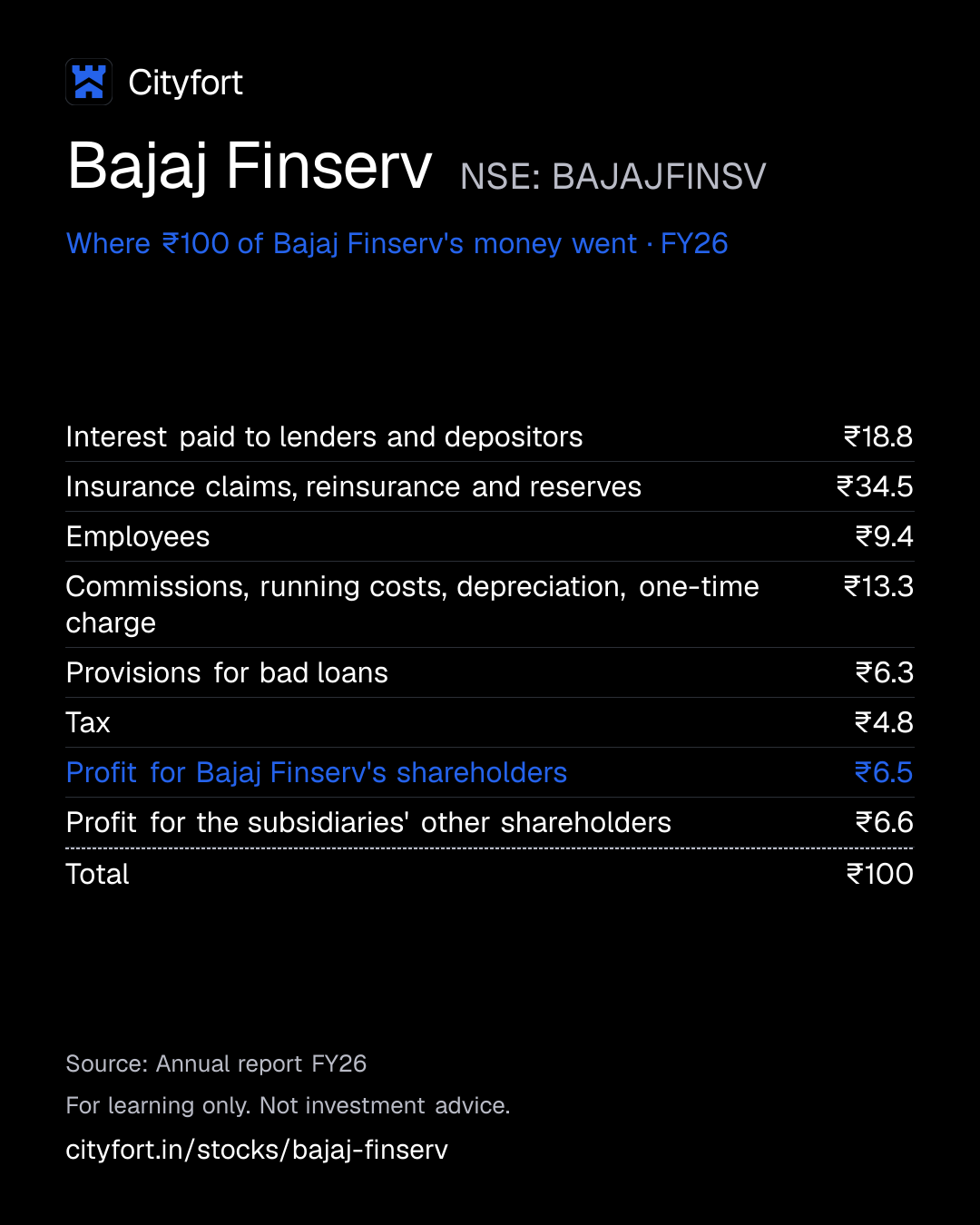
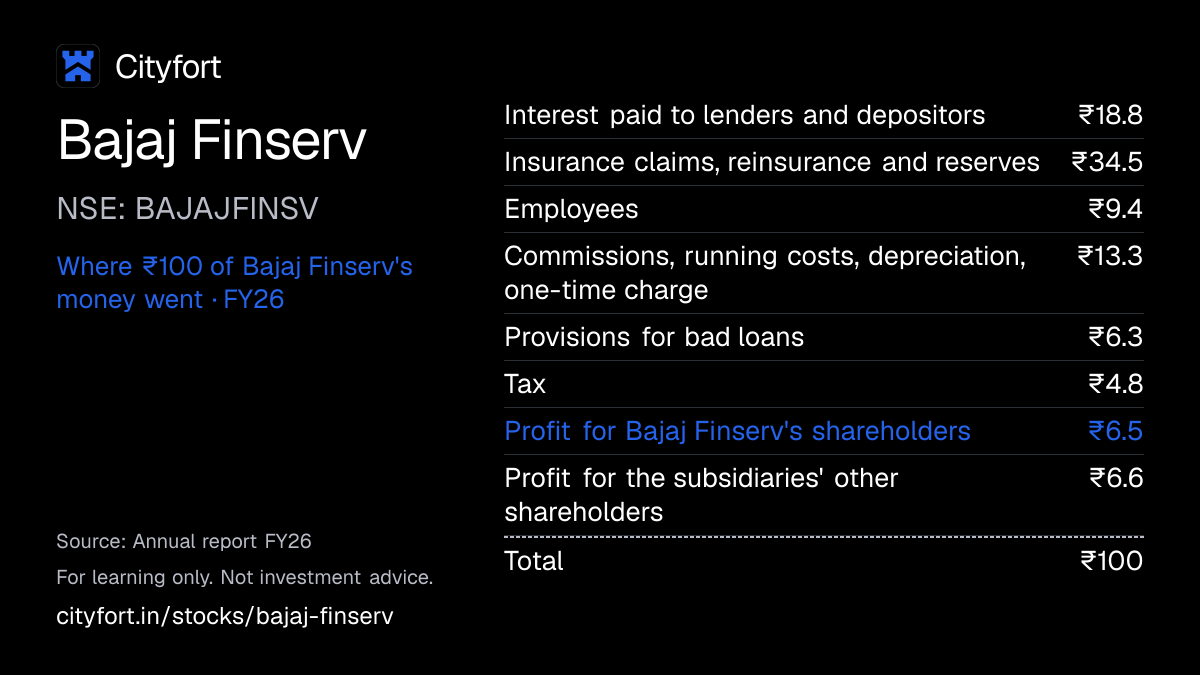
Where does ₹100 of Bajaj Finserv's money go?
Bajaj Finserv · FY26
Receipt for every ₹100
| Interest paid to lenders and depositors | ₹18.8 |
|---|---|
| Insurance claims, reinsurance and reserves | ₹34.5 |
| Employees | ₹9.4 |
| Commissions, running costs, depreciation, one-time charge | ₹13.3 |
| Provisions for bad loans | ₹6.3 |
| Tax | ₹4.8 |
| Profit for Bajaj Finserv's shareholders | ₹6.5 |
| Profit for the subsidiaries' other shareholders | ₹6.6 |
| Total | ₹100 |
Each line = amount ÷ total money in × 100. Lines may not add to exactly ₹100 because of rounding.
How this is worked out
Derived from moneyFlow: each line = line ÷ total money in (₹150,530 crore: revenue plus ₹27 crore of other income) × 100. Profit was ₹13.1 of every ₹100: ₹6.5 for Bajaj Finserv's shareholders and ₹6.6 for the subsidiaries' other shareholders (Cityfort calculation).
Save this receipt as an image
Embed this receipt or the key numbers
Paste this code into a blog or website to show the card you choose, with a link back to this page.
Each week: the next company due to report results, explained in 5 points.
We'll email you once a week with what changed on Cityfort. Facts only, no tips. Unsubscribe any time.
We store your email address with Kit, our email provider, which also records when you sign up and whether you open or click our emails. We send a confirmation email first. See our privacy policy.
02The business in one line
What does Bajaj Finserv do?
Borrowers and insurance buyers pay Bajaj Finserv's companies; in FY26 claims, reserves and interest took ₹53.2 of every ₹100, and ₹13.1 was profit.
- Bajaj Finserv owned 51.30% of the lender Bajaj Finance and 77.33% of each of its two insurers at 30 Sep 2026.
- So only about half of the group's profit is Bajaj Finserv's: ₹9,801 crore of ₹19,669 crore in FY26. The rest belongs to the subsidiaries' other shareholders.
03Who pays it
Who pays Bajaj Finserv?
Borrowers of Bajaj Finance and Bajaj Housing Finance
53.1%
of revenue
Interest and fees on loans: retail financing revenue of ₹81,990 crore in FY26.
General insurance buyers
22.4%
of revenue
Premiums and investment income at Bajaj General: ₹34,650 crore in FY26, including crop and government health schemes.
Life insurance buyers
22.1%
of revenue
Premiums and investment income at Bajaj Life: ₹34,210 crore in FY26.
Other businesses, investments and windmills
2.4%
of revenue
Health, online marketplace, mutual fund, Bajaj Finserv's own investment income and windmill power: ₹3,643 crore in FY26.
- Borrowers of Bajaj Finance and Bajaj Housing Finance53.1%
- General insurance buyers22.4%
- Life insurance buyers22.1%
- Other businesses, investments and windmills2.4%
How spread out the customers are
Shares are of FY26 segment revenue before removing ₹3,963 crore of sales between group companies (Cityfort calculation). No large single customer is disclosed; Bajaj Finance had 12.88 crore customers at 30 Sep 2026.
04How it makes money
How does Bajaj Finserv make money?
Bajaj Finserv's profit mostly tracks Bajaj Finance's lending profit; the insurers add a smaller share.
Bajaj Finance earns more interest on loans than it pays on borrowings, after bad-loan costs. In Bajaj Finserv's own FY26 table, Bajaj Finance gave ₹9,764 crore of the ₹10,504 crore profit before investment value changes (93.0%, Cityfort calculation). General insurance added ₹1,441 crore.
Profit for Bajaj Finserv's shareholders per ₹100 of group revenue
₹6.7₹6.5
FY22 to FY26
- Bajaj Finance borrows money from bondholders, banks and depositors.
- It lends to customers at higher rates and earns the gap, less bad-loan costs.
- The insurers collect premiums, pay claims and invest the money in between.
- Each subsidiary's profit is split by ownership: 51.30% of Bajaj Finance and 77.33% of each insurer go to Bajaj Finserv.
- Subsidiaries pay dividends to Bajaj Finserv: ₹1,788 crore in FY26.
- Bajaj Finserv pays its own dividend and funds new businesses and stakes.
↺ Step 6 feeds back into step 1.
05Business segments · FY26
Which businesses make up Bajaj Finserv?
Retail financing (Bajaj Finance)
53.1%Loans by Bajaj Finance and its subsidiaries. Segment profit before tax: ₹25,601 crore.
Revenue ₹81,990 cr · Operating profit ₹25,601 cr
General insurance
22.4%Bajaj General: premiums plus investment income. Segment profit before tax: ₹1,975 crore.
Revenue ₹34,650 cr · Operating profit ₹1,975 cr
Life insurance
22.1%Bajaj Life: premiums plus investment income. Segment profit before tax: ₹197 crore.
Revenue ₹34,210 cr · Operating profit ₹197 cr
Investments, other businesses and windmills
2.4%Bajaj Finserv's own investments, health, online marketplace, mutual fund and windmills. Segment result: a ₹890 crore loss.
Revenue ₹3,643 cr · Operating profit −₹890 cr
How the mix changed
- Retail financing (Bajaj Finance)
- General insurance
- Life insurance
- Investments, other businesses and windmills
Revenue by segment, FY22 to FY26.
₹ crore
See the numbers
06The numbers · Consolidated · ₹ crore
How has Bajaj Finserv done?
Revenue
₹150,504 crFY26
Revenue rose every year, from ₹68,406 crore in FY22 to ₹150,504 crore in FY26 (FY25 and Q4 FY25–Q3 FY26 as restated in 2026; Q3 FY25 not restated).
₹ crore
See the numbers
Net profit
₹9,801 crFY26
Profit for Bajaj Finserv's shareholders rose every year, from ₹4,557 crore in FY22 to ₹9,801 crore in FY26, out of ₹19,669 crore of total group profit.
₹ crore
See the numbers
Net profit for every ₹100 of revenue
₹6.5FY26
Profit for Bajaj Finserv's shareholders was between ₹6.5 and ₹7.8 per ₹100 of revenue in each year from FY22 to FY26.
Net margin: ₹ of net profit per ₹100 of revenue
See the numbers
Free cash flow is not shown because new loans count as operating cash flow (negative every year, ₹55,301 crore out in FY26); EBITDA is not shown because interest paid is Bajaj Finance's main cost of lending.
See all yearly numbers
EBITDA = profit before interest, tax and wear-and-tear of assets. Financial year runs April to March (March year end). Net profit is the share belonging to the company's owners. Total net income differs from net profit to the company's owners: Total profit includes the share of the subsidiaries' other shareholders, mainly Bajaj Finance's outside shareholders.
Sources (16)
- Annual Report FY23 (16th, 2022-23), file AR_2022_2023.pdf inside the NSE zip
- Annual Report FY24 (17th, 2023-24)
- Annual Report FY25 (18th, 2024-25)
- Annual Report FY26 (19th, 2025-26), incl. consolidated financial statements and BRSR
- Financial results XBRL, consolidated, Q3 FY25
- Outcome of board meeting: unaudited results Q3 FY26 (quarter to 31 Dec 2025) with press release
- Integrated filing (financials) XBRL, consolidated, Q4 FY25 and FY25
- Outcome of board meeting: audited results FY26 and Q4 FY26 with press release
- Integrated filing (financials) XBRL, consolidated, Q1 FY26
- Outcome of board meeting: unaudited results Q1 FY27 (quarter to 30 Jun 2026) with press release
- Integrated filing (financials) XBRL, consolidated, Q2 FY26
- Outcome of board meeting: unaudited results Q2 FY27 (quarter and half year to 30 Sep 2026) with press release
- Integrated filing (financials) XBRL, consolidated, Q3 FY26
- Integrated filing (financials) XBRL, consolidated, Q4 FY26 and FY26
- Integrated filing (financials) XBRL, consolidated, Q1 FY27
- Integrated filing (financials) XBRL, consolidated, Q2 FY27
07Who runs it
Who runs Bajaj Finserv, and did they deliver?
Sanjiv Bajaj
Chairman and Managing Director
Promoter executive director.
Ramandeep Singh Sahni
Chief Financial Officer
Speaks for the company on results calls.
Dr. Naushad Forbes
Independent director, audit committee chair
Tapan Singhel
MD and CEO, Bajaj General Insurance
Leads until 31 Mar 2027 under IRDAI's 15-year tenure cap; Deepak Reddy is CEO designate from 1 Apr 2027, subject to IRDAI approval.
Tarun Chugh
MD and CEO, Bajaj Life Insurance
What they said, and what happened
1 delivered · 4 too early to tell
Said on 17 Mar 2025
Buy Allianz's 26% stake in each insurer with Bajaj group companies, taking Bajaj Finserv to 75.01%.
DeliveredWhat happened
The 23% tranche closed on 8 Jan 2026 (75.01%). Allianz tendered its last 3% in buybacks on 12 Mar 2026, taking Bajaj Finserv to 77.33%.
Said on 31 Jul 2026
The CFO said Bajaj Finserv Direct (Bajaj Markets) would break even on a quarterly basis in Q3 or Q4 FY27.
Too early to tellWhat happened
Q2 FY27 loss ₹28 crore, against ₹45 crore a year earlier. On 3 Nov 2026 the CFO said it was on track for Q4.
Said on 31 Jul 2026
The CFO said Bajaj Finserv Health should break even quarterly in Q3 or Q4 FY28, and for a full year the year after.
Too early to tellWhat happened
Q2 FY27 loss ₹58 crore, against ₹32 crore a year earlier.
Said on 3 Nov 2026
The CFO said the mutual fund business needs about ₹300 crore more until break-even, probably in FY29.
Too early to tellWhat happened
Bajaj Asset Management lost ₹45 crore in Q2 FY27.
Said on 8 Jul 2026
The FY26 annual report said Bajaj Life's retail premium growth was expected to return to normal in FY27.
Too early to tellWhat happened
Retail premium (RWRP) grew 10.1% in H1 FY27, after 6.3% in FY26.
Sources (8)
- Annual Report FY26 (19th, 2025-26), incl. consolidated financial statements and BRSR
- Earnings call transcript Q2 FY27 (call 3 Nov 2026)
- Reg. 30: Bajaj General press release, Deepak Reddy CEO designate from 1 Apr 2027
- Reg. 30: share purchase agreements to buy Allianz SE's 26% in Bajaj Allianz General and Bajaj Allianz Life; BFDL stake
- Reg. 30: acquisition of 23% of Bajaj General and Bajaj Life from Allianz SE completed (with press release)
- Reg. 30: Allianz SE tendered its remaining 3% in the insurers' buybacks; BFS stake 77.33%
- Earnings call transcript Q1 FY27 (call 31 Jul 2026)
- Investor presentation Q2 FY27
08What could go wrong
What could go wrong for Bajaj Finserv?
- Concentration
Profit depends on Bajaj Finance
Bajaj Finance gave 93.0% of the FY26 profit Bajaj Finserv attributes to its shareholders before investment value changes (Cityfort calculation from the company's table). A slowdown or loan losses there would show directly.
Watch Bajaj Finance's quarterly profit for its owners (₹6,267 crore in Q2 FY27).
- Debt
Bad loans
Provisions for bad loans rose from ₹7,070 crore in FY25 to ₹9,480 crore in FY26. Bajaj Finance's gross bad loans were 1.06% of loans at 30 Sep 2026, against 1.24% a year earlier.
Watch Bajaj Finance's gross NPA (bad loans) ratio each quarter.
- Pricing
General insurance underwriting losses
Bajaj General's claims and costs exceeded premiums: combined ratio 104.5% in Q2 FY27, against 102.3% in Q2 FY26. It had an underwriting loss of ₹441 crore in FY26.
Watch Bajaj General's combined ratio each quarter.
- Regulation
Insurance rules are changing
The CFO said Ind AS accounting applies to the insurers from 1 Apr 2027, and Bajaj Life's CEO expects risk-based capital rules by then too. Bajaj Life said a draft IRDAI paper on expenses and commissions would need compliance by the end of FY29.
Watch Final IRDAI rules on expenses, commissions and capital.
- Competition
Life insurance growing slower than the market
Bajaj Life's retail premium grew 6.3% in FY26, against 10.2% for the industry. Its share fell from 5.9% to 5.7%.
Watch Bajaj Life's retail premium growth against the industry (10.1% for Bajaj Life in H1 FY27).
- Execution
Loss-making new businesses
Health, Bajaj Markets, the mutual fund and other new businesses lost ₹142 crore together in Q2 FY27. The reinsurance company still needs approvals.
Watch Quarterly profit or loss of Bajaj Finserv Health and Bajaj Finserv Direct.
- Other
Investment value swings
The insurers' share investments are marked to market. Unrealised value losses cut profit for Bajaj Finserv's shareholders by ₹434 crore in FY26 (company table). Group revenue included a ₹1,824 crore investment value loss.
Watch Market-value (MTM) changes in each quarter's results.
Sources (5)
09Supporters and critics
What do supporters and critics point to?
What supporters point to
- Profit for Bajaj Finserv's shareholders rose every year, from ₹4,557 crore in FY22 to ₹9,801 crore in FY26.
- Bajaj Finserv itself has no debt, and had ₹4,702 crore of surplus funds at 30 Sep 2026.
- Bajaj Finance's loans grew from ₹462,261 crore to ₹584,624 crore in the year to Sep 2026, while gross bad loans fell to 1.06%.
- Bajaj Life's new business margin rose to 21.6% in Q2 FY27, from 17.1% a year earlier.
- Bajaj Finserv's stake in each insurer rose from 74% to 77.33% in 2026 after Allianz's exit.
What critics point to
- About half the group's profit belongs to other shareholders: Bajaj Finserv's share was ₹9,801 crore of ₹19,669 crore in FY26.
- Bajaj General's combined ratio was above 100% in every period shown, 104.5% in Q2 FY27.
- Bajaj Life's retail premium grew 6.3% in FY26, against 10.2% for the industry.
- New businesses lost ₹142 crore in Q2 FY27; their break-even dates are management's statements.
- Bajaj General's solvency fell from 339% to 229% in the year to Sep 2026, after a buyback and a dividend.
10What to watch next
What should you watch next at Bajaj Finserv?
Next event
Q3 FY27 results (date not announced)
Date not announced yet.
Bajaj Finance's bad loans
Gross bad loans were 1.06% of loans at 30 Sep 2026. Bajaj Finance supplies most of Bajaj Finserv's profit.
Bajaj General's combined ratio
It was 104.5% in Q2 FY27, against 102.3% a year earlier; above 100% means an underwriting loss.
New businesses
The CFO said on 3 Nov 2026 that Bajaj Markets was on track for quarterly break-even in Q4 FY27. Bajaj Reinsurance awaits approvals.
11Key facts
Key facts about Bajaj Finserv
- What does Bajaj Finserv do?
- Bajaj Finserv is a Pune holding company. It owns 51.30% of the lender Bajaj Finance and 77.33% each of Bajaj General Insurance and Bajaj Life Insurance (30 Sep 2026). On its own it runs only 138 windmills.
- How does Bajaj Finserv make money?
- Bajaj Finserv earns its share of its subsidiaries' profits. In FY26 the group earned ₹79,956 crore of interest and ₹63,134 crore of insurance income. Bajaj Finance supplied ₹9,764 crore of the ₹10,504 crore profit Bajaj Finserv attributes to its shareholders before investment value changes.
- Who are Bajaj Finserv's customers?
- Bajaj Finserv's customers are borrowers and insurance buyers in India. In FY26 lending brought in 53.1% of segment revenue, general insurance 22.4% and life insurance 22.1%. Bajaj Finance had 12.88 crore customers at 30 Sep 2026.
- How big is Bajaj Finserv?
- Bajaj Finserv's group revenue was ₹150,504 crore in FY26, up from ₹132,943 crore in FY25. Profit for Bajaj Finserv's shareholders was ₹9,801 crore, and total group profit ₹19,669 crore.
- Who owns Bajaj Finserv?
- At 30 Sep 2026 the Bajaj promoter group owned 58.65% of Bajaj Finserv, including 38.38% held by Bajaj Holdings & Investment. Foreign institutions held 8.16%, Indian institutions 11.10% and other investors 21.97%.
- How are Bajaj Finserv and Bajaj Finance related?
- Bajaj Finance is a separately listed lender. Bajaj Finserv owned 51.30% of Bajaj Finance at 30 Sep 2026, so Bajaj Finance's results are included in Bajaj Finserv's consolidated accounts.
- Does Allianz still own part of the Bajaj insurers?
- No. Allianz sold 23% of each of Bajaj General and Bajaj Life to Bajaj group companies in Jan 2026. It tendered its last 3% in the insurers' buybacks in Mar 2026. Bajaj Finserv's stake in each insurer rose from 74% to 77.33%.
- Does Bajaj Finserv have debt?
- Bajaj Finserv itself has issued no debt and takes no deposits (FY26 annual report). The group's ₹494,037 crore of borrowings at 30 Sep 2026 sits almost entirely in Bajaj Finance and Bajaj Housing Finance, which borrow to lend.
Sources (7)
- Outcome of board meeting: unaudited results Q2 FY27 (quarter and half year to 30 Sep 2026) with press release
- Annual Report FY26 (19th, 2025-26), incl. consolidated financial statements and BRSR
- Investor presentation Q2 FY27
- Shareholding pattern as of 30 Sep 2026 (XBRL)
- Reg. 30: acquisition of 23% of Bajaj General and Bajaj Life from Allianz SE completed (with press release)
- Reg. 30: Allianz SE tendered its remaining 3% in the insurers' buybacks; BFS stake 77.33%
- Integrated filing (financials) XBRL, consolidated, Q2 FY27
Terms on this page
- Capital expenditure (capex)
- Dividend payout ratio
- FII and DII holding
- Market capitalisation
- Net debt
- Net profit
- Promoter holding
- Public shareholding
- Revenue from operations
- Segment revenue
Each explains the term in plain English, with the same number from other companies on Cityfort.
Go deeper
More detail from the same filings. Open any section.
12What it sells
12What it sells
What does Bajaj Finserv sell?
Loans (Bajaj Finance, 51.30% owned)
Retail loans through Bajaj Finance and home loans through its arm Bajaj Housing Finance. Loans managed: ₹584,624 crore at 30 Sep 2026.
General insurance (Bajaj General, 77.33% owned)
Non-life cover, including crop insurance and government health schemes. Gross premium written: ₹23,326 crore in FY26, 7.1% of India's direct premium.
Life insurance (Bajaj Life, 77.33% owned)
Unit-linked (43% of FY26 retail premium), savings, annuity and term plans. Gross premium written: ₹32,896 crore in FY26.
Smaller businesses
Bajaj Finserv Health, the Bajaj Markets online marketplace, a mutual fund (Bajaj Asset Management), alternative funds and a distribution arm. Together they lost ₹142 crore in Q2 FY27.
Windmills
Bajaj Finserv itself runs 138 windmills with 65.2 MW of capacity. Windmill revenue was ₹24 crore in FY26.
Think of it like this
Like a parent that owns majority stakes in a few large family businesses: it earns mainly through their profits and dividends, not its own sales.
What it does
- Does: Owns controlling stakes in a lender, a general insurer and a life insurer.
- Does: Puts money into new group businesses: ₹5,800 crore of Bajaj Finance warrants subscribed on 10 Nov 2026.
- Does: Runs 138 windmills directly; everything else happens in its subsidiaries.
What it does not do
- Does not: Is not Bajaj Finance: that is a separately listed company, 51.30% owned by Bajaj Finserv.
- Does not: Has no borrowings of its own: Bajaj Finserv has issued no debt and runs no deposit scheme.
- Does not: Is no longer partnered with Allianz: Allianz sold its last stakes in Mar 2026.
- Does not: Does not make vehicles: it was demerged from Bajaj Auto in 2008.
Sources (4)
- Outcome of board meeting: unaudited results Q2 FY27 (quarter and half year to 30 Sep 2026) with press release
- Investor presentation Q2 FY27
- Annual Report FY26 (19th, 2025-26), incl. consolidated financial statements and BRSR
- Reg. 30: Allianz SE tendered its remaining 3% in the insurers' buybacks; BFS stake 77.33%
13How the money flows
13How the money flows · FY26
How does money flow through Bajaj Finserv?
Money in
- Interest earned, mostly on Bajaj Finance's loans₹79,956 cr
- Insurance premiums and other insurance income₹63,134 cr
- Fees, services and other income, after a ₹1,824 crore investment value loss₹7,414 cr
- Other income₹27 cr
The company
Bajaj Finserv
₹150,531 cr came in
Money out
- Interest paid to lenders and depositors₹28,232 cr
- Insurance claims, reinsurance and reserves for policyholders₹51,885 cr
- Employees₹14,122 cr
- Commissions, running costs, depreciation and a ₹379 crore labour-code charge₹19,945 cr
- Provisions for bad loans₹9,480 cr
- Tax₹7,214 cr
- Net profit, all shareholders (₹9,801 crore for Bajaj Finserv's)₹19,669 cr
- In FY26 the group earned ₹79,956 crore of interest, mostly on Bajaj Finance's loans, and ₹63,134 crore from insurance.
- It paid ₹28,232 crore of interest, almost all on money Bajaj Finance borrowed to lend.
- The insurers spent ₹51,885 crore on claims, reinsurance and reserves for future policy payouts.
- Staff cost ₹14,122 crore, provisions for bad loans ₹9,480 crore and tax ₹7,214 crore.
- ₹19,669 crore was left as profit; ₹9,801 crore of it belonged to Bajaj Finserv's shareholders.
14What it needs to run
14What it needs to run
What does Bajaj Finserv need to run?
Borrowed money
Bajaj Finance lends money it raises through bonds, bank loans and deposits. Group borrowings were ₹494,037 crore at 30 Sep 2026.
Capital and regulators' approval
The regulator sets a minimum solvency ratio (capital held ÷ capital required) of 150% for insurers. Bajaj General held 229% and Bajaj Life 255% at 30 Sep 2026.
People and branches
The group had 113,732 permanent employees and 122,658 other workers, and 4,991 offices in India at 31 Mar 2026.
Agents and sales partners
Bajaj Life had over 160,000 agents in FY26, and its direct sales arm had 465 branches.
15Competitors and what protects it
15Competitors and what protects it
Who does Bajaj Finserv compete with?
LIC
NSE: LICI
Bajaj Finserv's FY26 annual report shows LIC's retail life premium (RWRP) at ₹37,189 crore, up 5.2%, against Bajaj Life's ₹7,514 crore.
Other private life insurers combined
Private life insurers' retail premium was ₹95,479 crore in FY26, up 12.3%; Bajaj Life had 7.9% of the private total.
Public-sector general insurers combined
They wrote ₹102,580 crore of direct general insurance premium in FY26, per industry data in Bajaj Finserv's annual report.
Standalone health insurers combined
Health-only insurers wrote ₹45,866 crore of premium in FY26, up 19.4%, faster than the 9.4% industry growth.
What protects the business
Each strength is scored 1 (weak) to 5 (strong) for the business, with the reason. It is not a rating of the share.
- Scale in lending4 of 5
Bajaj Finance managed ₹584,624 crore of loans and had 12.88 crore customers at 30 Sep 2026.
- Capital4 of 5
Bajaj Finserv has no debt of its own and had ₹4,702 crore of surplus funds at 30 Sep 2026. Both insurers held more than the 150% minimum solvency.
- Distribution3 of 5
The group had 4,991 offices in India at 31 Mar 2026; Bajaj Life had over 160,000 agents.
Weak spot
Insurance growth against the market
In FY26 Bajaj Life's retail premium grew 6.3% against 10.2% for the industry, and its share fell from 5.9% to 5.7%. Bajaj General's direct premium grew 8.2% against 9.4%.
16Where growth could come from
16Where growth could come from
Where could Bajaj Finserv's growth come from?
Bajaj Finserv gives no numeric guidance; on the 3 Nov 2026 call management said "we do not give a guidance". On the same call the CFO said new businesses would need less than ₹2,000 crore over 18 months, against a surplus of about ₹4,700 crore.
Bajaj Finance loan growth
WorkingLoans managed ₹462,261 cr → ₹584,624 cr, Sep 2025–Sep 2026
Bajaj Finance's profit for its owners rose from ₹4,876 crore in Q2 FY26 to ₹6,267 crore in Q2 FY27.
Status: Working, on track against what the company said.
Bigger stakes in the insurers
New74% → 77.33% of each insurer, Jan–Mar 2026
After Allianz's exit, Bajaj Finserv's share of each insurer's profit is larger from Q4 FY26. Promoter-group companies bought most of the rest.
Status: New, recently announced.
Bajaj Life new business margin
Working17.1% → 21.6%, Q2 FY26 → Q2 FY27
Value of new business, the expected profit on policies sold in the quarter, rose from ₹367 crore to ₹512 crore.
Status: Working, on track against what the company said.
Health, Bajaj Markets and the mutual fund
Early₹142 cr combined loss of other businesses, Q2 FY27
All three lost money in Q2 FY27. Break-even dates are management's statements (see promises below).
Status: Early, too early to judge.
Reinsurance
NewBajaj Reinsurance incorporated 17 Oct 2026
The new company needs regulatory approval before it can operate. On 3 Nov 2026 the CFO said it would need about ₹500 crore over 2 to 3 years.
Status: New, recently announced.
Status compares progress with what the company itself said it would do: Working = on track against what the company said; Mixed = partly on track; Behind = behind the company's own plan; New = recently announced; Early = too early to judge.
Sources (5)
- Earnings call transcript Q2 FY27 (call 3 Nov 2026)
- Investor presentation Q2 FY27
- Reg. 30: acquisition of 23% of Bajaj General and Bajaj Life from Allianz SE completed (with press release)
- Reg. 30: Allianz SE tendered its remaining 3% in the insurers' buybacks; BFS stake 77.33%
- Reg. 30: incorporation of wholly owned subsidiary Bajaj Reinsurance Limited
17Financial strength and debt
17Financial strength · 30 Sep 2026
How much debt does Bajaj Finserv have?
- Total debt₹494,037 cr
- Cash and investments₹66,164 cr
- Net debt (debt minus cash)₹427,873 cr
- Net worth (shareholders' money)₹83,974 cr
- Borrowings are bonds, bank loans, deposits and subordinated debt of the lending companies. They fund loans of ₹575,455 crore.
- Cash here is cash, bank balances and shareholders' investments. ₹161,089 crore of policyholders' investments is left out, because it backs insurance promises.
- Borrowings were 3.26 times total equity (including the subsidiaries' other shareholders) at 30 Sep 2026, up from 2.42 at 31 Mar 2022 (Cityfort calculation). This reflects Bajaj Finance's lending, not debt of Bajaj Finserv.
- Bajaj Finserv's own (standalone) net worth was ₹12,902 crore and its surplus funds ₹4,702 crore at 30 Sep 2026. On 10 Nov 2026 it subscribed for ₹5,800 crore of Bajaj Finance warrants; the CFO said 25% is paid now and the rest over 18 months.
- Bajaj Finserv has no credit rating: its FY26 annual report says it has issued no debt and runs no deposit scheme. Its subsidiaries are rated separately.
Sources (7)
- Integrated filing (financials) XBRL, consolidated, Q2 FY27
- Outcome of board meeting: unaudited results Q2 FY27 (quarter and half year to 30 Sep 2026) with press release
- Investor presentation Q2 FY27
- Annual Report FY26 (19th, 2025-26), incl. consolidated financial statements and BRSR
- Annual Report FY23 (16th, 2022-23), file AR_2022_2023.pdf inside the NSE zip
- Reg. 30: subscription to 5,74,25,740 Bajaj Finance warrants at Rs 1,010 each
- Earnings call transcript Q2 FY27 (call 3 Nov 2026)
18Who owns it
18Who owns it · Q2 FY27
Who owns Bajaj Finserv?
- Promoters (founders or parent company)58.7%
- Foreign institutions (FII)8.2%
- Indian institutions (DII)11.1%
- Public and others22.1%
Promoter pledge
No promoter shares were pledged in Q2 FY27.
How ownership changed
* Pledged = share of the promoters' own holding reported as pledged. In older filings this can include shares “otherwise encumbered”; the governance flags say when.
† Others = Employee share trust.
Sources (12)
- Shareholding pattern as of 30 Sep 2026 (XBRL)
- Shareholding pattern as of 30 Jun 2026 (XBRL)
- Shareholding pattern as of 31 Mar 2026 (XBRL)
- Shareholding pattern as of 31 Dec 2025 (XBRL)
- Shareholding pattern as of 30 Sep 2025 (XBRL)
- Shareholding pattern as of 30 Jun 2025 (XBRL)
- Shareholding pattern as of 31 Mar 2025 (XBRL)
- Shareholding pattern as of 31 Dec 2024 (XBRL)
- Shareholding pattern as of 30 Sep 2024 (XBRL)
- Shareholding pattern as of 30 Jun 2024 (XBRL)
- Shareholding pattern as of 31 Mar 2024 (XBRL)
- Shareholding pattern as of 31 Dec 2023 (XBRL), revised 22 May 2024 (promoter-group type corrected)
19What it does with profit
19What it does with profit
What does Bajaj Finserv do with its profit?
Dividend per share
₹1.50FY26
Dividend paid for each share, by financial year.
₹ per share
See the numbers
No buybacks or fund raises in the period covered.
20Governance signals
20Governance signals
What do Bajaj Finserv's governance filings show?
- Auditor
- KKC & Associates LLP (formerly Khimji Kunverji & Co LLP)
- Auditor changes
- None in the period covered
- Audit qualifications
- None reported
- Related-party dealings
- Bajaj Holdings & Investment, a promoter company, held 38.28% of Bajaj Finserv at 31 Mar 2026. In FY26 Bajaj Finserv paid it ₹61.27 crore of dividend and bought ₹23.50 crore of business support services from it. Deals between group companies cancel out in the consolidated accounts.
- Credit rating
- No public credit rating found
Flags to know about
related party · 8 Jan 2026
Promoter group bought most of Allianz's insurer stakes
Of the 23% bought from Allianz in Jan 2026 for ₹21,390 crore, Bajaj Finserv bought 1.01%. Promoter companies Bajaj Holdings & Investment (17.56%) and Jamnalal Sons (4.43%) bought the rest.
disclosure · 30 Apr 2026
Revenue regrouped in 2026
From the Q4 FY26 filing, earlier revenue was restated lower: FY25 from ₹133,821 crore to ₹132,943 crore, with the same amount taken off loan-loss costs. Profit did not change.
disclosure · 31 Jul 2026
Insurer figures use two accounting bases
The group accounts use Ind AS. The insurers' own figures (premiums, combined ratio, solvency, profit) follow IRDAI rules, so they do not add up to group numbers. The CFO said Ind AS applies to the insurers from 1 Apr 2027.
other · 30 Sep 2026
Promoter shares under a court undertaking
100,360 promoter-group shares (0.01%) are shown as encumbered under a 2020 Bombay High Court undertaking. The filing says they are not pledged.
other · 8 Jul 2026
Board seat to stay open
The FY26 annual report (filed 8 Jul 2026) said Rajiv Bajaj would retire by rotation at the 31 Jul 2026 annual meeting, and the board proposed not to fill the seat.
Sources (8)
- Annual Report FY26 (19th, 2025-26), incl. consolidated financial statements and BRSR
- Reg. 30: re-appointment of KKC & Associates LLP as statutory auditors (second 5-year term)
- Reg. 30: acquisition of 23% of Bajaj General and Bajaj Life from Allianz SE completed (with press release)
- Annual Report FY25 (18th, 2024-25)
- Outcome of board meeting: audited results FY26 and Q4 FY26 with press release
- Investor presentation Q2 FY27
- Earnings call transcript Q1 FY27 (call 31 Jul 2026)
- Shareholding pattern as of 30 Sep 2026 (XBRL)
21What the market paid
21What the market paid · price as of 11 Nov 2026
What did the market pay for Bajaj Finserv on 11 Nov 2026?
Price as of 11 Nov 2026 (shown for education; prices change daily).
Price as of 11 Nov 2026: ₹1,845.00, the NSE closing price. Market value: ₹295,580 crore on 1,602,061,346 shares (30 Sep 2026 count). P/E is the price divided by one year's profit per share: 30.1 on FY26 EPS of ₹61.3, and 27.7 on the four quarters to Sep 2026 (₹66.72). P/B divides the price by shareholders' money per share, ₹524.16 at 30 Sep 2026: 3.52. EV/EBITDA is not shown, because EBITDA does not fit a lending and insurance group.
- Share price
- ₹1,845.00
- Market value (market cap)
- ₹295,580 cr
- P/E
- 30.1×
- P/B
- 3.5×
Source: NSE capital-market bhavcopy, 11 Nov 2026; Shareholding pattern as of 30 Sep 2026 (XBRL); Annual Report FY26 (19th, 2025-26), incl. consolidated financial statements and BRSR and 4 more
Sources (7)
- NSE capital-market bhavcopy, 11 Nov 2026
- Shareholding pattern as of 30 Sep 2026 (XBRL)
- Annual Report FY26 (19th, 2025-26), incl. consolidated financial statements and BRSR
- Integrated filing (financials) XBRL, consolidated, Q2 FY27
- Integrated filing (financials) XBRL, consolidated, Q1 FY27
- Integrated filing (financials) XBRL, consolidated, Q4 FY26 and FY26
- Integrated filing (financials) XBRL, consolidated, Q3 FY26
22How it got here
22How it got here
How did Bajaj Finserv get here?
2007
Milestone
Incorporated
Bajaj Finserv was incorporated in Pune on 30 Apr 2007.
2008
Business-model change
Demerged from Bajaj Auto
The financial businesses were split out of Bajaj Auto into Bajaj Finserv, which then listed.
2022
Milestone
Share split and bonus
Each ₹5 share was split into five ₹1 shares, followed by a 1:1 bonus issue on 15 Sep 2022.
2023
Milestone
Mutual fund licence
SEBI gave final registration to Bajaj Finserv Mutual Fund on 1 Mar 2023.
2025
Business-model change
Deal to buy out Allianz
On 17 Mar 2025 Bajaj group companies agreed to buy Allianz's 26% in each insurer for ₹24,180 crore in total.
2026
Business-model change
Allianz exits; insurers renamed
The deal closed in Jan and Mar 2026, leaving Bajaj Finserv with 77.33% of each insurer. They became Bajaj General and Bajaj Life.
2026
Milestone
Reinsurance company formed
Bajaj Reinsurance Ltd was incorporated on 17 Oct 2026, subject to regulatory approvals.
2026
Milestone
₹5,800 crore into Bajaj Finance warrants
On 10 Nov 2026 Bajaj Finserv subscribed for 5,74,25,740 Bajaj Finance warrants at ₹1,010 each.
Sources (8)
- Annual Report FY26 (19th, 2025-26), incl. consolidated financial statements and BRSR
- Annual Report FY23 (16th, 2022-23), file AR_2022_2023.pdf inside the NSE zip
- Reg. 30: share purchase agreements to buy Allianz SE's 26% in Bajaj Allianz General and Bajaj Allianz Life; BFDL stake
- Reg. 30: acquisition of 23% of Bajaj General and Bajaj Life from Allianz SE completed (with press release)
- Reg. 30: Allianz SE tendered its remaining 3% in the insurers' buybacks; BFS stake 77.33%
- Outcome of board meeting: unaudited results Q2 FY27 (quarter and half year to 30 Sep 2026) with press release
- Reg. 30: incorporation of wholly owned subsidiary Bajaj Reinsurance Limited
- Reg. 30: subscription to 5,74,25,740 Bajaj Finance warrants at Rs 1,010 each
23Sources and changes
Where every number on this page comes from
Sources (40 documents)
- S1Annual Report FY26 (19th, 2025-26), incl. consolidated financial statements and BRSR · NSE (company filing, nsearchives.nseindia.com) · Tier 1: company or exchange filing · 8 Jul 2026
- S2Annual Report FY25 (18th, 2024-25) · NSE (company filing, nsearchives.nseindia.com) · Tier 1: company or exchange filing · 2 Jul 2025
- S3Annual Report FY24 (17th, 2023-24) · NSE (company filing, nsearchives.nseindia.com) · Tier 1: company or exchange filing · 27 Jun 2024
- S4Annual Report FY23 (16th, 2022-23), file AR_2022_2023.pdf inside the NSE zip · NSE (company filing, nsearchives.nseindia.com) · Tier 1: company or exchange filing · 4 Jul 2023
- S5Annual Report FY22 (15th, 2021-22), PDF inside the NSE zip · NSE (company filing, nsearchives.nseindia.com) · Tier 1: company or exchange filing · 5 Jul 2022
- S6Outcome of board meeting: unaudited results Q2 FY27 (quarter and half year to 30 Sep 2026) with press release · NSE (company filing, nsearchives.nseindia.com) · Tier 1: company or exchange filing · 3 Nov 2026
- S7Integrated filing (financials) XBRL, consolidated, Q2 FY27 · NSE (company filing, nsearchives.nseindia.com) · Tier 1: company or exchange filing · 3 Nov 2026
- S8Outcome of board meeting: unaudited results Q1 FY27 (quarter to 30 Jun 2026) with press release · NSE (company filing, nsearchives.nseindia.com) · Tier 1: company or exchange filing · 31 Jul 2026
- S9Integrated filing (financials) XBRL, consolidated, Q1 FY27 · NSE (company filing, nsearchives.nseindia.com) · Tier 1: company or exchange filing · 31 Jul 2026
- S10Outcome of board meeting: audited results FY26 and Q4 FY26 with press release · NSE (company filing, nsearchives.nseindia.com) · Tier 1: company or exchange filing · 30 Apr 2026
- S11Integrated filing (financials) XBRL, consolidated, Q4 FY26 and FY26 · NSE (company filing, nsearchives.nseindia.com) · Tier 1: company or exchange filing · 30 Apr 2026
- S12Outcome of board meeting: unaudited results Q3 FY26 (quarter to 31 Dec 2025) with press release · NSE (company filing, nsearchives.nseindia.com) · Tier 1: company or exchange filing · 4 Feb 2026
- S13Integrated filing (financials) XBRL, consolidated, Q3 FY26 · NSE (company filing, nsearchives.nseindia.com) · Tier 1: company or exchange filing · 4 Feb 2026
- S14Integrated filing (financials) XBRL, consolidated, Q2 FY26 · NSE (company filing, nsearchives.nseindia.com) · Tier 1: company or exchange filing · 11 Nov 2025
- S15Integrated filing (financials) XBRL, consolidated, Q1 FY26 · NSE (company filing, nsearchives.nseindia.com) · Tier 1: company or exchange filing · 26 Jul 2025
- S16Integrated filing (financials) XBRL, consolidated, Q4 FY25 and FY25 · NSE (company filing, nsearchives.nseindia.com) · Tier 1: company or exchange filing · 30 Apr 2025
- S17Financial results XBRL, consolidated, Q3 FY25 · NSE (company filing, nsearchives.nseindia.com) · Tier 1: company or exchange filing · 30 Jan 2025
- S18Investor presentation Q2 FY27 · NSE (company filing, nsearchives.nseindia.com) · Tier 1: company or exchange filing · 3 Nov 2026
- S20Earnings call transcript Q2 FY27 (call 3 Nov 2026) · NSE (company filing, nsearchives.nseindia.com) · Tier 1: company or exchange filing · 10 Nov 2026
- S21Earnings call transcript Q1 FY27 (call 31 Jul 2026) · NSE (company filing, nsearchives.nseindia.com) · Tier 1: company or exchange filing · 5 Aug 2026
- S24Shareholding pattern as of 30 Sep 2026 (XBRL) · NSE (company filing, nsearchives.nseindia.com) · Tier 1: company or exchange filing · 16 Oct 2026
- S25Shareholding pattern as of 30 Jun 2026 (XBRL) · NSE (company filing, nsearchives.nseindia.com) · Tier 1: company or exchange filing · 18 Jul 2026
- S26Shareholding pattern as of 31 Mar 2026 (XBRL) · NSE (company filing, nsearchives.nseindia.com) · Tier 1: company or exchange filing · 21 Apr 2026
- S27Shareholding pattern as of 31 Dec 2025 (XBRL) · NSE (company filing, nsearchives.nseindia.com) · Tier 1: company or exchange filing · 21 Jan 2026
- S28Shareholding pattern as of 30 Sep 2025 (XBRL) · NSE (company filing, nsearchives.nseindia.com) · Tier 1: company or exchange filing · 18 Oct 2025
- S29Shareholding pattern as of 30 Jun 2025 (XBRL) · NSE (company filing, nsearchives.nseindia.com) · Tier 1: company or exchange filing · 21 Jul 2025
- S30Shareholding pattern as of 31 Mar 2025 (XBRL) · NSE (company filing, nsearchives.nseindia.com) · Tier 1: company or exchange filing · 19 Apr 2025
- S31Shareholding pattern as of 31 Dec 2024 (XBRL) · NSE (company filing, nsearchives.nseindia.com) · Tier 1: company or exchange filing · 20 Jan 2025
- S32Shareholding pattern as of 30 Sep 2024 (XBRL) · NSE (company filing, nsearchives.nseindia.com) · Tier 1: company or exchange filing · 17 Oct 2024
- S33Shareholding pattern as of 30 Jun 2024 (XBRL) · NSE (company filing, nsearchives.nseindia.com) · Tier 1: company or exchange filing · 19 Jul 2024
- S34Shareholding pattern as of 31 Mar 2024 (XBRL) · NSE (company filing, nsearchives.nseindia.com) · Tier 1: company or exchange filing · 18 Apr 2024
- S35Shareholding pattern as of 31 Dec 2023 (XBRL), revised 22 May 2024 (promoter-group type corrected) · NSE (company filing, nsearchives.nseindia.com) · Tier 1: company or exchange filing · 22 May 2024
- S36Reg. 30: share purchase agreements to buy Allianz SE's 26% in Bajaj Allianz General and Bajaj Allianz Life; BFDL stake · NSE (company filing, nsearchives.nseindia.com) · Tier 1: company or exchange filing · 17 Mar 2025
- S37Reg. 30: acquisition of 23% of Bajaj General and Bajaj Life from Allianz SE completed (with press release) · NSE (company filing, nsearchives.nseindia.com) · Tier 1: company or exchange filing · 8 Jan 2026
- S38Reg. 30: Allianz SE tendered its remaining 3% in the insurers' buybacks; BFS stake 77.33% · NSE (company filing, nsearchives.nseindia.com) · Tier 1: company or exchange filing · 12 Mar 2026
- S41Reg. 30: incorporation of wholly owned subsidiary Bajaj Reinsurance Limited · NSE (company filing, nsearchives.nseindia.com) · Tier 1: company or exchange filing · 17 Oct 2026
- S43Reg. 30: subscription to 5,74,25,740 Bajaj Finance warrants at Rs 1,010 each · NSE (company filing, nsearchives.nseindia.com) · Tier 1: company or exchange filing · 10 Nov 2026
- S44Reg. 30: Bajaj General press release, Deepak Reddy CEO designate from 1 Apr 2027 · NSE (company filing, nsearchives.nseindia.com) · Tier 1: company or exchange filing · 23 Oct 2026
- S45Reg. 30: re-appointment of KKC & Associates LLP as statutory auditors (second 5-year term) · NSE (company filing, nsearchives.nseindia.com) · Tier 1: company or exchange filing · 30 Apr 2026
- S46NSE capital-market bhavcopy, 11 Nov 2026 · NSE (nsearchives.nseindia.com) · Tier 1: company or exchange filing · 11 Nov 2026
Changes to this page (v1 · 11 Nov 2026)
- v1 · 11 Nov 2026First version. (first version)
Numbers come only from tier 1 and tier 2 sources. Read how we research.
Disclaimer
For learning only. Cityfort is not a SEBI-registered adviser and does not recommend buying or selling any security. Prices shown are dated and may be out of date.
Investing in securities involves risk, including loss of capital. Before making any investment decision, do your own research and consider consulting a SEBI-registered investment adviser.
Cityfort, its owners and contributors may or may not hold securities of companies covered. Content is not an offer or solicitation to buy or sell any security.
Read the full disclaimerHide the full disclaimer
Cityfort publishes educational content that explains how listed companies work. Cityfort is not registered with the Securities and Exchange Board of India (SEBI) as an Investment Adviser or Research Analyst and does not provide investment advice, recommendations, ratings, price targets or any opinion on whether to buy, sell or hold any security.
All information is taken from publicly available sources, mainly company filings on BSE and NSE, which are listed on each page with dates. We work to keep it accurate and correct errors publicly, but we do not guarantee that it is complete, accurate or up to date. Any market price or price-based ratio shown is dated, may be out of date by the time you read it, and is included only to explain concepts.
Statements by company management are reported as statements, with their date and source; they are not our forecasts.