Financial Services · NSE: ANGELONE · BSE: 543235
Angel One: how the business works
Angel One runs a trading app and a network of over 10,000 authorised persons through which people in India trade shares and derivatives, earning ₹5,137 crore of revenue in FY26.
Follow Angel One
Email me when Angel One's page is updated after results.
We store your email address with Kit, our email provider, which also records when you sign up and whether you open or click our emails. We send a confirmation email first. See our privacy policy.
Angel One Limited · Mumbai, Maharashtra · Founded 1996
Updated for Q2 FY27 · checked
- Revenue, FY26
- ₹5,137 cr
- Profit, FY26
- ₹915 cr
- Client base, 30 Sep 2026
- 4.00 crore
- Employees (Angel One Ltd), FY26
- 2,942
- Promoter holding, 31 Mar 2026
- 28.80%
The short version
Angel One in 5 points
1 · What it sells
Angel One runs a trading app and a network of over 10,000 authorised persons through which people in India trade shares, futures and options and commodities, with revenue of ₹5,137 crore in FY26.
2 · Who pays it
In FY26, 59.7% of Angel One's total income was broking fees, 31.7% interest on client loans and bank deposits, 3.7% depository fees, 3.7% distribution income and 1.2% other fees and income.
3 · What it keeps from ₹100
Of every ₹100 that came in during FY26, Angel One kept ₹17.8 as profit after ₹126.73 crore of IPL sponsorship costs; ₹0.3 of the ₹100 was other income, and the company's own EBDAT margin was 35.0%.
4 · Where the operating profit comes from
Angel One reports one business segment, and ICRA's 13 Jul 2026 report says futures and options gave about 76% of its FY2026 gross broking income.
5 · The one thing to watch
Angel One's average client funding book rose from about ₹5,300 crore in FY26 to ₹7,450 crore in Q2 FY27, while borrowings reached ₹7,554.89 crore at 30 Sep 2026.
Sources: From Angel One's FY26 annual report, Q2 FY27 results, press release and presentation, and ICRA's rating report · checked
Sources (4)
- Annual Report FY26 (30th Annual Report 2025-26), standalone and consolidated financial statements
- Q2 FY27 results (quarter and six months to 30 Sep 2026), standalone and consolidated, with board outcome and 2nd interim dividend
- ICRA rationale: rated amount enhanced for commercial paper; ratings reaffirmed ([ICRA]AA- (Stable)/[ICRA]A1+)
- Q2 FY27 business performance highlights (press release)
01Where the money goes · FY26
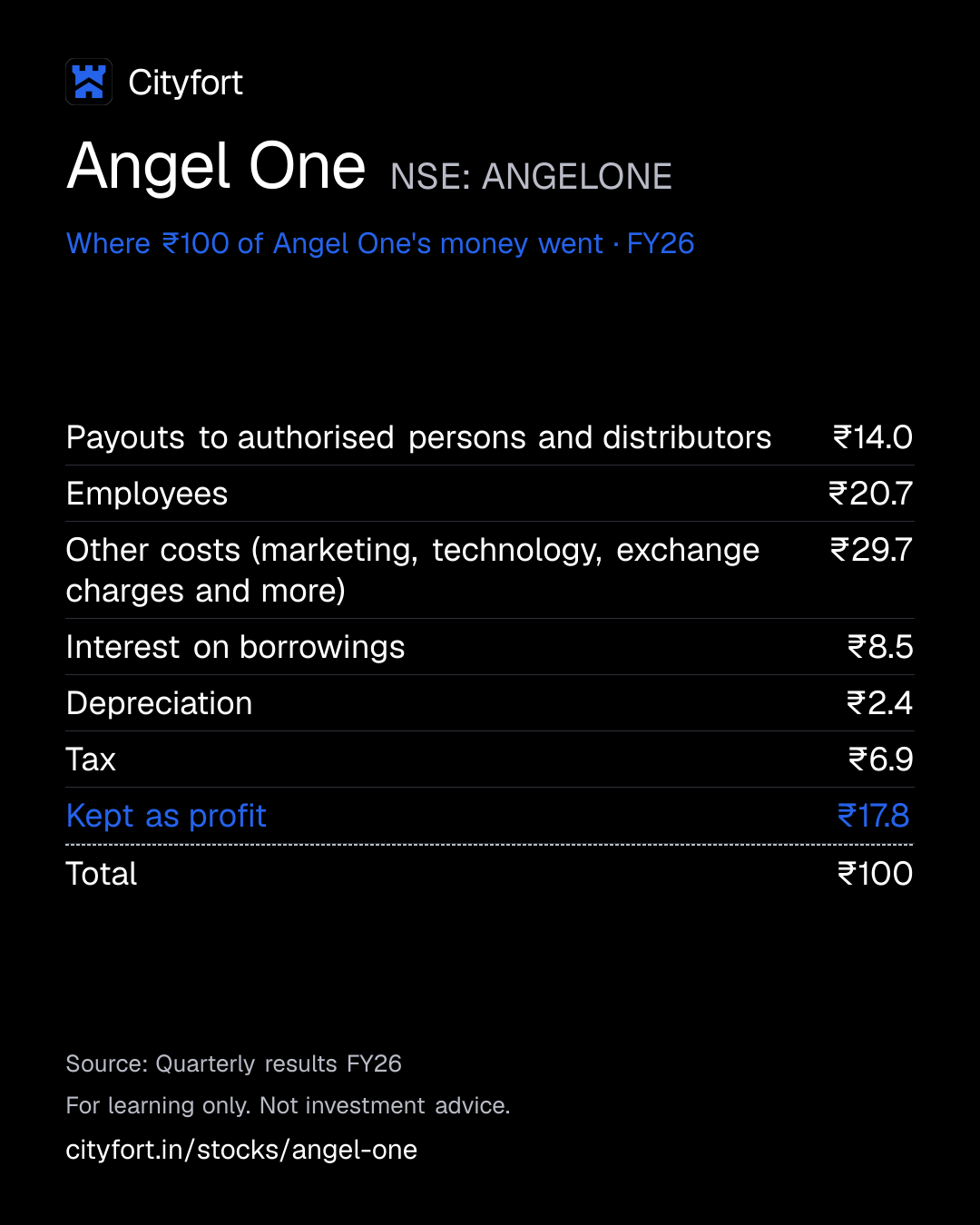
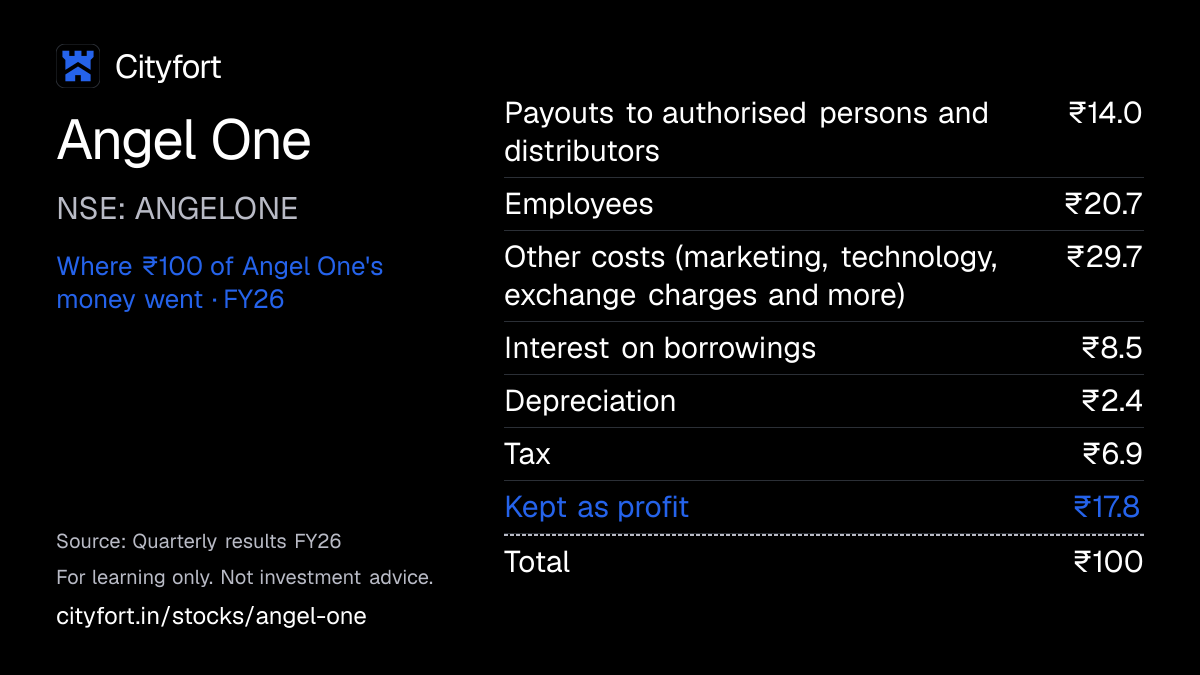
Where does ₹100 of Angel One's money go?
Angel One · FY26
Receipt for every ₹100
| Payouts to authorised persons and distributors | ₹14.0 |
|---|---|
| Employees | ₹20.7 |
| Other costs (marketing, technology, exchange charges and more) | ₹29.7 |
| Interest on borrowings | ₹8.5 |
| Depreciation | ₹2.4 |
| Tax | ₹6.9 |
| Kept as profit | ₹17.8 |
| Total | ₹100 |
Each line = amount ÷ total money in × 100. Lines may not add to exactly ₹100 because of rounding.
How this is worked out
Each line = line ÷ total money in × 100 (Cityfort calculation from the FY26 annual report). Money in is ₹5,152.24 crore: revenue ₹5,136.61 crore plus other income ₹15.63 crore, which is ₹0.3 of every ₹100. Other costs include ₹3.12 crore of impairment and a ₹0.13 crore loss from an associate.
Save this receipt as an image
Embed this receipt or the key numbers
Paste this code into a blog or website to show the card you choose, with a link back to this page.
Each week: the next company due to report results, explained in 5 points.
We'll email you once a week with what changed on Cityfort. Facts only, no tips. Unsubscribe any time.
We store your email address with Kit, our email provider, which also records when you sign up and whether you open or click our emails. We send a confirmation email first. See our privacy policy.
02The business in one line
What does Angel One do?
Traders pay Angel One a fee on each order and interest on money it lends them; most of the money goes on staff, partner payouts, marketing and technology, and in FY26 ₹17.8 of every ₹100 that came in was left as profit.
- Broking fees were 59.7% of FY26 total income and interest 31.7%, earned on loans to clients and on bank deposits.
- Profit fell 21.9% to ₹915 crore in FY26 after SEBI tightened rules on futures and options trading. Q2 FY27 profit was ₹335 crore, up 58.2% from a year earlier.
03Who pays it
Who pays Angel One?
Traders and investors (broking fees)
59.7%
of revenue
Fees on orders in shares, futures and options and commodities: gross broking income of ₹3,078.4 crore in FY26.
Margin trading clients and banks (interest)
31.7%
of revenue
₹1,631.7 crore of interest in FY26. About ₹840 crore came from the client funding book; the rest came mostly from bank deposits.
Clients holding shares (depository fees)
3.7%
of revenue
Charges for keeping clients' shares in demat accounts: ₹192.8 crore in FY26.
Fund houses and lenders (distribution)
3.7%
of revenue
Commissions for distributing mutual funds, loans and other products.
Other fees and income
1.2%
of revenue
The remaining 1.2% of FY26 total income, a Cityfort calculation (100 minus the shares above).
- Traders and investors (broking fees)59.7%
- Margin trading clients and banks (interest)31.7%
- Clients holding shares (depository fees)3.7%
- Fund houses and lenders (distribution)3.7%
- Other fees and income1.2%
How spread out the customers are
Shares are of FY26 consolidated total income (₹5,152.24 crore), as the FY26 annual report's management discussion splits it. Clients are individuals; the company does not disclose any customer concentration. The client base was 4.00 crore at 30 Sep 2026.
04How it makes money
How does Angel One make money?
Angel One earns more when clients place more orders, while much of its cost stays the same, so profit swings more than revenue.
In FY26 orders fell 10.9% and revenue 1.9%, but profit fell 21.9% as staff costs rose. Interest from the growing client funding book cushioned the fall: interest income rose 21.7%.
Profit kept per ₹100 of revenue (Cityfort calculation)
₹29.6₹17.8
FY23 to FY26
- Clients join through the app or authorised persons: 4.00 crore at 30 Sep 2026.
- Each order earns a fee; 1.5 billion orders were executed in FY26.
- Clients borrow to buy shares, and the funding book earns interest.
- Partner payouts move with orders, but staff, technology and brand costs mostly do not.
- When orders rise, more of each ₹100 is left as profit; when they fall, less is.
- Profit pays dividends and, with borrowing, funds the capital the client funding book needs.
↺ Step 6 feeds back into step 1.
05The numbers · Consolidated · ₹ crore
How has Angel One done?
Revenue
₹5,137 crFY26
Revenue rose every year from ₹2,291 crore in FY22 to ₹5,238 crore in FY25, fell 1.9% in FY26, and was ₹1,427 crore in Q2 FY27, up 18.7% from a year earlier.
₹ crore
See the numbers
Net profit
₹915 crFY26
Profit fell 21.9% to ₹915 crore in FY26; IPL sponsorship costs weigh on Q1 quarters (₹111.7 crore in Q1 FY26, ₹136.6 crore in Q1 FY27), and EPS for FY22–FY24 and Q3 FY25 is the filed figure divided by 10 for the 2026 share split (Cityfort calculation).
₹ crore
See the numbers
Net profit for every ₹100 of revenue
₹17.8FY26
EBITDA margin (Cityfort calculation, which adds back interest that mostly funds client loans) fell from 43.1% in FY23 to 35.4% in FY26, while the company's own EBDAT margin, after that interest, was 35.0% in FY26.
Net margin: ₹ of net profit per ₹100 of revenue
See the numbers
Free cash flow
−₹4,223 crFY26
Operating cash flow was negative from FY24 (−₹4,142 crore in FY26) because cash went into client loans and bank deposits placed with exchanges, funded by borrowing, so free cash flow here does not show what owners earned.
₹ crore · cash from operations minus spending on plants and equipment
See the numbers
See all yearly numbers
EBITDA = profit before interest, tax and wear-and-tear of assets. Financial year runs April to March (March year end). Net profit is the share belonging to the company's owners.
Sources (8)
- Annual Report FY23 (27th Annual Report 2022-23)
- Annual Report FY24 (28th Annual Report 2023-24)
- Annual Report FY25 (29th Annual Report 2024-25)
- Annual Report FY26 (30th Annual Report 2025-26), standalone and consolidated financial statements
- Q3 FY26 results (quarter and nine months to 31 Dec 2025)
- Q4 FY26 and FY26 audited results (quarter and year to 31 Mar 2026)
- Q1 FY27 results (quarter to 30 Jun 2026), standalone and consolidated
- Q2 FY27 results (quarter and six months to 30 Sep 2026), standalone and consolidated, with board outcome and 2nd interim dividend
06Who runs it
Who runs Angel One, and did they deliver?
Dinesh Thakkar
Founder, Chairman and Managing Director · since 1996
Promoter; held 18.41% of the shares at 31 Mar 2026.
Ambarish Kenghe
Group CEO and Whole-time Director
Vineet Agrawal
Chief Financial Officer
Naheed Patel
Company Secretary
What they said, and what happened
3 too early to tell
Said on 16 Jan 2026
Management said in the Q3 FY26 earnings call that "on an annual basis, we should be able to achieve 40-45% operating margin" for broking and distribution.
Too early to tellWhat happened
The range was given for coming years, in reply to questions on next year's costs including the IPL spend due in Q1 FY27. Standalone EBDAT margin was 36.6% in Q1 FY27 and 48.9% in Q2 FY27 (FY26: 38.1%).
Said on 17 Apr 2026
Management said in the Q4 FY26 call (17 Apr 2026) to look for a margin above 45% on broking and distribution, and in the Q2 FY27 call (16 Oct 2026) that it would endeavour to reach 45% for the year.
Too early to tellWhat happened
The standalone EBDAT margin was 36.6% in Q1 FY27, a quarter with ₹136.6 crore of IPL costs, and 48.9% in Q2 FY27. FY27 ends in Mar 2027.
Said on 16 Oct 2026
Management said in the Q2 FY27 call (16 Oct 2026) it would keep its guidance of about ₹1,100 crore of employee costs, including stock options, for FY27.
Too early to tellWhat happened
Employee costs were ₹524.13 crore in H1 FY27, against ₹1,067.05 crore for all of FY26.
Sources (7)
- Annual Report FY26 (30th Annual Report 2025-26), standalone and consolidated financial statements
- Q2 FY27 business performance highlights (press release)
- Q3 FY26 earnings call transcript
- Q2 FY27 investor presentation
- Q4 FY26 earnings call transcript (call of 17 Apr 2026)
- Q2 FY27 earnings call transcript (call of 16 Oct 2026)
- Q2 FY27 results (quarter and six months to 30 Sep 2026), standalone and consolidated, with board outcome and 2nd interim dividend
07What could go wrong
What could go wrong for Angel One?
- Concentration
Most broking income comes from futures and options
ICRA says futures and options gave about 76% of gross broking income in FY2026. They were 39% of gross income in Q2 FY27, the largest single stream.
Watch Futures and options orders in the monthly business updates (256 million in Q2 FY27).
- Regulation
SEBI rule changes for trading and brokers
SEBI's futures and options rules from the second half of FY25 cut orders; FY26 revenue fell 1.9% and profit 21.9%. In Q2 FY27 the company listed two more rule changes: revised bank funding norms for brokers and a closing auction session in cash shares.
Watch New SEBI circulars on derivatives and broker funding, and the effect the company reports each quarter.
- Debt
More borrowing to fund client loans
Borrowings rose from ₹3,382.83 crore at 31 Mar 2025 to ₹7,554.89 crore at 30 Sep 2026, and interest on borrowings from ₹135.95 crore in FY24 to ₹436.75 crore in FY26.
Watch Finance costs in each quarter's results (₹147.46 crore in Q2 FY27) and borrowings against equity.
- Cash and liquidity
Operating cash flow below profit
Operating cash flow was −₹329.90 crore in FY24, −₹1,859.84 crore in FY25 and −₹4,141.74 crore in FY26. Profit was positive in those years; the cash went into client loans and bank deposits with exchanges.
Watch Operating cash flow and the change in loans in the half-year and annual cash flow statements.
- Legal
Oversight of authorised persons
Over 10,000 authorised persons serve clients. In Jun 2026 Angel One paid about ₹4.28 crore to settle SEBI proceedings over alleged lapses in supervising them, without admitting or denying the findings.
Watch SEBI and exchange orders disclosed by the company, and the penalties listed in the annual report.
- Competition
Slower client additions and a falling commodity share
Gross client additions were 1.5 million in Q2 FY27, down 14.1% from a year earlier. The company's share of retail commodity turnover fell from 65.1% in Q2 FY26 to 44.0% in Q2 FY27.
Watch Client additions and turnover shares in the monthly business updates.
- Technology
Technology outages
ICRA notes 7 technical glitches reported on NSE in FY2026. The Cloudflare outage of 5 Dec 2025 hit the company's web platform.
Watch Outage disclosures to the exchanges and ICRA's next rating report.
Sources (8)
- ICRA rationale: rated amount enhanced for commercial paper; ratings reaffirmed ([ICRA]AA- (Stable)/[ICRA]A1+)
- Q2 FY27 investor presentation
- Q2 FY27 business performance highlights (press release)
- Annual Report FY26 (30th Annual Report 2025-26), standalone and consolidated financial statements
- Annual Report FY25 (29th Annual Report 2024-25)
- Q2 FY27 results (quarter and six months to 30 Sep 2026), standalone and consolidated, with board outcome and 2nd interim dividend
- Disclosure of SEBI settlement order (supervision of authorised persons, Rs 4,28,01,600)
- Clarification on media report of the 5 Dec 2025 Cloudflare outage
08Supporters and critics
What do supporters and critics point to?
What supporters point to
- Revenue rose from ₹2,291.11 crore in FY22 to ₹5,136.61 crore in FY26.
- Q2 FY27 profit was ₹334.97 crore, up 58.2% from ₹211.73 crore a year earlier.
- The client base was 4.00 crore at 30 Sep 2026, which the company puts at 16.6% of India's demat accounts.
- The average client funding book was ₹7,450 crore in Q2 FY27, up 40.5% from a year earlier.
- ICRA reaffirmed its [ICRA]AA- (Stable) rating on 13 Jul 2026.
What critics point to
- ICRA says futures and options gave about 76% of gross broking income in FY2026.
- Profit fell 21.9% to ₹915.10 crore in FY26, and profit per ₹100 of revenue fell from ₹29.6 in FY23 to ₹17.8.
- Borrowings rose from ₹3,382.83 crore at 31 Mar 2025 to ₹7,554.89 crore at 30 Sep 2026.
- Operating cash flow was negative in FY24, FY25 and FY26 (−₹4,141.74 crore).
- Angel One paid about ₹4.28 crore in Jun 2026 to settle SEBI proceedings over alleged lapses in supervising authorised persons, without admitting or denying the findings.
09What to watch next
What should you watch next at Angel One?
Next event
Q3 FY27 results (expected mid-Jan 2027, not announced as of 16 Nov 2026; Q3 FY26 results came on 15 Jan 2026)
15 Jan 2027
Expected, based on last year's date
Client funding book and finance costs
The average book was ₹7,806 crore in Oct 2026; finance costs were ₹147.46 crore in Q2 FY27.
Futures and options orders after SEBI's changes
Futures and options orders were 256 million in Q2 FY27, against 300 million in Q1 FY27.
Costs against what management said
Management said on 16 Oct 2026 it expects about ₹1,100 crore of FY27 employee costs; H1 FY27 was ₹524.13 crore.
10Key facts
Key facts about Angel One
- What does Angel One do?
- Angel One is a Mumbai stock broker. People in India use its app, or one of over 10,000 authorised persons, to trade shares, futures and options and commodities. Angel One also lends to clients against shares, distributes mutual funds and loans, and runs a wealth business and a mutual fund.
- How does Angel One make money?
- In FY26, 59.7% of Angel One's total income was gross broking income (₹3,078.4 crore), the fees clients pay on their orders. Another 31.7% (₹1,631.7 crore) was interest, earned on money lent to clients to buy shares and on bank deposits.
- Who are Angel One's customers?
- Angel One's customers are individual investors and traders in India. Angel One's client base was 4.00 crore (40.0 million) at 30 Sep 2026, which the company puts at 16.6% of India's demat accounts.
- How big is Angel One?
- Angel One's revenue was ₹5,136.61 crore in FY26, against ₹5,238.38 crore in FY25. Profit was ₹915.10 crore in FY26, down from ₹1,172.08 crore. In Q2 FY27 Angel One's revenue was ₹1,426.99 crore and its profit ₹334.97 crore.
- Who owns Angel One?
- At 31 Mar 2026 Angel One's promoter group held 28.80% of the shares, the FY26 annual report shows. Founder Dinesh Thakkar held 18.41% himself. Other shareholders held the remaining 71.20%.
- Why did Angel One's profit fall in FY26?
- Angel One's FY26 annual report links the fall to SEBI's rules on equity futures and options from the second half of FY25. Angel One executed 1.5 billion orders in FY26, 10.9% fewer than in FY25. FY26 revenue fell 1.9% and profit 21.9%.
- What is Angel One's client funding book?
- Angel One's client funding (margin trading) book is the money it lends clients to buy shares, on which it earns interest. Angel One's average client funding book was ₹7,450 crore in Q2 FY27, up 40.5% from a year earlier.
- Does Angel One have debt?
- Angel One's borrowings, including commercial paper and debentures, were ₹7,554.89 crore at 30 Sep 2026, against shareholders' equity of ₹6,667.47 crore. Loans to Angel One's clients were ₹7,958.23 crore on the same date.
- When did Angel One split its shares?
- Angel One's shareholders approved splitting each ₹10 share into ten ₹1 shares by postal ballot on 18 Feb 2026. Angel One's ISIN changed to INE732I01021 with the split.
Sources (5)
- Annual Report FY26 (30th Annual Report 2025-26), standalone and consolidated financial statements
- Q2 FY27 business performance highlights (press release)
- Q2 FY27 results (quarter and six months to 30 Sep 2026), standalone and consolidated, with board outcome and 2nd interim dividend
- Q2 FY27 investor presentation
- Board meeting intimation: proposal to split shares, first interim dividend FY26
Terms on this page
- Capital expenditure (capex)
- Credit rating
- EBITDA
- Free cash flow
- Net debt
- Net profit
- Operating margin
- Revenue from operations
Each explains the term in plain English, with the same number from other companies on Cityfort.
Go deeper
More detail from the same filings. Open any section.
11What it sells
11What it sells
What does Angel One sell?
Broking: shares, futures and options, commodities
A fee on each order. Gross broking income was ₹3,078.4 crore in FY26, down 6.8% from FY25. ICRA says futures and options gave about 76% of it.
Client funding (margin trading)
Angel One pays part of the price of shares a client buys and charges interest, 14.99% a year since Nov 2024. The average book was ₹7,450 crore in Q2 FY27.
Depository services
Keeping clients' shares in electronic form (a demat account) and charging for it. Depository income was ₹192.8 crore in FY26.
Distribution of mutual funds and loans
Commissions for selling other companies' products. Partners lent ₹690 crore through Angel One in Q2 FY27, up 51.8% from a year earlier.
Wealth management (Angel One Wealth)
Managing money for richer clients. Assets were ₹16,000 crore at 30 Sep 2026, up from ₹10,080 crore at 31 Mar 2026.
Angel One Asset Management (mutual fund)
Its own fund house. It managed ₹570 crore at 30 Sep 2026, up from ₹360 crore at 31 Mar 2026.
Think of it like this
Like a ticket counter for the stock market: the exchange runs the market, and Angel One earns a charge each time a client places an order through it.
What it does
- Does: Earns a fee on each order its clients place: 1.5 billion orders were executed in FY26.
- Does: Lends clients money to buy shares and earns interest on it.
- Does: Pays a share of income to over 10,000 authorised persons and over 11,000 mutual fund distributors who bring in and serve clients.
What it does not do
- Does not: Does not run a stock exchange: clients' trades are made on exchanges such as NSE and BSE.
- Does not: Is not a bank: the bank balances on its balance sheet are mostly clients' money and margin placed with exchanges.
- Does not: Does not operate abroad: it reports one business segment, "Broking and related services", in India, and has no overseas office.
12How the money flows
12How the money flows · FY26
How does money flow through Angel One?
Money in
- Fees and commissions (mostly broking)₹3,484 cr
- Interest (client loans and bank deposits)₹1,632 cr
- Gains on investments₹20.8 cr
- Other income₹15.6 cr
The company
Angel One
₹5,152 cr came in
Money out
- Payouts to authorised persons and distributors₹720 cr
- Employees (incl. ₹183.18 crore share-based pay)₹1,067 cr
- Other costs (incl. ₹126.73 crore IPL sponsorship)₹1,531 cr
- Interest on borrowings₹437 cr
- Depreciation₹125 cr
- Tax₹357 cr
- Net profit₹915 cr
- In FY26 Angel One earned ₹3,484 crore of fees and commissions, mostly on clients' orders.
- Interest on loans to clients and on bank deposits brought in ₹1,632 crore.
- It paid ₹720 crore to authorised persons and distributors, and ₹1,067 crore to staff.
- Other costs, including IPL sponsorship, took ₹1,531 crore, and interest on borrowings ₹437 crore.
- After depreciation and ₹357 crore of tax, ₹915 crore was left as profit.
13What it needs to run
13What it needs to run
What does Angel One need to run?
Licences
SEBI registrations as a stock broker, depository participant (with CDSL), portfolio manager, research analyst and investment adviser, plus AMFI registration to distribute mutual funds.
Authorised persons and distributors
Over 10,000 authorised persons and over 11,000 mutual fund distributors share in the income from clients they bring and serve. They were paid ₹720.24 crore in FY26.
Borrowed money to lend
Borrowings were ₹7,554.89 crore at 30 Sep 2026, against ₹7,958.23 crore of loans to clients.
Bank deposits with exchanges
Other bank balances, mostly clients' money and margin placed with exchanges, were ₹12,993.17 crore at 30 Sep 2026.
Technology and people
Depreciation rose to ₹125.00 crore in FY26 as it spent on technology and data centres. Angel One Ltd had 2,942 employees, 32.0% of them women.
Sources (3)
- Disclosure of SEBI settlement order (supervision of authorised persons, Rs 4,28,01,600)
- Annual Report FY26 (30th Annual Report 2025-26), standalone and consolidated financial statements
- Q2 FY27 results (quarter and six months to 30 Sep 2026), standalone and consolidated, with board outcome and 2nd interim dividend
14Where growth could come from
14Where growth could come from
Where could Angel One's growth come from?
Management said in the Q2 FY27 earnings call (16 Oct 2026) that "on an annual basis, we will endeavor to achieve 45% operating margin" for broking and distribution, and kept its guidance of about ₹1,100 crore of employee costs for FY27.
Client funding (margin trading)
WorkingAverage book ₹5,300 cr (FY26) → ₹7,450 cr (Q2 FY27)
Interest was 36% of gross income in Q2 FY27. The average book was ₹7,806 crore in Oct 2026, up 34.8% from a year earlier.
Status: Working, on track against what the company said.
Wealth management
EarlyAssets ₹10,080 cr → ₹16,000 cr, Mar–Sep 2026
Angel One Wealth manages money for richer clients. Management said in the Q2 FY27 call that it expects businesses beyond broking to reach "low double digits in the next 2 to 3 years".
Status: Early, too early to judge.
Distribution of loans and funds
WorkingLoans distributed ₹690 cr in Q2 FY27, +51.8%
Distribution was 5% of gross income in Q2 FY27. Partners lent ₹2,010 crore through Angel One in FY26.
Status: Working, on track against what the company said.
Mutual fund (Angel One Asset Management)
EarlyAssets ₹360 cr → ₹570 cr, Mar–Sep 2026
A new fund house. Separately, client assets held in custody (shares and mutual funds) were ₹1.7 lakh crore at 30 Sep 2026.
Status: Early, too early to judge.
Commodity trading
MixedRetail turnover share 65.1% → 44.0%, Q2 FY26–Q2 FY27
Commodity orders reached a record 135 million in FY26, but the company's share of retail commodity turnover (premium basis) fell to 38.4% in Oct 2026.
Status: Mixed, partly on track.
Insurance, loans against shares and GIFT City
New26% of a planned ₹400 cr insurance venture
ICRA reports a planned life insurance venture with LivWell, subject to approvals. In Q2 FY27 the company said loans against shares were in early beta and it was authorised as a Global Access Provider in GIFT City.
Status: New, recently announced.
Status compares progress with what the company itself said it would do: Working = on track against what the company said; Mixed = partly on track; Behind = behind the company's own plan; New = recently announced; Early = too early to judge.
Sources (6)
- Q2 FY27 earnings call transcript (call of 16 Oct 2026)
- Annual Report FY26 (30th Annual Report 2025-26), standalone and consolidated financial statements
- Q2 FY27 business performance highlights (press release)
- Q2 FY27 investor presentation
- Monthly business update for October 2026
- ICRA rationale: rated amount enhanced for commercial paper; ratings reaffirmed ([ICRA]AA- (Stable)/[ICRA]A1+)
15Financial strength and debt
15Financial strength · 30 Sep 2026
How much debt does Angel One have?
- Total debt₹7,555 cr
- Cash and investments₹87.4 cr
- Net debt (debt minus cash)₹7,468 cr
- Net worth (shareholders' money)₹6,667 cr
- Debt to equity
- 1.13×
- ₹ of debt for every ₹1 of shareholders' money
- Borrowings rose from ₹3,382.83 crore at 31 Mar 2025 to ₹7,879.06 crore at 31 Mar 2026 as the client funding book grew. At 30 Sep 2026 they were ₹5,318.88 crore of commercial paper and debentures and ₹2,236.02 crore of other borrowings.
- Cash here is cash and cash equivalents only (₹87.38 crore). Other bank balances of ₹12,993.17 crore are left out because they are mostly clients' money and margin placed with exchanges.
- Trade payables of ₹7,810.11 crore at 30 Sep 2026 are mostly money owed to clients. Lease liabilities of ₹77.59 crore are not counted as borrowings.
- Net debt (borrowings − cash and cash equivalents) and debt to equity are Cityfort calculations from the Q2 FY27 results. ICRA put gearing at 1.3 times at 31 Mar 2026.
- Non-controlling interest of ₹44.93 crore at 30 Sep 2026 comes from convertible debentures issued by the subsidiary Angel One Wealth.
Sources (4)
- Q2 FY27 results (quarter and six months to 30 Sep 2026), standalone and consolidated, with board outcome and 2nd interim dividend
- Annual Report FY26 (30th Annual Report 2025-26), standalone and consolidated financial statements
- Annual Report FY25 (29th Annual Report 2024-25)
- ICRA rationale: rated amount enhanced for commercial paper; ratings reaffirmed ([ICRA]AA- (Stable)/[ICRA]A1+)
16What it does with profit
16What it does with profit
What does Angel One do with its profit?
Dividend per share
₹4.05FY26
Dividend paid for each share, by financial year.
₹ per share
See the numbers
Money raised · 2 Apr 2024
Qualified institutional placement (QIP): 58,70,818 new shares of ₹10 allotted, raising ₹1,500 crore.
₹1,500 cr
17Governance signals
17Governance signals
What do Angel One's governance filings show?
- Auditor
- S.R. Batliboi & Co. LLP, since 2017
- Auditor changes
- None in the period covered
- Audit qualifications
- None reported
- Related-party dealings
- The FY26 directors' report says all related-party transactions were at arm's length and in the ordinary course of business. It reports no materially significant ones with promoters, directors or key managers that could conflict with the company's interests, except as stated in the financial statements.
- Credit rating
- ICRA [ICRA]AA- long term; [ICRA]A1+ short term and commercial paper (reaffirmed) (outlook Stable), 13 Jul 2026
A credit rating describes the company's ability to repay debt. It is not a rating of the share.
Flags to know about
regulatory · 15 Jun 2026
SEBI settlement over supervision of authorised persons
SEBI had begun proceedings over alleged lapses in supervising and monitoring authorised persons. Angel One settled them without admitting or denying the findings, paying ₹4,28,01,600 (about ₹4.28 crore); SEBI disposed of the proceedings by an order disclosed on 15 Jun 2026.
regulatory · 19 Mar 2026
SEBI settlement scheme on algo platforms
Angel One joined SEBI's 2025 settlement scheme on brokers' association with certain algo trading platforms and paid ₹1,00,000. The order was disclosed on 19 Mar 2026.
regulatory · 30 Sep 2025
Exchange penalties in FY26
The FY26 annual report lists an NSE penalty of ₹5,74,400 for incorrect reporting of margin collection and a ₹3,00,000 penalty for terminals operated by unapproved users.
auditor · 15 Jul 2026
Statutory auditor to change from FY28
S.R. Batliboi & Co. LLP's second five-year term ends at the AGM for FY27. On 15 Jul 2026 the board said it intends to appoint Deloitte Haskins & Sells LLP from FY2027-28, subject to compliances.
other · 27 Jun 2025
Promoter-group members reclassified as public
The exchanges approved on 27 Jun 2025 the reclassification of 16 promoter-group members, including Lalit Thakkar and Deepak Thakkar, as public shareholders. The promoter group's stake was 28.80% at 31 Mar 2026, against 35.55% a year earlier.
other · 13 Jul 2026
Technical glitches
ICRA notes 7 technical glitches reported on NSE in FY2026. The company said the Cloudflare outage of 5 Dec 2025 hit its web platform while its apps kept working.
Sources (7)
- Annual Report FY26 (30th Annual Report 2025-26), standalone and consolidated financial statements
- Annual Report FY22 (2021-22)
- ICRA rationale: rated amount enhanced for commercial paper; ratings reaffirmed ([ICRA]AA- (Stable)/[ICRA]A1+)
- Disclosure of SEBI settlement order (supervision of authorised persons, Rs 4,28,01,600)
- Disclosure of SEBI settlement order (algo platform association scheme, Rs 1 lakh)
- Q1 FY27 results (quarter to 30 Jun 2026), standalone and consolidated
- Clarification on media report of the 5 Dec 2025 Cloudflare outage
18How it got here
18How it got here
How did Angel One get here?
1996
Milestone
The company begins
The company was incorporated in Maharashtra in 1996; Dinesh Thakkar says he began "from a single-room office".
2020
Milestone
Listed on NSE and BSE
The ₹600 crore IPO at ₹306 a share (₹300 crore of new shares, ₹300 crore sold by shareholders) led to listing on 5 Oct 2020.
2021
Business-model change
Angel Broking becomes Angel One
Shareholders approved the name change by postal ballot on 8 Sep 2021.
2024
Milestone
₹1,500 crore raised from institutions
A qualified institutional placement of 58,70,818 shares was allotted on 2 Apr 2024.
2024
Crisis
SEBI tightens futures and options rules
SEBI's measures from the second half of FY25 cut orders. FY26 orders fell 10.9% to 1.5 billion and profit 21.9%.
2025
Milestone
Promoter-group members become public shareholders
The exchanges approved the reclassification of 16 promoter-group members on 27 Jun 2025.
2026
Milestone
Shares split 10 for 1
Each ₹10 share became ten ₹1 shares, approved by postal ballot on 18 Feb 2026.
Sources (6)
- Q2 FY27 results (quarter and six months to 30 Sep 2026), standalone and consolidated, with board outcome and 2nd interim dividend
- Annual Report FY26 (30th Annual Report 2025-26), standalone and consolidated financial statements
- Annual Report FY22 (2021-22)
- Annual Report FY25 (29th Annual Report 2024-25)
- ICRA rationale: rated amount enhanced for commercial paper; ratings reaffirmed ([ICRA]AA- (Stable)/[ICRA]A1+)
- Board meeting intimation: proposal to split shares, first interim dividend FY26
19Sources and changes
Where every number on this page comes from
Sources (20 documents)
- S1Annual Report FY26 (30th Annual Report 2025-26), standalone and consolidated financial statements · Angel One (company IR) · Tier 1: company or exchange filing · 20 May 2026
- S2Annual Report FY25 (29th Annual Report 2024-25) · Angel One (company IR) · Tier 1: company or exchange filing · 16 May 2025
- S3Annual Report FY24 (28th Annual Report 2023-24) · Angel One (company IR) · Tier 1: company or exchange filing · 18 Jul 2024
- S4Annual Report FY23 (27th Annual Report 2022-23) · Angel One (company IR) · Tier 1: company or exchange filing · 31 May 2023
- S5Annual Report FY22 (2021-22) · Angel One (company IR) · Tier 1: company or exchange filing · 10 May 2022
- S6Q2 FY27 results (quarter and six months to 30 Sep 2026), standalone and consolidated, with board outcome and 2nd interim dividend · Angel One (company IR; filed with NSE/BSE) · Tier 1: company or exchange filing · 15 Oct 2026
- S7Q1 FY27 results (quarter to 30 Jun 2026), standalone and consolidated · Angel One (company IR; filed with NSE/BSE) · Tier 1: company or exchange filing · 15 Jul 2026
- S8Q4 FY26 and FY26 audited results (quarter and year to 31 Mar 2026) · Angel One (company IR; filed with NSE/BSE) · Tier 1: company or exchange filing · 16 Apr 2026
- S9Q3 FY26 results (quarter and nine months to 31 Dec 2025) · Angel One (company IR; filed with NSE/BSE) · Tier 1: company or exchange filing · 15 Jan 2026
- S10Q2 FY27 business performance highlights (press release) · Angel One (company IR; filed with NSE/BSE) · Tier 1: company or exchange filing · 15 Oct 2026
- S11Q2 FY27 investor presentation · Angel One (company IR; filed with NSE/BSE) · Tier 1: company or exchange filing · 15 Oct 2026
- S13Q2 FY27 earnings call transcript (call of 16 Oct 2026) · Angel One (company IR; filed with NSE/BSE) · Tier 1: company or exchange filing · 21 Oct 2026
- S15Q4 FY26 earnings call transcript (call of 17 Apr 2026) · Angel One (company IR; filed with NSE/BSE) · Tier 1: company or exchange filing · 22 Apr 2026
- S16Q3 FY26 earnings call transcript · Angel One (company IR; filed with NSE/BSE) · Tier 1: company or exchange filing · 21 Jan 2026
- S17ICRA rationale: rated amount enhanced for commercial paper; ratings reaffirmed ([ICRA]AA- (Stable)/[ICRA]A1+) · ICRA Limited · Tier 2: rating agency or regulator · 13 Jul 2026
- S18Disclosure of SEBI settlement order (algo platform association scheme, Rs 1 lakh) · Angel One (company IR; filed with NSE/BSE) · Tier 1: company or exchange filing · 19 Mar 2026
- S19Disclosure of SEBI settlement order (supervision of authorised persons, Rs 4,28,01,600) · Angel One (company IR; filed with NSE/BSE) · Tier 1: company or exchange filing · 15 Jun 2026
- S20Board meeting intimation: proposal to split shares, first interim dividend FY26 · Angel One (company IR; filed with NSE/BSE) · Tier 1: company or exchange filing · 7 Jan 2026
- S21Monthly business update for October 2026 · Angel One (company IR; filed with NSE/BSE) · Tier 1: company or exchange filing · 4 Nov 2026
- S22Clarification on media report of the 5 Dec 2025 Cloudflare outage · Angel One (company IR; filed with NSE/BSE) · Tier 1: company or exchange filing · 5 Dec 2025
Changes to this page (v1 · 16 Nov 2026)
- v1 · 16 Nov 2026First version. (first version)
Numbers come only from tier 1 and tier 2 sources. Read how we research.
Disclaimer
For learning only. Cityfort is not a SEBI-registered adviser and does not recommend buying or selling any security. Prices shown are dated and may be out of date.
Investing in securities involves risk, including loss of capital. Before making any investment decision, do your own research and consider consulting a SEBI-registered investment adviser.
Cityfort, its owners and contributors may or may not hold securities of companies covered. Content is not an offer or solicitation to buy or sell any security.
Read the full disclaimerHide the full disclaimer
Cityfort publishes educational content that explains how listed companies work. Cityfort is not registered with the Securities and Exchange Board of India (SEBI) as an Investment Adviser or Research Analyst and does not provide investment advice, recommendations, ratings, price targets or any opinion on whether to buy, sell or hold any security.
All information is taken from publicly available sources, mainly company filings on BSE and NSE, which are listed on each page with dates. We work to keep it accurate and correct errors publicly, but we do not guarantee that it is complete, accurate or up to date. Any market price or price-based ratio shown is dated, may be out of date by the time you read it, and is included only to explain concepts.
Statements by company management are reported as statements, with their date and source; they are not our forecasts.